Vietnam, Uganda promote cooperation in sustainable coffee development

The dialogue marked the first expression of intent by the two governments to cooperate, with IDH support, in developing a sustainable, climate-resilient and deforestation-free coffee sector.

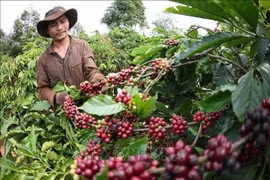
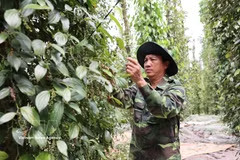
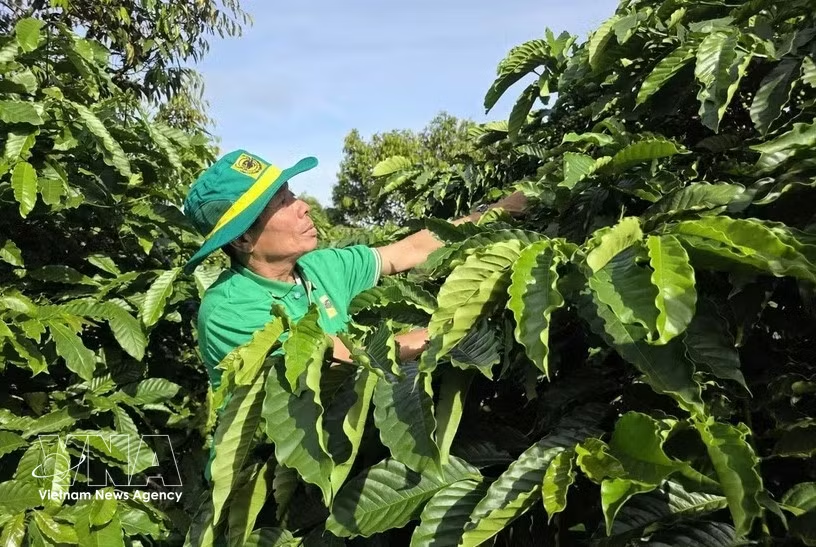
A farmer tends to his coffee farm that applies a smart cultivation model. (Photo: VNA)

Hanoi (VNA) – Vietnam and Uganda held a dialogue in Hanoi on August 11 to promote sustainable coffee development within the South–South cooperation framework, focusing on climate resilience, forest protection, and quality and value addition across the coffee value chain.

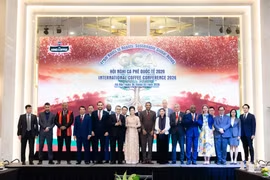
The event brought together representatives of Vietnam’s Ministry of Agriculture and Environment, Uganda's Ministry of Agriculture, Animal Industry and Fisheries, IDH organisation, international organisations, businesses and coffee value-chain partners of the two countries.

Speaking at the event, Pham Ngoc Mau, Deputy Director-General of the Department of International Cooperation under the Ministry of Agriculture and Environment, said coffee plays an important role in both countries, involving millions of people in production and value chains. Beyond being an agricultural and trade commodity, coffee is closely linked to livelihoods, rural development and opportunities to raise farmers’ incomes.

However, he noted, the sector faces growing requirements related to climate change, resource efficiency, product quality and safety, traceability and increasingly stringent international market standards. These challenges require a shift towards more sustainable production and development models.

Mau noted that coffee value is generated not only on farms but also through science – technology, processing, branding, market development and linkages across the value chain. Vietnam is therefore increasingly focusing not only on productivity but also on quality, added value, sustainability and climate resilience.

According to the official, Vietnam has experience in developing production areas, organising coffee value chains, processing, raising product value and expanding markets. Meanwhile, Uganda has its own strengths, potential and development priorities. Given this, the two sides should focus on sharing experience and identifying measures suited to each country’s conditions rather than seeking a single model applied to both.

Ugandan Minister of Agriculture, Animal Industry and Fisheries Frank K. Tumwebaze said coffee is essential to the livelihoods of millions of Ugandan farmers. Their future depends on the balance of productivity, sustainability and resilience.

Cooperation with Vietnam and IDH will offer Uganda a chance to learn from its partners while advancing a resilient and deforestation-free coffee sector, he added.

Daan Wensing, CEO of IDH, said sustainable transformation in the coffee industry cannot be achieved through isolated efforts. Cooperation and co-investment are essential to securing sustainable coffee supplies amid climate pressures and rising market requirements.

The dialogue also marked the first expression of intent by the two governments to cooperate, with IDH support, in developing a sustainable, climate-resilient and deforestation-free coffee sector. It represents a new step in South–South cooperation between two leading Robusta coffee producers.

By combining the experience, strengths and resources of the two sides, Vietnam–Uganda cooperation is expected to help build sustainable and resilient coffee value chains while creating long-term value for producers, businesses and markets.

At the event, IDH also officially launched the Resilient Coffee Programme (RCP) in Vietnam. With Germany’s ALDI SÜD as the pioneering investor, the programme aims to develop a verifiable supply of regenerative Robusta coffee in the next four years. It targets about 75,000 coffee farmers, with 70% of participating households expected to adopt regenerative farming practices, helping reduce 240,000 tonnes of CO2 emissions and raise farmers’ incomes by 15%.

Results will be transparently reported through measurement, reporting and verification (MRV), traceability and co-claiming mechanisms, contributing to forming a climate-resilient Robusta coffee supply chain that meets increasingly demanding international market requirements./.

VNA
See more

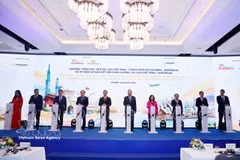
Delegates press the button to launch the project. (Photo: VNA)

Ca Mau launches 96 million USD wind power project

The project which has a designed capacity of 50MW, will cover around 600ha of sea and land areas, with total investment estimated at 2.5 trillion VND (96 million USD). It comprises a 13km 110kV transmission line, a 63MVA step-up substation, medium-voltage underground cable systems, and wind turbines and their foundations.

A Vietnam Airlines aircraft. (Photo: VNA)

Vietnam Airlines marks 35,000th flight to Australia

Over 35 years of operations, Vietnam Airlines has operated 35,000 flights and carried 7.5 million passengers between Vietnam and Australia, reflecting steady market growth and rising demand for connectivity between the two countries.

A view of the press conference. (Photo: VNA)

2026 Banking Sector Digital Transformation to open in Hanoi

The annual event, which will be held on August 18-19, 2026, at the ICE International Exhibition Centre, 91 Tran Hung Dao Street, Hanoi, is expected to attract around 324 delegates and feature 21 booths representing credit institutions, payment intermediary service providers, and technology companies.

SME products livestreamed on the digital platform of Ca Mau Radio and Television Station.( Photo: VNA)

Digital transformation key to unlocking SME growth in Vietnam

Science, technology, innovation and digital transformation have become strategic imperatives directly linked to labour productivity, competitiveness, growth quality and the economy's self-reliance, with sci-tech application and innovation by small and medium-sized enterprises (SMEs) playing an important role.

New Zealand apples on sale at a supermarket in Vietnam (Photo: VNA)

Vietnamese consumers develop taste for Australian, New Zealand fruit

According to statistics from the Department of Customs, in the first six months of 2026, Vietnam imported 102.8 million USD worth of fruit, vegetables and flowers from Australia, up 55.7% from the same period last year. Australia's share of total imports rose from 5.5% to 6.51%, highlighting the growing position of the market as a supplier. Imports from New Zealand reached 78.04 million USD, up 20.4% year-on-year.

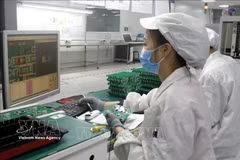
Semiconductor products, chips and components displayed at a ceremony to launch a national centre for semiconductor chip pilot production support in Hanoi on June 26. (Photo: VNA)

US semiconductor push offers Vietnam opportunities, policy challenges

The Vietnam-US semiconductor partnership is therefore not simply a “golden opportunity” arising from geopolitical shifts, but also a long-term test of Vietnam’s institutional reform and implementation capacity. If domestic capacity cannot keep pace, adjusting targets toward quality and execution, rather than simply expanding the number of projects, will be essential.

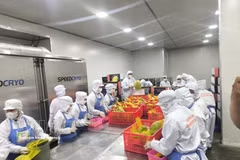
Workers process fruit for export at the Chanh Thu factory in Cho Lach commune, Vinh Long province. (Photo: VNA)

Vietnam works to maintain edge in key agricultural market

According to Le Hang, Deputy Secretary-General of the Vietnam Association of Seafood Exporters and Producers (VASEP), China and Hong Kong (China) remained bright spots for Vietnam’s aquatic exports in July, with revenue exceeding 267 million USD, up 24.7% year-on-year.

An estimated 6,300 workers are needed by the semiconductor industry in Bac Giang province during the 2025-2030 period. (Photo: VNA)

India's semiconductor strategy complementary to Vietnam's chip sector: expert

Sudhanshu Mittal, Director of Engineering Solutions at the National Association of Software and Service Companies (Nasscom) of India, noted that during the state visit to India by General Secretary of the Communist Party of Vietnam Central Committee and President To Lam in May, the two countries signed a number of cooperation agreements, with semiconductors identified as a priority area alongside artificial intelligence (AI), cybersecurity, and advanced technologies.

At the working session between Vietnamese Minister of Finance Ngo Van Tuan (right) and RMIT University’s Vice-Chancellor and President Professor Alec Cameron in Sydney on August 10 (Photo: tapchikinhtetaichinh.vn)

Vietnam, Australia seek to expand investment in rice value chain

During General Secretary of the Communist Party of Vietnam Central Committee and President To Lam’s state visit to Australia from August 9-12, Vietnamese Minister of Finance Ngo Van Tuan, authorised by the General Secretary and President, held working sessions with SunRice Group CEO Paul Serra and RMIT University’s Vice-Chancellor and President Professor Alec Cameron in Sydney on August 10.