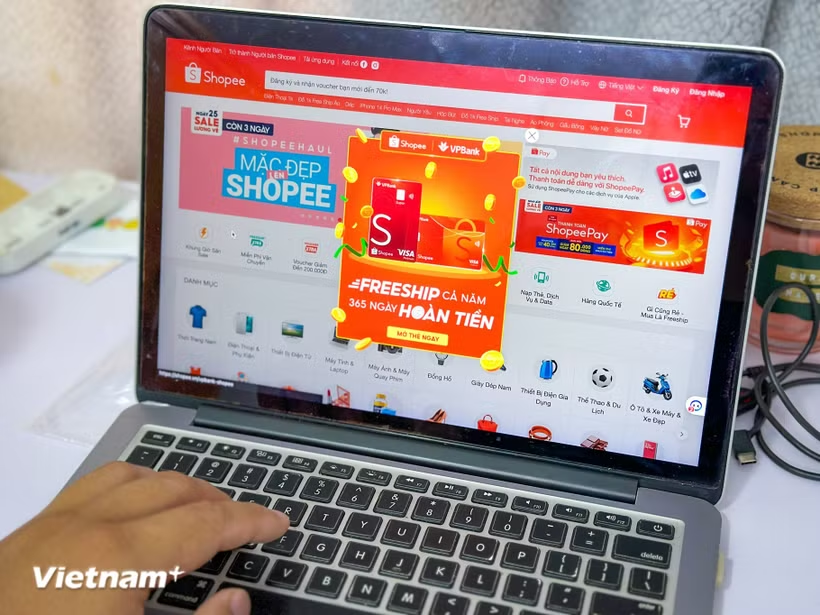
Hanoi (VNA) – Vietnam’s e-commerce sector is entering a new phase of development, with transaction security, consumer trust, long-term digital branding and the narrowing of regional digital gaps emerging as key conditions for sustainable growth.
Against this backdrop, the national .VN domain provides businesses, household enterprises and other economic actors with an official, stable and trusted digital presence.
According to the 2025 E-commerce Index (EBI) report by the Vietnam E-commerce Association (VECOM), Vietnam’s e-commerce market was estimated at 38.5 billion USD in 2025, up nearly tenfold in a decade.
Experts said that in 2026, Vietnam’s e-commerce sector is entering a more stable and sustainable phase, with greater emphasis on consumer protection, export support, environmental sustainability and narrowing the digital divide. The shift reflects a move from rapid expansion to solid growth.
One of the key issues highlighted by the EBI report is the wide gap in e-commerce development among localities. Ho Chi Minh City ranked first with 91.1 points, followed by Hanoi with 87.5 points, while Da Nang, ranked third, scored only 22.3 points. The average score among Vietnam’s 34 provinces and cities was 15.8. The gap is reflected not only in sales and the number of online stores, but also in the development of digital presence and infrastructure.
By the end of 2025, around 685,000 .VN domains were active nationwide. Hanoi and Ho Chi Minh City accounted for 63.3% of the total, despite representing only about 22% of the country’s population.
According to Thai Huu Ly, head of the Service Development Division at the Vietnam Internet Network Information Centre (VNNIC) under the Ministry of Science and Technology, the figures demonstrate significant differences among localities in the ability of businesses and individuals to establish an official digital presence. The digital divide, therefore, is no longer simply about Internet access, but also about digital skills and, more importantly, the ability to turn technology into practical value.
As selling through e-commerce platforms and social media becomes increasingly common, businesses’ own websites continue to play an important role. According to the EBI report, 46% of surveyed businesses have their own websites for marketing and business activities. Among the domain names preferred by businesses, .VN ranked first at 50%, followed by .COM at 43%.
Notably, 83% of businesses said their main reason for developing a website was to build credibility, promote and enhance their brands, while 70% used websites for advertising, marketing and introducing products and services.
In a multichannel e-commerce model, marketplaces enable businesses to sell quickly and social media helps them reach a broad customer base, while an independent website can serve as the “anchor” of a digital brand.
Marketplaces and social media are controlled by third-party platforms. Their algorithms and policies can change, advertising costs can rise and accounts can be restricted. By contrast, a website linked to a proprietary domain provides a space that businesses can manage over the long term, accumulating content, brand value and customer relationships.
Security and trust are also major concerns. The EBI report found that 45% of businesses consider data security and privacy protection their biggest challenge in implementing e-commerce.
Among consumers, 58% are concerned about the reputation of e-commerce websites, applications or sellers, while 35% are concerned about the security of personal information. In addition, 57% of businesses view the risk of personal information leaks as an obstacle to online shopping.
A .VN domain alone cannot guarantee website security. E-commerce security depends on a range of technical solutions, including data protection, identity authentication, secure payment systems and other technical and operational safeguards. However, a .VN domain provides a foundation for an official and stable digital presence.
VNNIC said a website using a dedicated domain gives businesses an official address where they can publish legal information, products, sales policies, warranties, return policies and contact details. A dedicated domain also allows businesses to use branded email addresses rather than relying entirely on free accounts or messaging tools provided by platforms.
More importantly, a .VN website can serve as an official reference point within a multichannel ecosystem. Facebook, TikTok, Zalo, marketplace stores and QR codes on product packaging can all direct customers to the same official website. This gives businesses a “home address” for their digital brands while providing consumers with a reliable point for verifying information.
A website using a .VN domain can function as a “digital business profile,” bringing together information on product origins, production processes, certifications, QR codes and sales channels. This approach can also benefit small businesses, household enterprises, cooperatives and producers in local communities. A domain linked to a website, content and brand can gradually become a digital asset that businesses build and own over time.
As the address for websites, email and online brands, the .VN domain is becoming an important foundation for businesses, household enterprises and individuals to establish a more official, independent and sustainable digital presence.
Ly said the value of .VN therefore lies not only in the number of registered domains, but, more importantly, in how many domains are actually put to use to create value in the digital environment.
When more businesses establish a presence online, having an official digital address, a digital brand and a communication channel under their own control will also provide an important foundation for Vietnam’s e-commerce sector to become safer, more trusted and more sustainable, he stressed./.