Vietnam – one of most attractive destinations for leading US semiconductor companies: expert

Vietnam has built a solid semiconductor and electronics industry before joining ITSI, attracting major US semiconductor companies. Intel Products Vietnam is one of Intel's largest assembly and testing facilities worldwide, while chip design companies such as Synopsys, Cadence, Marvell and Qualcomm have established engineering and research centres in the Southeast Asian country.

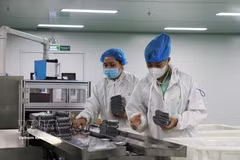
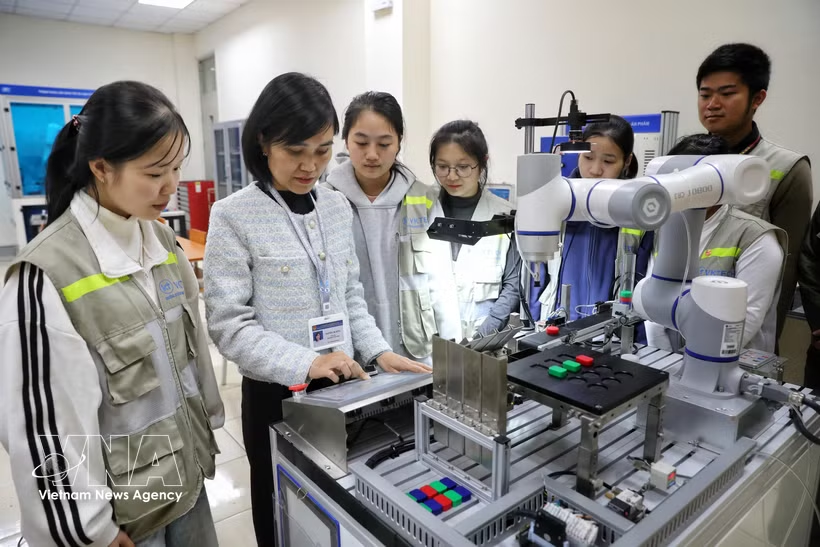
Students practice microcontroller programming at the Vietnam-Korea College of Technology in Bac Ninh province (Photo: VNA)

Washington D.C., (VNA) - Vietnam has emerged one of the most attractive destinations for leading US semiconductor companies, thanks to its competitive labour costs, political stability, favourable geographic location and extensive network of free trade agreements (FTAs), according to Dr. Tran Doan Huan, Senior Research Scientist at Georgia Institute of Technology in Atlanta.

Speaking to Vietnam News Agency correspondents in the US, Huan, who is also Head of Research Innovation at Matmerize, Inc., noted several factors behind the US decision to include Vietnam in the International Technology Security and Innovation (ITSI) programme under the 2022 CHIPS and Science Act.

According to him, Vietnam has built a solid semiconductor and electronics industry before joining ITSI, attracting major US semiconductor companies. Intel Products Vietnam is one of Intel's largest assembly and testing facilities worldwide, while chip design companies such as Synopsys, Cadence, Marvell and Qualcomm have established engineering and research centres in the Southeast Asian country, providing a foundation for Vietnam to gradually move into higher value-added segments of the semiconductor value chain.

Vietnam's participation supports the US goal of diversifying and strengthening the resilience of semiconductor supply chains. Following the COVID-19 pandemic and amid geopolitical tensions, the US has sought to reduce excessive dependence on a small number of countries. Rather than bringing all semiconductor production back to the US, the country aims to build a network of trustworthy partners that share commitments to transparency, supply-chain security and technological cooperation.

In this context, Vietnam is well positioned to develop semiconductor assembly, testing, packaging and chip design activities, helping reduce concentration in global supply chains.
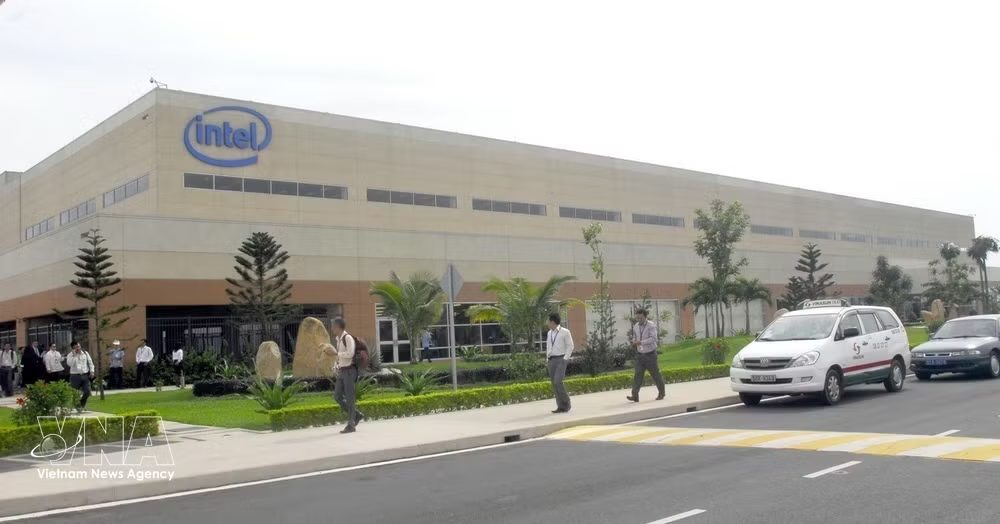
vnanet-intel.jpg
Intel's chip assembly and testing plant at the Ho Chi Minh City Hi-Tech Park (Photo: VNA)

Huan also highlighted Vietnam's large electronics manufacturing ecosystem, with major companies such as Samsung, Foxconn and LG operating in the country. The ecosystem, together with a young workforce, strong mathematics and software skills and competitive labour costs, provides favourable conditions for semiconductor development.

Human resources remain a key strength, he said, noting that Vietnam trains tens of thousands of engineers in electronics, information technology and engineering every year. Although the number of specialised semiconductor engineers remains limited, ITSI can help support training engineers, developing curricula, establishing laboratories, and strengthening university - business collaboration.

Geopolitically, Vietnam's strategic location and its independent and balanced foreign policy also make the country an important partner for the US in building more secure technology supply chains. The elevation of Vietnam-US relations to a Comprehensive Strategic Partnership in 2023 reflects Vietnam's growing importance in the US’s regional strategy, with semiconductor cooperation among the key areas.

Huan noted that the Vietnamese Government's strong commitment to developing semiconductors is another important factor. Vietnam has identified semiconductors as a strategic technology sector, with plans to train tens of thousands of engineers, develop chip design centres, attract foreign investment and build domestic semiconductor companies.

ITSI is designed to support countries with strong political commitment and a willingness to improve their investment environment and technological capabilities. Vietnam meets these criteria well, creating favourable conditions for US support programmes to deliver long-term results, he said.

According to the expert, besides Vietnam, many other countries have also been selected to participate in the ITSI programme. However, very few of them possess all the conditions that Vietnam currently has: a large-scale electronics industry, the presence of major US semiconductor companies, an abundant pool of skilled technical workers, a stable political environment, strong government commitment, and the ability to integrate deeply into global supply chains.

The combination of these factors makes Vietnam one of the most important strategic partners for the US in the ITSI programme, he said, adding the US decision to include Vietnam in the ITSI programme reflects a long-term cooperation strategy based on the complementary interests of the two countries.

For the US, cooperation with Vietnam can help diversify semiconductor supply chains, reduce geopolitical risks and expand its network of trustworthy technology partners. For Vietnam, ITSI offers opportunities to access resources, knowledge, technology and global business networks, laying the groundwork for a stronger position in the global semiconductor value chain.

The 2022 CHIPS and Science Act represents a major shift in US semiconductor policy. It seeks not only to restore domestic chip manufacturing but also to build a comprehensive ecosystem capable of maintaining US technological leadership.

International cooperation is a key pillar of the strategy. Through ITSI, the US works with strategic partners including Vietnam, Costa Rica, Mexico, the Philippines and Indonesia, to develop human resources, strengthen assembly, testing and packaging capacity, and build more diversified and secure semiconductor supply chains./.

VNA

See more

Lawmakers on August 9 discuss a draft law amending and supplementing a number of articles of the Law on the State Bank of Vietnam, the Law on Anti-Money Laundering and the Law on Credit Institutions. (Photo: VNA)

Lawmakers discuss measures to ensure banking system safety, support digital economy

The draft law sets out provisions to control conflicts of interest when commercial banks act as agents managing collateral for corporate bonds. In this regard, Deputy Le Van The of Ninh Binh province said he supported the move, noting that it could provide a more professional approach to collateral management and help strengthen investor confidence if properly regulated.

A company in Da Nang operates a customer relationship management system supported by AI chatbots. (Photo: VNA)

AI drives rise of sleepless enterprises in Vietnam

The concept of a sleepless enterprise does not necessarily mean making employees stay on the job all the time. Instead, it's about building intelligent systems that can respond to customers, process transactions, monitor operations, analyse data and flag risks continuously.

Head of the Vietnam Trade Office in Australia Tran Thi Thanh My (Photo: VNA)

Vietnam, Australia eye 20 bln USD trade target

The head of the Vietnam Trade Office in Australia hoped that the visit by Party General Secretary and State President To Lam will mark a new milestone, opening the door for firms on both sides to forge stronger links and launch concrete cooperation agendas, helping hit that 20 billion USD trade goal sooner rather than later.

Phu Quoc pepper products, granted three stars under the OCOP programme in An Giang province, are displayed at an exhibition of outstanding OCOP products from the Mekong Delta. (Photo: VNA)

Phu Quoc leverages OCOP programme to take local specialities global

Better known as one of Vietnam’s premier island destinations, Phu Quoc is leveraging its “One Commune, One Product” (OCOP) programme to transform traditional specialities into internationally recognised products, integrating local agriculture, food processing and tourism to promote sustainable economic growth.

Production at an FDI enterprise in Tay Ninh province. (Photo: VNA)

FTA Index 2025 to be unveiled later this month

The index is designed to provide valuable information not only for State management agencies but also as an important reference for businesses, foreign investors, and industry associations in planning investment and business activities in Vietnam.

Air Premia, a carrier of the Republic of Korea, will resume flights between Incheon and Ho Chi Minh City from November 5. (Photo: The Courtesy of Air Premia)

Air Premia to resume Incheon–Ho Chi Minh City route from November

Flights will depart Incheon International Airport at 6:40 pm (RoK time) and arrive at Tan Son Nhat International Airport in Ho Chi Minh City at 11 pm (Vietnam time). Return flights will leave Ho Chi Minh City at 12:30 am on Mondays, Tuesdays, Thursdays, Fridays and Sundays, landing in Incheon at 7:40 am.

Production at Viet Hai High-Tech Structure Production Company Limited in Vung Ang Economic Zone. Ha Tinh province aims to develop Vung Ang Economic Zone into a regional centre for industry, energy, seaports and logistics (Photo: VNA)

Revised master plan of Vung Ang EZ approved

The adjustment aims to create a more rational development framework to maximise the zone’s potential and advantages while providing a legal foundation for construction management and ensuring sustainable development.

Illustrative image (Photo: VNA)

Vietnam looks to domestic market to sustain wood industry growth

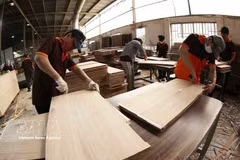
Vietnam’s wood sector has long been a top foreign-currency earner. Exports of wood and wooden products neared 17.3 billion USD in 2025, reaching more than 160 countries and territories and clearing the high bars set by the US, the European Union and Japan.

Delegates at the event (Photo: VNA)

Vietnam remains key market for Polish food producers

The campaign promotes selected European Union agricultural and food products, including fresh, chilled and frozen beef and pork, fresh apples, apple juice and dried apples, targeting consumers, importers, distributors, retailers and the hospitality sector.

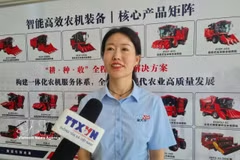
Wei Xiaoli, a representative of Shandong Jindafeng Machinery Co., Ltd., in an interview granted to the Vietnam News Agency. (Photo: VNA)

Chinese firms see strong potential for agricultural mechanisation cooperation with Vietnam

Business representatives said mechanisation not only helps reduce reliance on manual labour but also improves production efficiency, shortens planting and harvesting times, reduces post-harvest losses and enhances the quality of agricultural products. For rice-producing countries like Vietnam, they noted, accelerating mechanisation is an inevitable trend to strengthen the competitiveness of the agricultural sector.

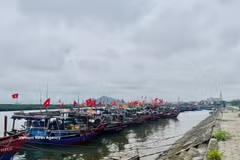
Community-led fisheries groups have become frontline defenders of coastal fisheries. (Photo: VNA)

Community-led fisheries groups strengthen IUU fight in Ha Tinh

With a long coastline and abundant inshore fishing grounds, Ha Tinh has long identified the marine economy as a key growth driver. However, growing fishing pressure and destructive practices have posed major management challenges. Community-led self-management initiatives are now providing an effective solution.