Resolution helps attract new wave of high-quality Korean investment

The RoK is currently Vietnam's largest foreign investor by cumulative registered capital, with more than 10,400 valid projects worth over 95 billion USD. Two-way trade has reached nearly 95 billion USD, which is expected to reach 150 billion USD by 2030.

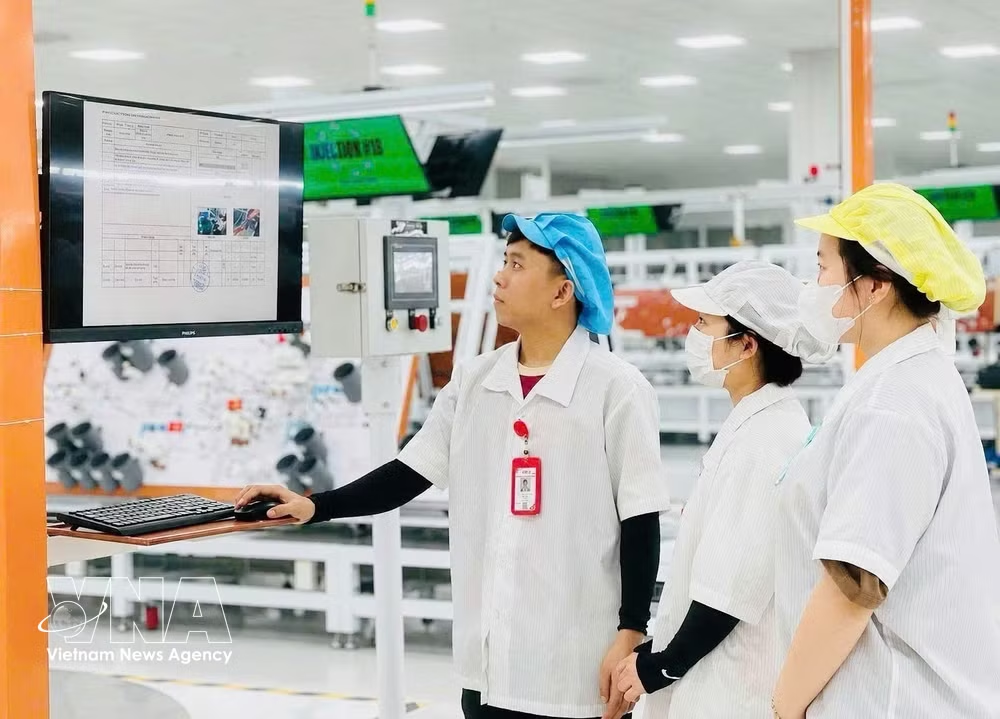
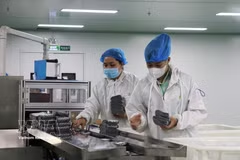
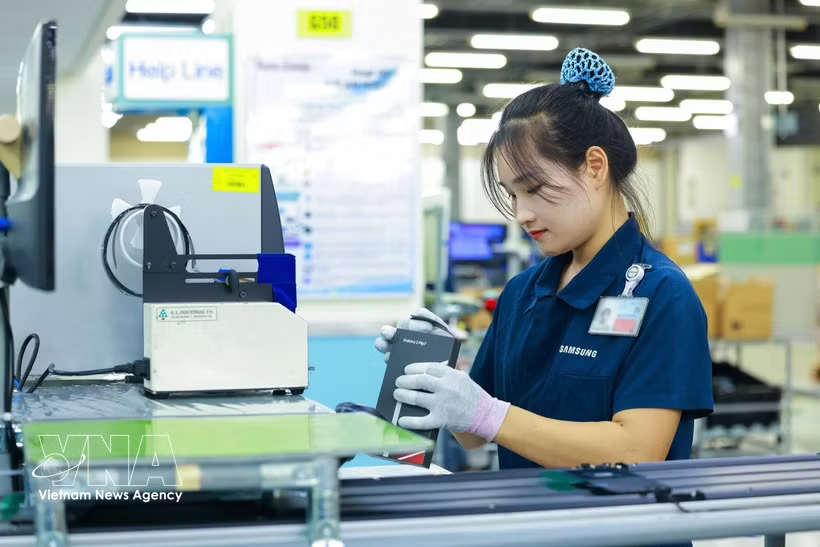
Smartphone assembly at Samsung Electronics Vietnam Thai Nguyen Co., Ltd. in Yen Binh Industrial Park. (Photo: VNA)

Ho Chi Minh City (VNA) – Vietnam's strategy to attract high-quality foreign direct investment (FDI) under the Politburo's Resolution No. 10-NQ/TW on foreign-invested economic development is creating fresh momentum for investment in high technology, innovation and value-added industries. The Republic of Korea (RoK) is emerging as one of the leading partners in this transition.​

Samsung's decision to build its first factory in the northern province of Bac Ninh in 2008 marked a turning point in Vietnam-RoK economic ties. Today, around half of Samsung's smartphones sold worldwide are manufactured in Vietnam.​

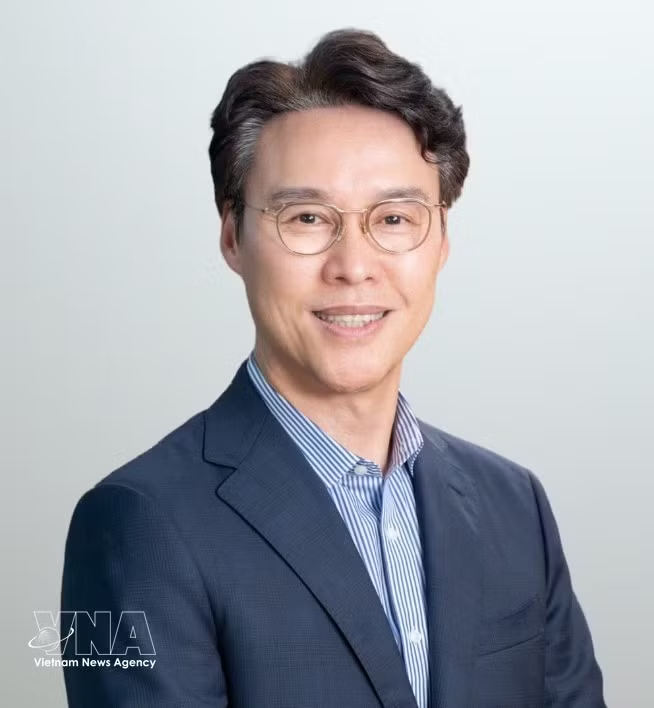
Peter Kim, CEO of HSBC Korea, said Vietnam remains one of the top destinations considered by Korean businesses when making global investment decisions.​

vnanet-peter-kim.jpg
Peter Kim, CEO of HSBC Korea (Photo: VNA)

The RoK is currently Vietnam's largest foreign investor by cumulative registered capital, with more than 10,400 valid projects worth over 95 billion USD. Two-way trade has reached nearly 95 billion USD, which is expected to reach 150 billion USD by 2030.​

The figures reflect the presence of major Korean conglomerates in Vietnam's industrial landscape. Samsung has invested more than 23 billion USD, while LG's investment exceeds 8 billion USD, anchored by its display manufacturing complex in Hai Phong. Hyosung has committed 4 billion USD and plans to double that amount, while SK is studying energy projects in central Vietnam. Other major corporations, including Lotte, CJ and Doosan, are also expanding their operations, together with suppliers across their value chains.​

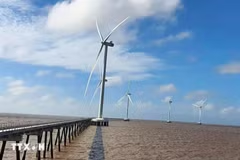
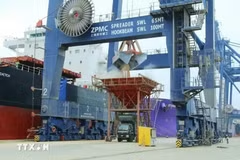
Korean investment has expanded across a wide range of sectors, from electronics, display panels, textiles, petrochemicals, logistics, retail and finance to clean energy and digital infrastructure.​

According to Kim, investment capital follows confidence, and confidence is built on a stable and predictable business environment. Vietnam has strengthened its attractiveness through sustained macroeconomic stability, a network of 17 effective free trade agreements and an increasingly skilled workforce.​

vnanet-potal-tay-ninh-diem-den-cua-dong-von-fdi-the-he-moi-8904440.jpg
Illustrative photo (Photo: VNA)

HSBC Global Research estimates that annual FDI inflows into Vietnam are equivalent to more than 4% of GDP, among the highest levels in Southeast Asia.​

Kim said the next stage of Korean investment in Vietnam will focus not only on expanding manufacturing capacity but also on moving up the value chain, from assembly to advanced manufacturing and from production to R&D.​

A notable example is Samsung's 220-million-USD R&D Centre in Hanoi, the group's largest research facility in Southeast Asia, where thousands of Vietnamese engineers are working on artificial intelligence, software and next-generation technologies.​

HSBC believes high-quality FDI will strengthen Vietnam's domestic capabilities by enabling local firms to participate more deeply in global supply chains while developing a highly skilled technical workforce. Vietnam has already produced more than two billion smartphones and is gradually moving beyond assembly into technology development.​

Kim said this trend is closely aligned with Resolution No. 10-NQ/TW, which prioritises attracting high-value-added FDI, promoting technology transfer, strengthening the participation of Vietnamese enterprises in global supply chains and encouraging multinational corporations to establish R&D centres in Vietnam.​

The investment model pursued by Korean businesses over nearly two decades reflects these priorities through technology transfer, supplier development, R&D integration and workforce training. In the first months of 2026, newly registered Korean investment in Vietnam rose by more than 30% year-on-year, indicating sustained investor confidence.​

Lee Young Jick, Director of the Korea-ASEAN Financial Cooperation Centre, said Korean businesses praise Vietnam's strong macroeconomic fundamentals, supported by robust growth, low inflation, healthy exports and a stable balance of payments.​

He said Vietnam is benefiting not only from the global relocation of manufacturing but is also becoming an increasingly important global production hub with a rising position in international supply chains and global value chains.​

Lee noted that Vietnam is expanding into high-tech sectors such as electronics, mechanical engineering, smartphones, semiconductors and AI data centres.​

Combined with the international financial centre and innovation clusters, these sectors are expected to create new growth momentum for the economy.​

He added that financial market development would play a vital role in this process, expressing confidence that stronger financial cooperation between the RoK and Vietnam would generate greater synergies in supply chains, the innovation economy and financial market development./.
VNA

See more

A company in Da Nang operates a customer relationship management system supported by AI chatbots. (Photo: VNA)

AI drives rise of sleepless enterprises in Vietnam

The concept of a sleepless enterprise does not necessarily mean making employees stay on the job all the time. Instead, it's about building intelligent systems that can respond to customers, process transactions, monitor operations, analyse data and flag risks continuously.

Head of the Vietnam Trade Office in Australia Tran Thi Thanh My (Photo: VNA)

Vietnam, Australia eye 20 bln USD trade target

The head of the Vietnam Trade Office in Australia hoped that the visit by Party General Secretary and State President To Lam will mark a new milestone, opening the door for firms on both sides to forge stronger links and launch concrete cooperation agendas, helping hit that 20 billion USD trade goal sooner rather than later.

Phu Quoc pepper products, granted three stars under the OCOP programme in An Giang province, are displayed at an exhibition of outstanding OCOP products from the Mekong Delta. (Photo: VNA)

Phu Quoc leverages OCOP programme to take local specialities global

Better known as one of Vietnam’s premier island destinations, Phu Quoc is leveraging its “One Commune, One Product” (OCOP) programme to transform traditional specialities into internationally recognised products, integrating local agriculture, food processing and tourism to promote sustainable economic growth.

Production at an FDI enterprise in Tay Ninh province. (Photo: VNA)

FTA Index 2025 to be unveiled later this month

The index is designed to provide valuable information not only for State management agencies but also as an important reference for businesses, foreign investors, and industry associations in planning investment and business activities in Vietnam.

Air Premia, a carrier of the Republic of Korea, will resume flights between Incheon and Ho Chi Minh City from November 5. (Photo: The Courtesy of Air Premia)

Air Premia to resume Incheon–Ho Chi Minh City route from November

Flights will depart Incheon International Airport at 6:40 pm (RoK time) and arrive at Tan Son Nhat International Airport in Ho Chi Minh City at 11 pm (Vietnam time). Return flights will leave Ho Chi Minh City at 12:30 am on Mondays, Tuesdays, Thursdays, Fridays and Sundays, landing in Incheon at 7:40 am.

Production at Viet Hai High-Tech Structure Production Company Limited in Vung Ang Economic Zone. Ha Tinh province aims to develop Vung Ang Economic Zone into a regional centre for industry, energy, seaports and logistics (Photo: VNA)

Revised master plan of Vung Ang EZ approved

The adjustment aims to create a more rational development framework to maximise the zone’s potential and advantages while providing a legal foundation for construction management and ensuring sustainable development.

Illustrative image (Photo: VNA)

Vietnam looks to domestic market to sustain wood industry growth

Vietnam’s wood sector has long been a top foreign-currency earner. Exports of wood and wooden products neared 17.3 billion USD in 2025, reaching more than 160 countries and territories and clearing the high bars set by the US, the European Union and Japan.

Delegates at the event (Photo: VNA)

Vietnam remains key market for Polish food producers

The campaign promotes selected European Union agricultural and food products, including fresh, chilled and frozen beef and pork, fresh apples, apple juice and dried apples, targeting consumers, importers, distributors, retailers and the hospitality sector.

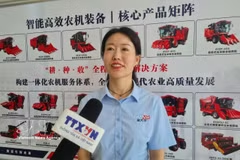
Wei Xiaoli, a representative of Shandong Jindafeng Machinery Co., Ltd., in an interview granted to the Vietnam News Agency. (Photo: VNA)

Chinese firms see strong potential for agricultural mechanisation cooperation with Vietnam

Business representatives said mechanisation not only helps reduce reliance on manual labour but also improves production efficiency, shortens planting and harvesting times, reduces post-harvest losses and enhances the quality of agricultural products. For rice-producing countries like Vietnam, they noted, accelerating mechanisation is an inevitable trend to strengthen the competitiveness of the agricultural sector.

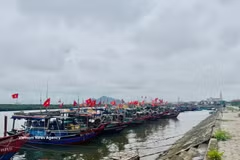
Community-led fisheries groups have become frontline defenders of coastal fisheries. (Photo: VNA)

Community-led fisheries groups strengthen IUU fight in Ha Tinh

With a long coastline and abundant inshore fishing grounds, Ha Tinh has long identified the marine economy as a key growth driver. However, growing fishing pressure and destructive practices have posed major management challenges. Community-led self-management initiatives are now providing an effective solution.

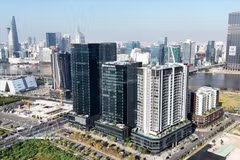
At the VIFC-HCMC (Photo: VNA)

700 bln USD for net zero: Vietnam bets on VIFC

Assoc. Prof. Dr. Nguyen Huu Huan, Vice Chairman of the Executive Board of VIFC-HCMC, said the VIFC will focus on building market infrastructure needed to bridge the gap between big investment pledges and bankable projects.