Tay Ninh taps Dau Tieng Reservoir’s dual roles in ecotourism, water security

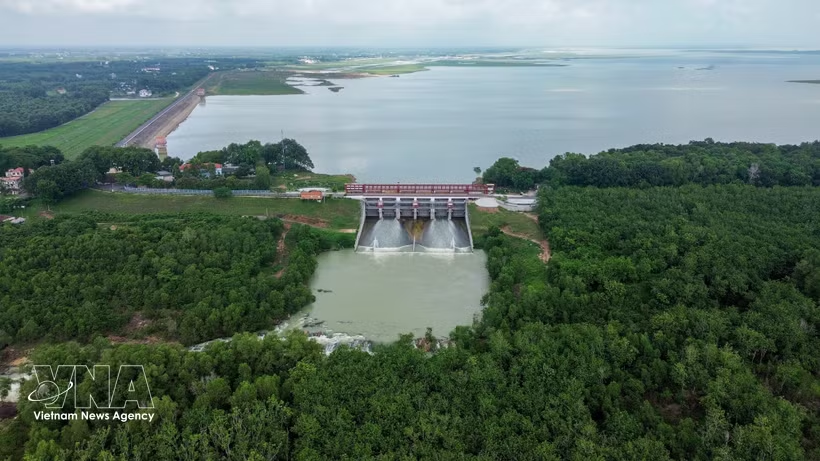
As Southeast Asia's largest artificial irrigation reservoir, Dau Tieng covers about 270 sq.km and has a designed storage capacity of 1.58 billion cubic metres, playing a vital role in ensuring water security and boasting enormous potential for supporting sustainable economic development.

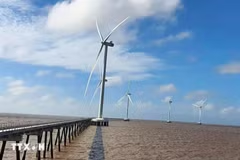
Dau Tieng Reservoir is a particularly important irrigation project, playing a crucial role in ensuring water security, preventing natural disasters, and promoting socio-economic development in the southeastern region of Vietnam. (Photo: VNA)

Tay Ninh (VNA) – Boasting a vast water surface, unique natural landscapes and a rich ecosystem, Dau Tieng Reservoir is emerging as a promising destination for green economic development while continuing to play a key role in ensuring water security for Tay Ninh province and the southeastern region.

Vital role and potential of “turquoise gem”

​As Southeast Asia's largest artificial irrigation reservoir, Dau Tieng covers about 270 sq.km and has a designed storage capacity of 1.58 billion cubic metres. It spans Tay Ninh province, Ho Chi Minh City and Dong Nai province, with a system comprising the main dam, auxiliary dams, regulating sluices, spillways, about 150km of canals and more than 300 irrigation facilities.

For decades, the reservoir has played a vital role in ensuring water security by providing direct irrigation for nearly 117,000 hectares of farmland while supplying water for additional agricultural areas, domestic use and industrial production.
vnanet-dau-tieng2.jpg
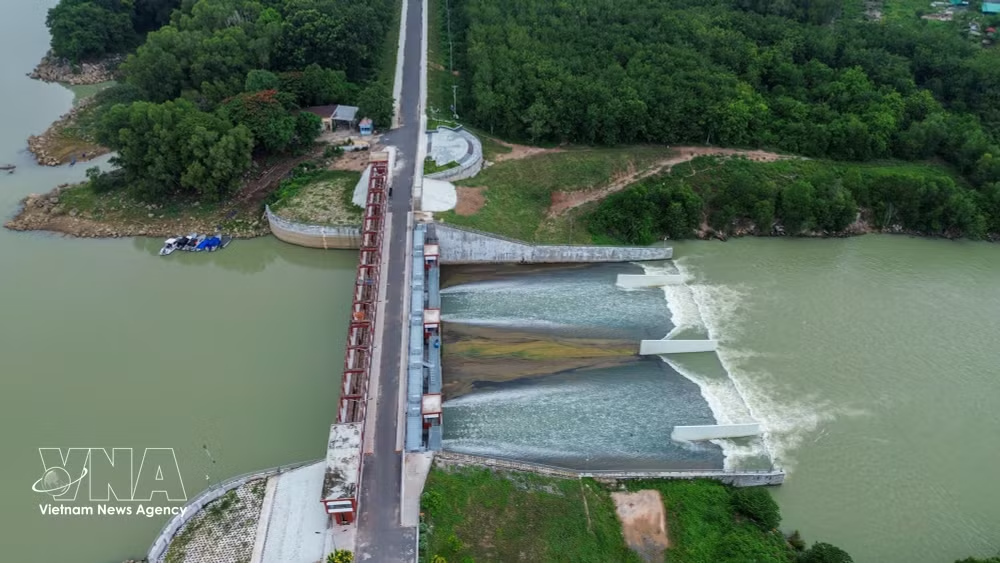
Dau Tieng Reservoir ensures water supplies for production and daily life while helping mitigate the impacts of natural disasters in the southeastern region. (Photo: VNA)

It also helps prevent saltwater intrusion, ensures irrigation for about 28,800 hectares of farmland along the Sai Gon River and 32,317 hectares along the Vam Co Dong River, mitigates flooding, improves the downstream environment and enhances water quality. In addition, it generates electricity by utilising environmental discharge flows and water released through intake sluices, with a combined installed capacity of 20.5 MW.

​Beyond its irrigation functions, Dau Tieng has become known as the "green lung" of the region thanks to its expansive water surface, peninsulas, islands and diverse ecosystems. These natural advantages provide favourable conditions for developing eco-tourism, ecological agriculture, sustainable aquaculture and other nature-based services.

On clear days, the vast turquoise lake stretches to the horizon, reflecting surrounding forests and scattered islands. Its peaceful setting and fresh air have made it a popular destination for boating, camping, fishing and watching sunrise and sunset.

​When connected with the Ba Den Mountain national tourist site and nearby historical and cultural attractions, the reservoir is expected to become part of a diversified tourism network that encourages visitors to stay longer and spend more.

​One of the reservoir’s most distinctive attractions is the sight of herds of cattle grazing on semi-submerged grasslands that emerge as water levels recede during the dry season. Set against lush green fields and the vast expanse of water, the landscape has become a favourite destination for photographers, nature lovers and outdoor enthusiasts, with many describing it as one of Dau Tieng Reservoir's unique seasonal highlights.

​Doan Thi Nhu Huong, a visitor from Ho Chi Minh City, said she was impressed by the reservoir's immense size, clean air and largely untouched landscape, adding that it offers ideal conditions for camping, boating and sightseeing and promises to become a tourist magnet if developed in harmony with environmental conservation.

Similarly, Nguyen Thanh Danh from Dong Nai province said Dau Tieng’s well-preserved ecosystem and tranquil scenery give it a distinctive appeal. He stressed that development should always go hand in hand with environmental protection to maintain its natural beauty for future generations.

Coordinated actions to optimise advantages

​Tran Quang Hung, General Director of Southern Irrigation Exploitation One Member Co. Ltd., noted the reservoir still holds considerable untapped potential for eco-tourism, aquaculture, semi-submerged forest, responsible mineral exploitation, and renewable energy projects such as floating solar power.
vnanet-dau-tieng-reservoir-2.jpg
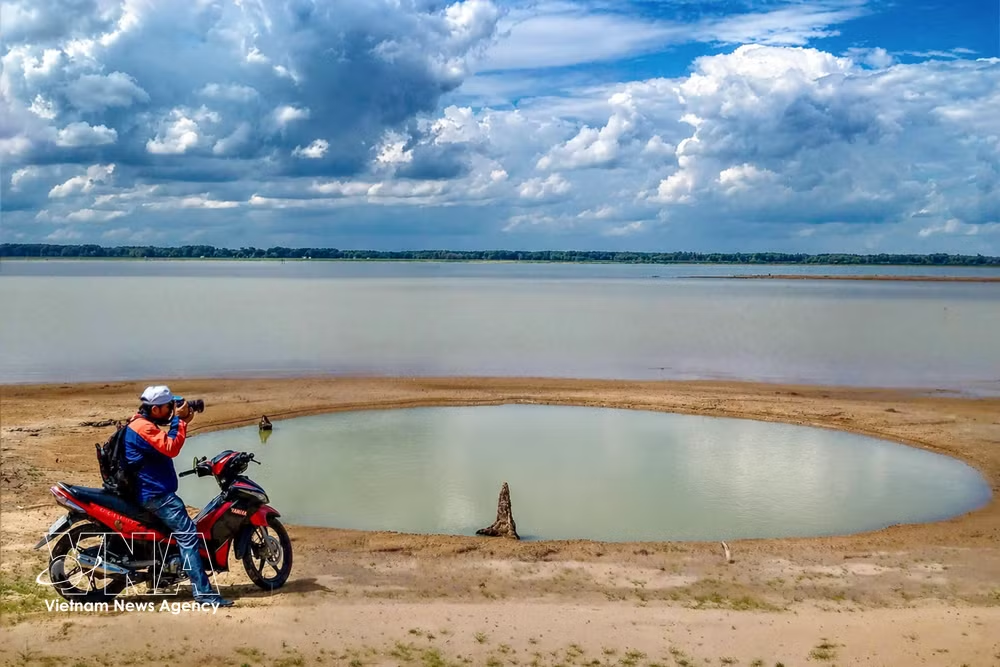
A visitor captures the natural beauty of Dau Tieng Reservoir. (Photo: VNA)

To maximise opportunities, the company will work with relevant agencies to review and digitise maps of the reservoir's protected zones, increase boundary markers and improve land management.

​It will also coordinate with local authorities to incorporate land within the reservoir area into local land-use plans while ensuring a balance between infrastructure protection and the legitimate interests of residents in the lake’s semi-submerged areas and protection corridors, Hung went on.

Meanwhile, Tay Ninh authorities will continue working with management units to strengthen safety monitoring, protect reservoir corridors, control resource exploitation, prevent water pollution, conserve upstream forests and biodiversity, monitor water quality and raise public awareness of environmental protection, ensuring Dau Tieng Reservoir develops sustainably while maintaining its vital role in regional water security and economic growth./.
VNA

See more

Phu Quoc pepper products, granted three stars under the OCOP programme in An Giang province, are displayed at an exhibition of outstanding OCOP products from the Mekong Delta. (Photo: VNA)

Phu Quoc leverages OCOP programme to take local specialities global

Better known as one of Vietnam’s premier island destinations, Phu Quoc is leveraging its “One Commune, One Product” (OCOP) programme to transform traditional specialities into internationally recognised products, integrating local agriculture, food processing and tourism to promote sustainable economic growth.

Production at an FDI enterprise in Tay Ninh province. (Photo: VNA)

FTA Index 2025 to be unveiled later this month

The index is designed to provide valuable information not only for State management agencies but also as an important reference for businesses, foreign investors, and industry associations in planning investment and business activities in Vietnam.

Air Premia, a carrier of the Republic of Korea, will resume flights between Incheon and Ho Chi Minh City from November 5. (Photo: The Courtesy of Air Premia)

Air Premia to resume Incheon–Ho Chi Minh City route from November

Flights will depart Incheon International Airport at 6:40 pm (RoK time) and arrive at Tan Son Nhat International Airport in Ho Chi Minh City at 11 pm (Vietnam time). Return flights will leave Ho Chi Minh City at 12:30 am on Mondays, Tuesdays, Thursdays, Fridays and Sundays, landing in Incheon at 7:40 am.

Production at Viet Hai High-Tech Structure Production Company Limited in Vung Ang Economic Zone. Ha Tinh province aims to develop Vung Ang Economic Zone into a regional centre for industry, energy, seaports and logistics (Photo: VNA)

Revised master plan of Vung Ang EZ approved

The adjustment aims to create a more rational development framework to maximise the zone’s potential and advantages while providing a legal foundation for construction management and ensuring sustainable development.

Illustrative image (Photo: VNA)

Vietnam looks to domestic market to sustain wood industry growth

Vietnam’s wood sector has long been a top foreign-currency earner. Exports of wood and wooden products neared 17.3 billion USD in 2025, reaching more than 160 countries and territories and clearing the high bars set by the US, the European Union and Japan.

Delegates at the event (Photo: VNA)

Vietnam remains key market for Polish food producers

The campaign promotes selected European Union agricultural and food products, including fresh, chilled and frozen beef and pork, fresh apples, apple juice and dried apples, targeting consumers, importers, distributors, retailers and the hospitality sector.

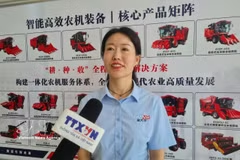
Wei Xiaoli, a representative of Shandong Jindafeng Machinery Co., Ltd., in an interview granted to the Vietnam News Agency. (Photo: VNA)

Chinese firms see strong potential for agricultural mechanisation cooperation with Vietnam

Business representatives said mechanisation not only helps reduce reliance on manual labour but also improves production efficiency, shortens planting and harvesting times, reduces post-harvest losses and enhances the quality of agricultural products. For rice-producing countries like Vietnam, they noted, accelerating mechanisation is an inevitable trend to strengthen the competitiveness of the agricultural sector.

Community-led fisheries groups have become frontline defenders of coastal fisheries. (Photo: VNA)

Community-led fisheries groups strengthen IUU fight in Ha Tinh

With a long coastline and abundant inshore fishing grounds, Ha Tinh has long identified the marine economy as a key growth driver. However, growing fishing pressure and destructive practices have posed major management challenges. Community-led self-management initiatives are now providing an effective solution.

At the VIFC-HCMC (Photo: VNA)

700 bln USD for net zero: Vietnam bets on VIFC

Assoc. Prof. Dr. Nguyen Huu Huan, Vice Chairman of the Executive Board of VIFC-HCMC, said the VIFC will focus on building market infrastructure needed to bridge the gap between big investment pledges and bankable projects.

A view of the launch ceremony for the expanded Vietnam–China cross-border QR payment service. (Photo: NAPAS)

Over 1 billion Weixin Pay users can make QR code payments in Vietnam

NAPAS, Weixin Pay, and BIDV will study the rollout of the reverse payment service, enabling users of Vietnamese banking applications and e-wallets to make QR code payments in China, with the aim of completing a comprehensive cross-border payment ecosystem between the two countries.

Vietnam cuts retail fuel prices on August 6. (Photo: VNA)

Vietnam cuts retail fuel prices on August 6

The maximum retail price of E5RON92 biofuel was reduced by 1,160 VND to 21,728 VND (0.83 USD) per litre, while that of E10RON95-III fell by 1,035 VND to 22,324 VND per litre.

Production of electronic components at Star Engineers Vietnam Co. Ltd. in Binh Xuyen I Industrial Park in Phu Tho province. (Photo: VNA)

Vietnam targets higher-quality FDI under Resolution 10

During the first seven months of 2026, Vietnam attracted more than 38 billion USD in registered FDI, up nearly 58% year-on-year. More importantly, the increase was driven by large-scale, high-tech projects rather than a surge in the number of new investments, signalling a significant improvement in the quality of capital inflows.