Vietnamese agricultural exports hold untapped potential in Algeria

Vietnamese businesses need a better understanding of Algeria's import regulations and should proactively adjust their market approaches to expand their share.

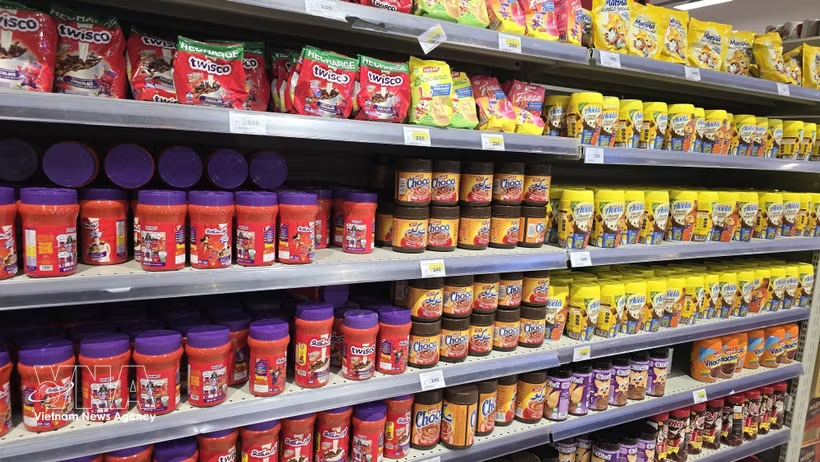
Cocoa-based products on a supermarket shelf in Algeria (Photo: VNA)

Hanoi (VNA) – Vietnamese agricultural products have significant room to expand in Algeria, but tapping the North African market will require exporters to better understand import regulations, build direct partnerships and strengthen their presence in the country, according to a representative of the Algerian Forum for Import-Export, Trading and Investment (AFIETI).

Speaking to Vietnam News Agency correspondents in Algeria, Mohamed Nabil, a trade adviser of AFIETI, said Vietnamese businesses need a better understanding of Algeria's import regulations and should proactively adjust their market approaches to expand their share.

Vietnam's agricultural exports to Algeria have maintained an upward trend in recent years, but remain concentrated in several key products, while many of the country's other competitive products have yet to fully realise their potential there.

Major Vietnamese agricultural exports to Algeria include coffee, cashew nuts, pepper, rice, dried coconut and some seafood products. Coffee accounts for a large share of export value, reaching 80-85% of Vietnam's total exports to Algeria at times. The range of exported products has gradually expanded, indicating considerable demand in Algeria for tropical agricultural products. However, exports remain heavily dependent on several key products and are affected by Algeria's import management policies.

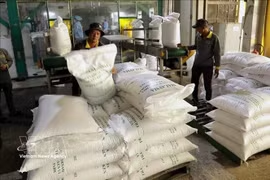
Rice, one of Vietnam's major agricultural exports, once had a significant presence in Algeria but has declined sharply in recent years and is now scarcely seen in the country's retail system.

Algeria mainly consumes three types of rice – parboiled, basmati and white rice. Parboiled and white rice are regulated by the Algerian Interprofessional Office of Cereals (OAIC), with import rules and mechanisms varying according to programmes and orders. Vietnamese exporters therefore need to regularly update import requirements and ensure compliance before signing contracts.

Basmati rice, meanwhile, represents a promising segment given its relatively strong demand in Algeria, he said, noting that identifying the right segment, consumer preferences and import mechanisms could open up additional opportunities for Vietnamese exporters.

Beyond rice, Nabil said many other Vietnamese agricultural products also have considerable room for growth in Algeria. Coffee is a notable example, as Algeria is among the markets with significant coffee consumption, yet Vietnamese coffee still needs stronger promotion to enhance brand recognition and expand its market share.

Nabil cited Algeria's tea market to highlight the importance of direct commercial presence. Besides quality and price, access to importers, business relationships, promotion and product branding are crucial to turning production advantages into actual market share, he said.

Vietnam also has strengths in spices such as star anise, cinnamon and pepper, but access to the Algerian market and direct links with local partners remain limited, he said, noting that stronger government-level cooperation could help facilitate bilateral trade and enable businesses from both countries to better tap untapped potential.

Nabil said Vietnamese companies could work with local distributors and technical partners or establish representative offices or businesses in Algeria. He stressed that a stronger local presence would help them better understand market demand and regulations, build distribution networks and respond more quickly to changes in import policies.

He also suggested a “triangle” business model, under which Vietnamese companies could source materials from Algeria while selling products there or using the country as a gateway to other markets. Such an approach could shift ties from simple import-export activities towards production cooperation and greater value creation.

Vietnamese firms should also consider investing in processing and production in Algeria for products with strong market potential. Cooperation with Algerian companies in processing, packaging and product development could help Vietnamese goods better adapt to local demand while creating a foundation for expansion into other regional markets.

Nabil recommended that Vietnamese businesses step up direct trade promotion, regularly send representatives to Algeria to seek partners and study the market rather than relying mainly on remote export transactions.

According to Nabil, the opportunities for Vietnamese agricultural exports remain substantial, but expanding trade will depend not only on production capacity and prices but also on adapting to import regulations, developing local partnerships and strengthening market presence. Vietnam should maintain its strengths in coffee, cashews and pepper while exploring rice, tea, spices, coconut products and processed foods to diversify exports and make better use of the Algerian market./.
VNA

See more

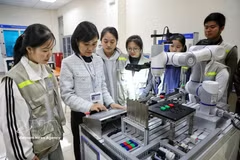
Students practice microcontroller programming at the Vietnam-Korea College of Technology in Bac Ninh province (Photo: VNA)

Vietnam – one of most attractive destinations for leading US semiconductor companies: expert

Vietnam has built a solid semiconductor and electronics industry before joining ITSI, attracting major US semiconductor companies. Intel Products Vietnam is one of Intel's largest assembly and testing facilities worldwide, while chip design companies such as Synopsys, Cadence, Marvell and Qualcomm have established engineering and research centres in the Southeast Asian country.

Lawmakers on August 9 discuss a draft law amending and supplementing a number of articles of the Law on the State Bank of Vietnam, the Law on Anti-Money Laundering and the Law on Credit Institutions. (Photo: VNA)

Lawmakers discuss measures to ensure banking system safety, support digital economy

The draft law sets out provisions to control conflicts of interest when commercial banks act as agents managing collateral for corporate bonds. In this regard, Deputy Le Van The of Ninh Binh province said he supported the move, noting that it could provide a more professional approach to collateral management and help strengthen investor confidence if properly regulated.

A company in Da Nang operates a customer relationship management system supported by AI chatbots. (Photo: VNA)

AI drives rise of sleepless enterprises in Vietnam

The concept of a sleepless enterprise does not necessarily mean making employees stay on the job all the time. Instead, it's about building intelligent systems that can respond to customers, process transactions, monitor operations, analyse data and flag risks continuously.

Head of the Vietnam Trade Office in Australia Tran Thi Thanh My (Photo: VNA)

Vietnam, Australia eye 20 bln USD trade target

The head of the Vietnam Trade Office in Australia hoped that the visit by Party General Secretary and State President To Lam will mark a new milestone, opening the door for firms on both sides to forge stronger links and launch concrete cooperation agendas, helping hit that 20 billion USD trade goal sooner rather than later.

Phu Quoc pepper products, granted three stars under the OCOP programme in An Giang province, are displayed at an exhibition of outstanding OCOP products from the Mekong Delta. (Photo: VNA)

Phu Quoc leverages OCOP programme to take local specialities global

Better known as one of Vietnam’s premier island destinations, Phu Quoc is leveraging its “One Commune, One Product” (OCOP) programme to transform traditional specialities into internationally recognised products, integrating local agriculture, food processing and tourism to promote sustainable economic growth.

Production at an FDI enterprise in Tay Ninh province. (Photo: VNA)

FTA Index 2025 to be unveiled later this month

The index is designed to provide valuable information not only for State management agencies but also as an important reference for businesses, foreign investors, and industry associations in planning investment and business activities in Vietnam.

Air Premia, a carrier of the Republic of Korea, will resume flights between Incheon and Ho Chi Minh City from November 5. (Photo: The Courtesy of Air Premia)

Air Premia to resume Incheon–Ho Chi Minh City route from November

Flights will depart Incheon International Airport at 6:40 pm (RoK time) and arrive at Tan Son Nhat International Airport in Ho Chi Minh City at 11 pm (Vietnam time). Return flights will leave Ho Chi Minh City at 12:30 am on Mondays, Tuesdays, Thursdays, Fridays and Sundays, landing in Incheon at 7:40 am.

Production at Viet Hai High-Tech Structure Production Company Limited in Vung Ang Economic Zone. Ha Tinh province aims to develop Vung Ang Economic Zone into a regional centre for industry, energy, seaports and logistics (Photo: VNA)

Revised master plan of Vung Ang EZ approved

The adjustment aims to create a more rational development framework to maximise the zone’s potential and advantages while providing a legal foundation for construction management and ensuring sustainable development.

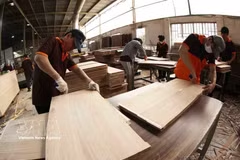
Illustrative image (Photo: VNA)

Vietnam looks to domestic market to sustain wood industry growth

Vietnam’s wood sector has long been a top foreign-currency earner. Exports of wood and wooden products neared 17.3 billion USD in 2025, reaching more than 160 countries and territories and clearing the high bars set by the US, the European Union and Japan.

Delegates at the event (Photo: VNA)

Vietnam remains key market for Polish food producers

The campaign promotes selected European Union agricultural and food products, including fresh, chilled and frozen beef and pork, fresh apples, apple juice and dried apples, targeting consumers, importers, distributors, retailers and the hospitality sector.