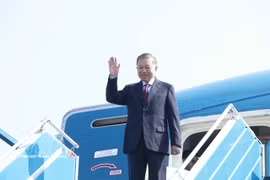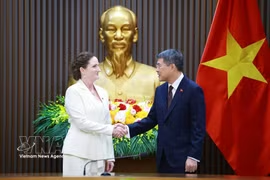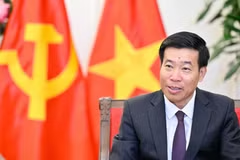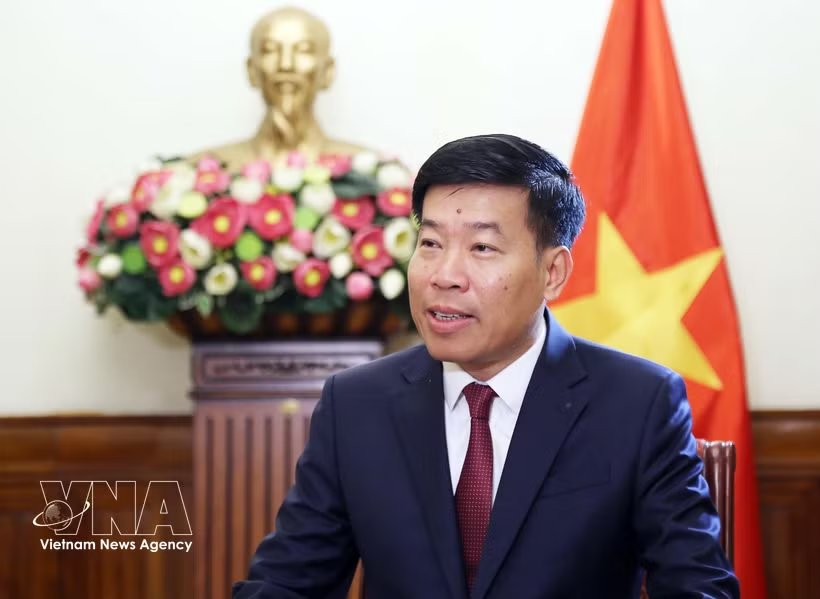
Hanoi (VNA) – The upcoming state visit to New Zealand by General Secretary of the Communist Party of Vietnam Central Committee and State President To Lam is expected to give fresh momentum to the bilateral Comprehensive Strategic Partnership, with a focus on turning political commitments into concrete projects and practical benefits for people and businesses, Vietnamese Deputy Minister of Foreign Affairs Nguyen Manh Cuong has said.
In an interview with media ahead of the visit, Cuong said the trip, at the invitation of New Zealand Governor-General Cindy Kiro, carries special significance as it will be the first state visit to New Zealand by a Vietnamese General Secretary and President in both capacities.
It will also be the first visit by a key Vietnamese leader since the two countries upgraded their ties to a Comprehensive Strategic Partnership in February 2025, he noted.
The visit reflects Vietnam's consistent policy of valuing its relationship with New Zealand, a friendly partner with great potential and many shared interests with Vietnam in the South Pacific region, according to the deputy minister.
The trip is an important milestone in developing the Comprehensive Strategic Partnership in a stronger, more substantive and effective manner in the new period, Cuong said.
The two countries have built a solid foundation for bilateral relations over more than five decades since establishing diplomatic ties. In 2025, as they marked the 50th anniversary of diplomatic relations, they also decided to upgrade their relationship to a Comprehensive Strategic Partnership.
"These two milestones in the same year reflect the maturity of bilateral ties and the trust built between the two countries over generations," Cuong said.
He noted that the visit comes as Vietnam enters a new development period, with priorities including high-quality human resources, high-value agriculture and green growth – areas in which New Zealand has strong expertise and international recognition.
The two sides therefore plan to promote concrete cooperation in education, agriculture, trade and sustainable development, while seeking to turn political commitments into practical benefits, programmes and projects that serve the development goals of both countries and contribute to regional peace, stability, sustainable development and resilience.
Looking back on bilateral relations, Cuong said that that a highlight of the Vietnam-New Zealand relationship is the complementarity between the two economies which creates vast scope for cooperation towards the sustainable development of each country.
He highlighted growing political trust and mutual understanding as one of the most important achievements.
The two countries maintain high-level contacts and annual consultations between their foreign ministries, while working closely together in multilateral forums, including ASEAN, APEC and the United Nations.
As the ASEAN-New Zealand Country Coordinator for 2024-2027, Vietnam has worked with New Zealand to promote the upgrading of ASEAN-New Zealand relations to a Comprehensive Strategic Partnership, helping strengthen New Zealand's engagement with Southeast Asia, he said.
Economic ties also have significant room for growth. Bilateral trade is moving towards a target of 3 billion USD, with the two sides working to expand agricultural market access, address technical barriers and make better use of trade agreements they both participate in, including the Comprehensive and Progressive Agreement for Trans-Pacific Partnership (CPTPP), Regional Comprehensive Economic Partnership (RCEP) and ASEAN-Australia-New Zealand Free Trade Area (AANZFTA).
The two economies are largely complementary rather than direct competitors, providing considerable potential for cooperation, particularly in agriculture.
New Zealand has strengths in breeding technologies, post-harvest technology, value-chain management and low-emission agriculture – areas Vietnam needs. The two countries are expanding cooperation in smart agriculture, climate change adaptation and carbon markets.
Education has also remained a long-term bridge between the two countries. Since the 1990s, when Vietnam was opening up its economy, New Zealand supported English-language training for Vietnamese officials through the English Language Training for Officials (ELTO) programme. Many generations of Vietnamese officials have also benefited from New Zealand scholarships. Cooperation has now expanded into vocational education, skills training and the development of highly qualified human resources.
Cuong also described New Zealand as an effective development partner, with cooperation focused on areas with long-term impact, including education, human resource development, high-tech agriculture and climate change response.
During the upcoming visit, the two sides are expected to hold talks and meetings, as well as a business roundtable and a Vietnam-New Zealand Education Forum. They are also expected to sign a new education cooperation agreement and a number of other important documents.
Cuong said a key expectation is to make full use of the complementary strengths of the two economies by expanding agricultural market access, promoting green agriculture and creating new momentum in education and vocational training.
He said the 3-billion-USD trade target should be viewed as a near-term milestone rather than a distant goal.
The two sides also aim to expand cooperation into new areas alongside traditional pillars, including science and technology, innovation, digital transformation and energy transition.
"Most importantly, the visit is an opportunity to affirm the pioneering role of external relations in mobilising external resources for national development," Cuong said.
He stressed that the success of the visit should not be measured by the number of documents signed, but by how quickly commitments can be turned into concrete projects, knowledge and high-quality human resources for Vietnam.
Building on more than half a century of trust and the Comprehensive Strategic Partnership framework, the visit is hoped to create fresh momentum for deeper bilateral ties, bring practical benefits to people and businesses in both countries, and contribute to peace, stability, cooperation and development in the region./.