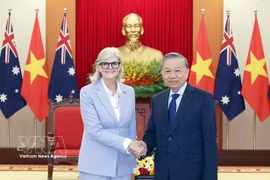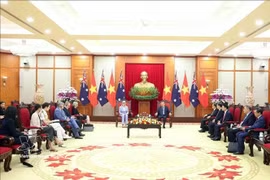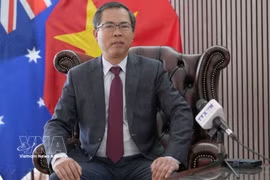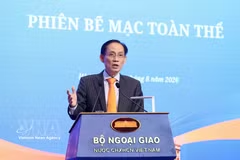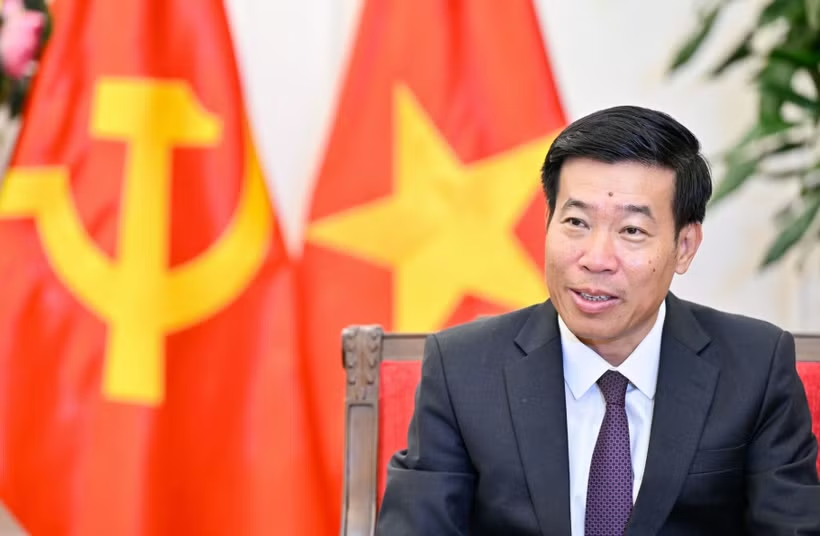
Hanoi (VNA) - The upcoming state visit to Australia by Party General Secretary and State President To Lam demonstrates Vietnam’s high regard for Australia as an important partner in the Indo-Pacific and its determination to make the new partnership framework deeper, more substantive and more effective, according to Deputy Minister of Foreign Affairs Le Manh Cuong.
Speaking to the media ahead of the visit, Cuong said the trip carries special significance as it will be General Secretary and State President Lam’s first visit to Australia in his current position and the first visit by a key Vietnamese leader since the two countries upgraded their relations to a Comprehensive Strategic Partnership in March 2024.
The visit is grounded in more than half a century of diplomatic relations between the two countries, during which their partnership has been successively upgraded from a Comprehensive Partnership to a Strategic Partnership and, most recently, a Comprehensive Strategic Partnership. Each upgrade has reflected a higher level of political trust and increasingly closely aligned interests, he noted.
It comes as Vietnam is promoting a new development model based on productivity, knowledge, science and technology, innovation, digital transformation and modern governance. These are also areas in which Australia has significant strengths, from basic research and strategic technologies to high-quality human resource training and a strong public administration and civil service.
The visit's agenda therefore links high-level diplomacy with concrete cooperation in economy, technology, education and human resources, with the objective of not only expanding bilateral relations but also creating new development momentum for Vietnam.
Regarding the development of bilateral ties, Cuong said Vietnam-Australia relations are currently at their most dynamic stage since the two countries established their Comprehensive Strategic Partnership.
Political trust remains a key highlight, with the two sides maintaining regular high-level exchanges and numerous bilateral cooperation mechanisms, while closely coordinating at the Association of Southeast Asian Nations (ASEAN), Asia-Pacific Economic Cooperation (APEC) and the United Nations, he said.
The official noted that two-way trade has reached more than 14 billion USD. The two economies are highly complementary and both participate in new-generation free trade agreements, including the Comprehensive and Progressive Agreement for Trans-Pacific Partnership (CPTPP), Regional Comprehensive Economic Partnership (RCEP) and ASEAN-Australia-New Zealand Free Trade Area (AANZFTA).
The Deputy FM said the two countries were not competitors but rather needed one another, creating a foundation for expanding trade and investment, diversifying supply chains and developing future industries.
He highlighted the Aus4Innovation programme and the Vietnam-Australia Centre for Strategic Technology as initiatives opening up new avenues for cooperation in artificial intelligence, semiconductors, digital data and critical minerals. Science, technology and innovation are consequently emerging as new growth pillars of bilateral relations.
Education and people-to-people links also constitute an important asset. RMIT University was the first foreign university to operate in Vietnam, while more than 35,000 Vietnamese students are currently studying in Australia.
Meanwhile, a community of more than 350,000 Vietnamese people in Australia, together with intellectual and business networks such as the Vietnamese-Australian Scholars and Experts Association (VASEA), serves as a strong bridge between the two peoples. Cuong described this as social capital that cannot be created overnight by any agreement.
Australia is also an important ODA partner of Vietnam in infrastructure, digital transformation, climate change response and green transition. The country has also expanded the training of Vietnamese officials through the Vietnam-Australia Centre (VAC) at the Ho Chi Minh National Academy of Politics.
Cuong said that defence and security cooperation represents another highlight of bilateral ties. Australia is the only country to have supported Vietnam in transporting field hospitals, while also providing English-language and military medical training.
These efforts have helped strengthen Vietnam’s capacity to participate in UN peacekeeping operations.
Regarding the expected outcomes of the visit, he said its focus will be on translating existing potential into concrete cooperation. Leaders of the two countries are expected to discuss strategic orientations for cooperation in technology, energy transition and high-quality human resource training.
A highlight of the visit will be the TechConnect Forum, which aims to promote a “three-party” linkage among the governments, businesses, and universities and research institutes of the two countries and build a shared innovation ecosystem. A number of important cooperation documents are also expected to be signed at governmental level and between research institutions and businesses.
According to the Deputy FM, the key expectation is a qualitative breakthrough, with science, technology, innovation and strategic technology industries becoming new growth pillars alongside trade, investment and education. This will help strengthen the resilience of both economies.
Building on more than half a century of mutual trust and the Comprehensive Strategic Partnership framework, Vietnam expects the visit to generate fresh momentum for deepening bilateral relations, deliver practical benefits to people and businesses in both countries, and make a positive contribution to peace, stability, cooperation and development in the region, he concluded./.