Lawmakers seek legal reforms to promote telecom infrastructure data sharing

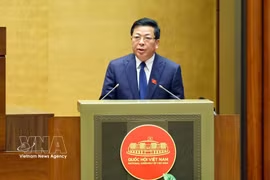
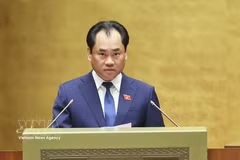
A deputy of Ha Tinh province said there is currently no clear legal basis for sharing technical infrastructure data. While the issue may be less apparent under normal circumstances, it could hamper local coordination and response during storms, floods and other disasters when detailed infrastructure data is not readily available.

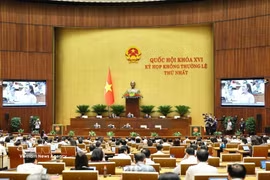
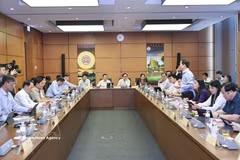
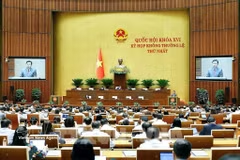
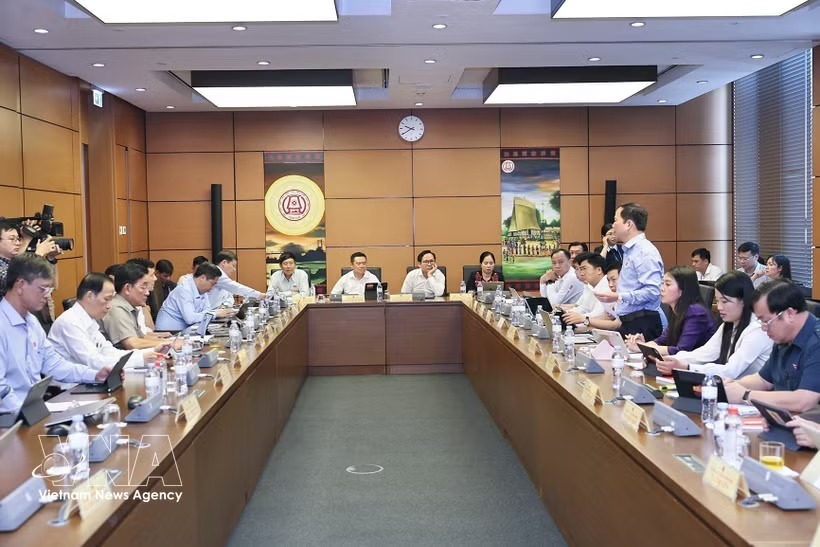
Lawmakers in a group discussion (Photo: VNA)

Hanoi (VNA) – Lawmakers on August 7 discussed in groups a draft law amending and supplementing a number of articles of the Law on Radio Frequencies, Law on Telecommunications, Law on Electronic Transactions and Law on Technology Transfer as part of the first extraordinary sitting of the 16th National Assembly.

Commenting on the bill, deputy Le Thanh Dong of Ha Tinh province proposed adding a provision requiring telecommunications enterprises to share technical infrastructure data with local state management agencies in accordance with regulations issued by the relevant ministry.

He said there is currently no clear legal basis for such data sharing, creating difficulties in managing and exploiting information for state management. While the issue may be less apparent under normal circumstances, it could hamper local coordination and response during storms, floods and other disasters when detailed infrastructure data is not readily available.

Regarding conditions for participating in auctions and examinations for rights to use radio frequencies, Dong proposed a provision requiring state management agencies to verify enterprises’ fulfilment of financial obligations by connecting to and exploiting data from the National Public Service Portal and relevant databases

On telecom infrastructure sharing, he suggested specifying the state agency authorised to make decisions.

Deputy Nguyen Thi Viet Nga of Hai Phong city broadly agreed with the draft and praised its approach. Although it amends four laws simultaneously, she noted, the draft focuses on three key policy areas: cutting and simplifying administrative procedures and investment and business conditions; promoting decentralisation and delegation of authority; and improving management mechanisms to ensure consistency in the legal system.

According to the draft, two administrative procedures would be abolished, 47 investment and business conditions cut, four simplified and three amended or supplemented. In the field of radio frequencies alone, 33 of 41 investment and business conditions would be removed.

Nga said the measures represent a significant reform and demonstrate a shift from pre-licensing to post-licensing inspection, helping reduce compliance costs. She also stressed the need to strengthen post-licensing inspection capacity once pre-licensing inspection requirements are removed.

The draft reflects a shift towards management through standards, technical regulations, data and enforcement monitoring rather than licences, conditions and paperwork, she said.

She proposed that guiding decrees clearly define alternative management tools, agencies responsible for each area, databases and sanctions for each group of conditions removed, along with stronger connectivity between national and sectoral databases, and an end to requiring people and businesses to resubmit information already held by state agencies.

Deputy Nguyen Minh Tam of Quang Tri province proposed clarifying provisions on frequency-band allocation for national defence and security purposes.

The draft allows, in special cases, frequency bands to be allocated for up to five years to State-owned enterprises directly serving national defence and security to develop economic activities in combination with performing defence and security tasks.

Tam said the concepts of “special cases” and “economic development combined with national defence and security tasks” remain qualitative and lack specific criteria, potentially leading to inconsistent application. He proposed authorising the Government to set detailed criteria for special cases, eligibility conditions and assessment of such activities to ensure consistent and transparent implementation./.

VNA
See more

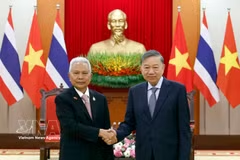
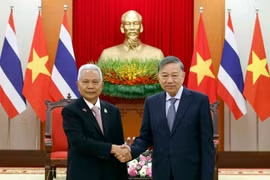
National Assembly Chairman Tran Thanh Man (R) and President of the National Assembly and Speaker of the House of Representatives of Thailand Sophon Zaram in Hanoi during the latter's official visit to Vietnam from August 5-7, 2026. (Photo: VNA)

Thailand's parliamentary leader concludes official visit to Vietnam

Thailand attaches great importance to its Comprehensive Strategic Partnership with Vietnam, and the two countries share a solid foundation of friendship, many common strategic interests and significant potential for cooperation, said President of the National Assembly and Speaker of the House of Representatives of Thailand Sophon Zaram.

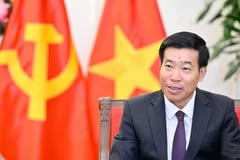
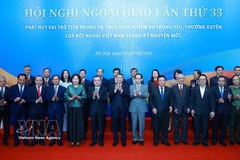
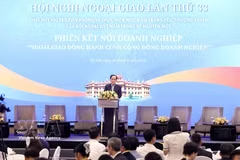
Politburo member and Minister of Foreign Affairs Le Hoai Trung speaks at the 33rd Diplomatic Conference's closing session in Hanoi on August 7, 2026. (Photo: VNA)

33rd Diplomatic Conference wraps up in Hanoi

Foreign relations are no longer viewed simply as relations with the outside world but as an integral component of national comprehensive strength and a responsibility shared by the entire Party, people, armed forces and political system.

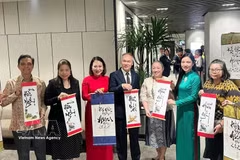
Consuls general of ASEAN countries in Ho Chi Minh City show calligraphy works presented to them at the gathering on August 7. (Photo: VNA)

Get-together celebrates 59th founding anniversary of ASEAN

​Despite differences in history, culture, languages, religions, levels of development, and social conditions, ASEAN member states have chosen to respect one another, build consensus, and pursue shared regional interests. It’s the unity in diversity that has shaped ASEAN’s identity, strength, resilience, and central role in the regional architecture.

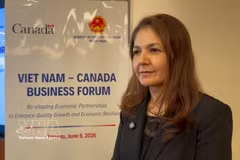
Vina Nadjibulla, former Vice President for Research and Strategy at the Asia Pacific Foundation of Canada (Photo; VNA)

33rd Diplomatic Conference: Vietnam's foreign policy wins praise from Canadian expert

Vina Nadjibulla, former Vice President for Research and Strategy at the Asia Pacific Foundation of Canada, credited pragmatic diplomacy with allowing Vietnam to build relationships with a range of partners without becoming overly dependent on any single country. That approach, she noted, has become more relevant as major-power rivalry heats up, the global economy fragments, and pressure mounts on countries to pick sides.

Minister of Agriculture and Environment Trinh Viet Hung speaks at the session (Photo: VNA)

Legislators review bills to streamline administrative procedures in agriculture, environment

Presenting the draft law on amending and supplementing several articles of 10 laws concerning administrative procedures and business conditions in the agriculture and environment sector, Minister of Agriculture and Environment Trinh Viet Hung said it is designed to institutionalise the Party's policy of reducing and simplifying administrative procedures and business conditions, while promoting decentralisation, innovation, and more effective state governance.

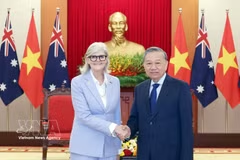
General Secretary of the Communist Party of Vietnam (CPV) Central Committee (right) hosts a reception for Australian Governor-General Sam Mostyn in Hanoi during her state visit to Vietnam in September last year (Photo: VNA)

Vietnam, Australia to further strenthern cooperation

The messages posted on Australian Government media platforms highlighted Australia and Vietnam as close regional partners with a long-standing friendship. This will be General Secretary and President Lam’s first visit to Australia since being appointed as President in April and it is also the first in-person meeting between the two leaders.

Lawmakers discuss bills in groups (Photo: VNA)

Lawmakers mull over various bills in group debates

The legislative package includes a draft Law on Urban Development, a bill amending and supplementing several articles of 10 laws that govern administrative procedures and business conditions in agriculture and environment, and the draft Law amending and supplementing several articles of the Law on Radio Frequencies, the Law on Telecommunications, the Law on E-Transactions, and the Law on Technology Transfer.

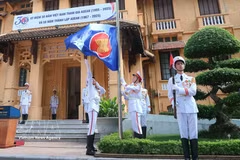
A flag-raising ceremony is held to mark the 58th founding anniversary of the Association of Southeast Asian Nations (ASEAN) on August 8, 2025 (Photo: VNA)

Vietnam remains active contributor to ASEAN Community Vision 2045

Vietnam's 31-year journey with ASEAN stands as compelling testimony to its strong commitment to regional integration, as well as its pioneering spirit, sense of responsibility, and proactive contributions to building a united and resilient ASEAN Community.

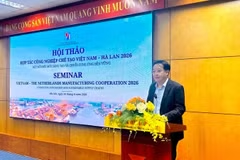
Bui Quang Hung, Deputy Director General of the Trade Promotion Agency, addresses the seminar. (Photo courtesy of the Ministry of Industry and Trade)

Vietnam, Netherlands seek deeper manufacturing cooperation

Manufacturing remains one of Vietnam's core industries, making a major contribution to economic growth, exports and foreign direct investment. The country has become an important production base for multinational corporations in electronics, precision engineering, electrical equipment and high-tech industries.

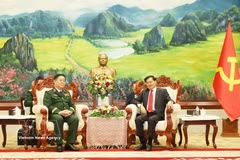
Lao Party General Secretary and President Thongloun Sisoulith (right) receives General Nguyen Trong Nghia, Chairman of the General Department of Politics of the Vietnam People's Army on August 6 (Photo: VNA)

Vietnam, Laos strengthen political, defence ties

The Lao leaders expressed satisfaction with the steady development of bilateral ties, noting that political relations have become increasingly close, deep and trustworthy, serving as the guiding force for overall cooperation.

Collins Chong Yew Keat, a foreign affairs, security and strategy analyst at the University of Malaya (Photo: VNA)

Malaysia-Vietnam defence ties set for more practical cooperation: expert

According to the expert, another key outcome was the reaffirmation of the 2023 defence cooperation MoU and the Action Programme for implementing the Comprehensive Strategic Partnership as the principal roadmap for future collaboration. The framework builds on existing cooperation in delegation exchanges, consultation mechanisms, military education, defence industry, and coordination within ASEAN and other multilateral forums.

Politburo member and Minister of Foreign Affairs Le Hoai Trung speaks at the networking session with business community on August 6. (Photo: VNA)

Diplomacy to accompany businesses in expanding Vietnam's development space

Opening the event, Politburo member and Minister of Foreign Affairs Le Hoai Trung said Vietnam is entering a new era of development in which foreign affairs and international integration is a crucial and regular task, contributing to maintaining a peaceful and stable environment, mobilising external resources and enhancing the country's international standing.

A view of a National Assembly meeting (Photo: VNA)

NA reviews special mechanisms to keep APEC 2027 projects on schedule

The draft laws include the Law on Urban Development; the Law on amending and supplementing several articles of 10 laws concerning administrative procedures and business conditions in the agriculture and environment sectors; and the Law amending and supplementing several articles of the Law on Radio Frequencies, the Law on Telecommunications, the Law on E-Transactions, and the Law on Technology Transfer.