Lawmakers mull over changes to architecture law

On architectural management, the draft Law amending and supplementing several articles of the Law on Architecture clarifies the concept of “national cultural identity in architecture”, tying design to the preservation and promotion of regional heritage. It pushes architecture that mirrors local identity and fits each locality’s natural, historical and social conditions, while setting criteria to identify, assess and protect architecturally valuable buildings as a distinct form of cultural heritage.

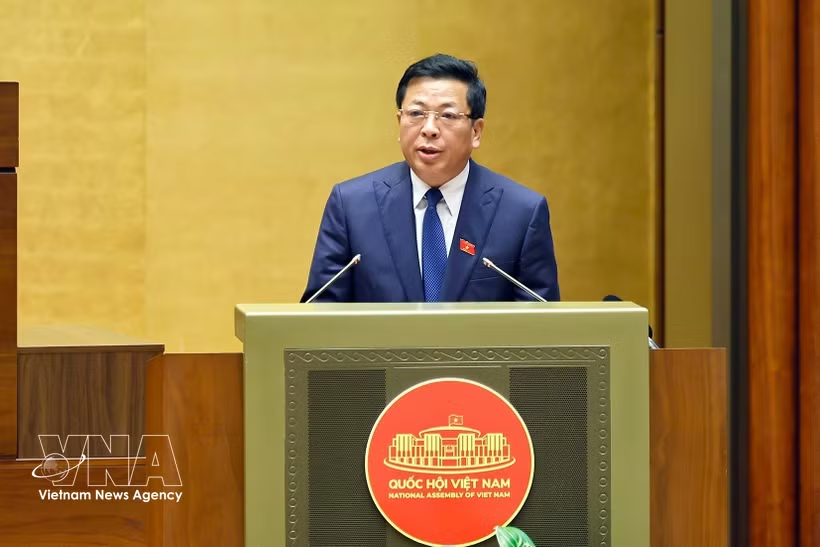
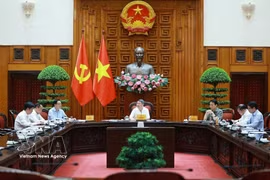
Minister of Construction Tran Hong Minh speaks at the session (Photo: VNA)

Hanoi (VNA) - Lawmakers heard a Government proposal and verification report on the draft Law amending and supplementing several articles of the Law on Architecture during the 16th National Assembly’s first extraordinary session in Hanoi on August 5.

Defining “national cultural identity in architecture”

Minister of Construction Tran Hong Minh said the draft law would amend or replace 14 articles, scrap four and keep 23 intact.

On architectural management, the draft clarifies the concept of “national cultural identity in architecture”, tying design to the preservation and promotion of regional heritage. It pushes architecture that mirrors local identity and fits each locality’s natural, historical and social conditions, while setting criteria to identify, assess and protect architecturally valuable buildings as a distinct form of cultural heritage.

It also aims to enshrine the Politburo’s Resolution 80-NQ/TW on Vietnamese culture development into law.

The draft upgrades architectural management tools, specifically management regulations and design competitions, to meet demands for lawmaking reform and national development in a new era.

Curbing wastefulness and red tape

Presenting the verification report on the draft law, Chairwoman of the NA Committee for Science, Technology and Environment Nguyen Thanh Hai said the committee largely backs the proposed changes to Article 5.

The committee recommended that the provincial-level People’s Committees issue a set of criteria and a general framework to guide the identification of national cultural identity locally. Commune-level authorities would then simply apply that framework without devising their own separate standards.

It broadly endorsed the proposed authority to issue architectural management regulations under the two-tier local administration model. To ensure feasibility, it urged the Government to consider requiring management regulations only in special, new urban and central areas, not across entire administrative boundaries.

It stressed strict urban design controls of large-scale private real estate projects and lakeside, riverside and coastal zones to protect the broader landscape.

Control mechanisms should be added to lift urban space quality, promote green architecture, improve energy efficiency and adaptation to climate change.

For architecturally valuable buildings, the committee asked drafters to codify core criteria for identification and classification, while clearly defining provincial-level committees’ duties in drawing up, approving, publishing and revising the relevant lists.

It also proposed studying consultation mechanisms that tap professional and social organisations, independent expert councils and local communities before any building is put on the list.

At the same time, mechanisms should be set up to manage and preserve buildings with outstanding architectural value that fall short of heritage recognition criteria, while balancing owners’ interests.

The committee also largely agreed with narrowing the scope of architectural positions that require a mandatory practice certificate, a move designed to cut red tape.

It proposed, however, scrapping the 10-year validity period for architectural practice certificates and instead managing their validity automatically based on professionals’ continuing professional development (CPD) points./.
VNA

See more

The top 14 contestants of Top Chef Vietnam 2026. (Photo: vtv.vn)

Top Chef Vietnam returns with mission to elevate Vietnamese cuisine globally

Vietnam currently ranks 16th among the world's top 100 cuisines in the latest TasteAtlas rankings, up three places from 2024 and six from 2023. Meanwhile, Travel + Leisure has described Vietnamese cuisine as "exceptional" and listed Vietnam among the leading destinations for travellers seeking cultural experiences through food.

Organisers, sponsors and officials pose for a commemorative photo at the launch ceremony. (Photo: VNA)

Halong Bay Heritage Marathon 2026 expected to attract 18,000 runners

Competitors will race in the 42.195 km marathon, 21.0975 km half marathon, 10 km and 5 km events. Starting and finishing at the Quang Ninh Planning, Fair and Exhibition Palace, the course will once again feature fully closed roads along Ha Long Bay, a route named by Runner's World UK among the world's 50 most scenic running courses.

Artists of Italy's Teatro Lirico Giuseppe Verdi di Trieste perform the opera La Traviata. (Photo published by VNA)

Over 100 Italian artists bring opera masterpiece La Traviata to Vietnam

First staged at Venice's Teatro La Fenice in 1853, La Traviata was adapted from Alexandre Dumas fils' La Dame aux Camélias (Camille). More than 170 years on, it remains one of the most enduring works in the operatic repertoire and is regularly performed at leading theatres worldwide.

Hanoi launches tourism-focused art programme

Hanoi launches tourism-focused art programme

The “Chuyen Ha Noi – Mot ngay rat Ha Noi” (Hanoi stories – A truly Hanoi day) programme is scheduled to be staged regularly at 8 p.m. every Friday at the theatre, located at 31–33 Luong Van Can street, Hoan Kiem ward. It is expected to become one of the city’s signature cultural attractions for both domestic and international visitors.

A digital book is embedded in the bronze nghe statues at the Temple of Literature in Hanoi. (Photo: VNA)

Vietnam’s folk culture to go digital

Digitising Vietnam’s folk culture, including oral literature, beliefs, customs, festivals and art passed down through generations, has become an urgent lever for national cultural development in the new era.

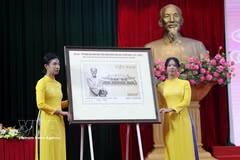
The special commemorative postage stamp marking the 300th birth anniversary of renowned Vietnamese cultural figure Le Quy Don (1726–2026) (Photo: VNA)

Commemorative stamp issued to mark Le Quy Don's 300th birth anniversary

Speaking at the event, Deputy Minister of Science and Technology Pham Duc Long described Le Quy Don as one of Vietnam's most distinguished cultural figures of the 18th century. A celebrated scholar, poet, historian, thinker, educator and diplomat, Le Quy Don left behind an extensive body of work whose enduring value continues to enrich the nation's cultural, scientific and educational heritage.

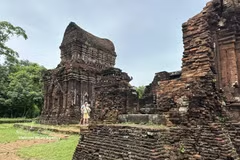
The My Son temple complex served as the foremost religious and spiritual centre of successive ancient Champa dynasties for nearly nine centuries, from the 4th to the 13th century, featuring an extensive ensemble of Hindu temples and towers. (Photo: VNA)

My Son inscriptions set sights on UNESCO documentary heritage status

Located in Thu Bon commune, Da Nang city, My Son is renowned for its architectural heritage, but it also preserves an exceptional archive engraved on stone. These inscriptions have enabled scholars to unravel the history of the sanctuary and trace the rise and development of the ancient Champa kingdom over many centuries.

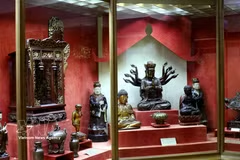
Vietnamese cultural artefacts on display at the State Museum of Oriental Art in Russia. (Photo: VNA)

Moscow museum bridges Vietnam-Russia cultural exchange

Among its rich collections, the Vietnamese gallery at the State Museum of Oriental Art in Moscow stands out as a vivid testament to the country's history, culture and craftsmanship, helping promote Vietnam's cultural identity to Russian and international visitors.

Students and teachers explore the legacy of scholar Le Quy Don (Photo: VNA)

Exhibition showcases legacy of scholar Le Quy Don

Speaking at the opening ceremony, Nguyen Hang Nga, Director of the Vietnam Exhibition Centre for Culture and Arts, said the exhibition gives visitors deeper insight into cultural figure and scholar Le Quy Don's vast scholarly contributions through photographs, historical documents, woodblock reproductions, stone inscriptions, books and other valuable archival materials.