Vietnam–Australia relationship has matured, underpinned by strong political trust: Australian expert

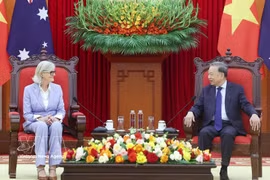
The state visit to Australia by Party General Secretary and State President To Lam represents an opportunity for both countries to translate strategic ambitions into concrete outcomes, said Layton Pike, a member of the Australia–Vietnam Policy Institute (AVPI)'s advisory board.

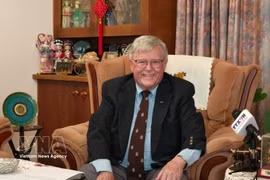
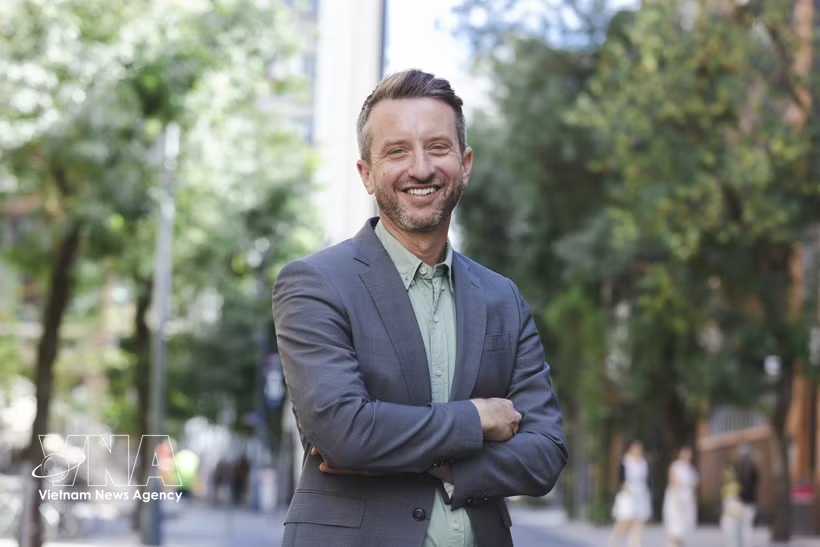
Layton Pike, a member of the Australia–Vietnam Policy Institute (AVPI)'s advisory board and Vice President International, RMIT University (Photo published by VNA)

Sydney (VNA) – The upcoming state visit to Australia of General Secretary of the Communist Party of Vietnam (CPV) Central Committee and President of Vietnam To Lam is a highly opportune moment for Vietnam and Australia to further deepen a relationship that has matured and is underpinned by strong political trust, Layton Pike, a member of the Australia–Vietnam Policy Institute (AVPI)'s advisory board, said in an interview granted to the Vietnam News Agency.

The expert, who is also Vice President International, RMIT University, noted that the Comprehensive Strategic Partnership framework, established in 2024, has created a practical foundation for the two countries to expand cooperation across a wide range of areas, including trade, investment, education, skills development, innovation, clean energy, security and people-to-people ties.

He observed that the two economies are clearly complementary. Vietnam offers a dynamic market, a young workforce with steadily improving skills, expanding manufacturing capacity and a growing role in regional supply chains. Australia, meanwhile, brings strengths in education, scientific research, resources, agriculture, clean energy, health care, technology and professional services.

The trip represents an opportunity for both countries to translate strategic ambitions into concrete outcomes, the expert stated.

In his view, there are five areas with significant untapped potential: elevating the value and resilience of the trade and investment relationship; cooperation in education, skills training and transnational education; research and innovation collaboration; development of clean energy, critical minerals and sustainable supply chains; and strengthening networks linking alumni, businesses, professionals and communities across both countries.

In particular, he emphasised that education should remain a central pillar of cooperation. He said the two countries can build on their long-standing partnership through joint training programmes, closer alignment between training and industry needs, and joint research projects in high-value areas such as artificial intelligence (AI), digital transformation, advanced manufacturing, health care, renewable energy and sustainable agriculture.

Green transition was also identified as one of the most promising drivers of cooperation. According to the expert, Australia's strengths in renewable energy, critical minerals and environmental management can effectively complement Vietnam's needs in securing energy supply, supporting industrial development and achieving its net-zero targets.

However, he stressed that the most important foundation of the Vietnam–Australia relationship remains its people. Having lived and worked in Vietnam for many years, he has witnessed how quickly bonds form between the peoples of both countries, whether through study, business, or cultural exchange and exploration. These connections, he said, provide a durable foundation for the bilateral relationship, and matter just as much as trade or investment figures.

He noted that as more Vietnamese students, professionals and entrepreneurs build ties with Australia, and as more Australians gain the opportunity to better understand Vietnam's people and culture, the connection between the two nations will continue to strengthen.

Regarding outcomes of the 3rd plenum of the 14th Party Central Committee, Pike said the focus on strengthening governance capacity, institutional reform and policy implementation reflects the demands of this new stage of development. In his view, a country's competitiveness is determined not only by the quality of its policy vision, but also by its ability to implement that vision consistently, effectively and transparently.

As Vietnam shifts toward a growth model driven by productivity, technology and innovation, institutional reform will play a critical role in reducing legal uncertainty and addressing bottlenecks related to land, infrastructure, energy, licensing and human resources. For the business and investor community, clarity in regulation, timeliness in decision-making and consistency in enforcement matter just as much as the substance of the policies themselves.

He added that the reform agenda also places strong emphasis on accountability, decentralisation and delegation of authority. Given that local governments are typically the first point of contact for investors and citizens, clearly defined responsibilities, stronger capacity among officials, adequate implementation resources, and transparent oversight mechanisms will all help improve governance effectiveness.

The expert believes these reforms will give Australian businesses, universities and research institutions greater confidence to invest in and build long-term partnerships with Vietnam, particularly in areas such as clean energy, critical minerals, agriculture, education, skills development, health care, digital transformation, research and innovation.

In his view, governance is a core economic asset for Vietnam. Stronger institutions and more effective implementation will be important to attracting higher-quality investment, supporting the green and digital transition, and ensuring that growth remains sustainable and inclusive while strengthening the economy's resilience against future shocks.

Looking at the longer-term outlook, Pike expressed optimism about Vietnam's development path. He said the directions set out at the 3rd plenum of the 14th Party Central Committee have helped clarify the roadmap toward becoming a high-income country, underpinned by an economy built on productivity, technology, innovation and a highly skilled workforce.

He said Vietnam's resilience will be strengthened as its existing foundations are converted into more durable institutional capacity, through effective governance, decentralisation paired with accountability, and consistent implementation. These are also factors that international investors increasingly value when choosing destinations for higher-quality capital linked to technology transfer, skills development and deeper supply chain integration.

At the same time, he cautioned that policy and institutions alone only create the necessary conditions.

Drawing on many years of observing Vietnam's development, he said the country's greatest strength lies in the determination, adaptability and drive of its officials, businesses and workers. This spirit, he noted, has helped turn many ambitious goals into real outcomes over the years, and is why he remains confident that the current reform agenda will be implemented effectively.

At the regional and global level, Pike said that if these reforms are successfully implemented, Vietnam will continue to strengthen its role as an increasingly important economy in the Indo-Pacific, gradually moving up into higher value-added segments such as advanced manufacturing, digital industries, and research and development (R&D) within regional and global supply chains. This, he added, will also make Vietnam an increasingly attractive partner for Australia over the coming decade.

Ultimately, he said, the true measure of success will be effective implementation. If Vietnam's ambitious reform directions are carried out consistently, the country will have every opportunity to enter one of the most important periods of development in its modern history./.​

VNA

See more

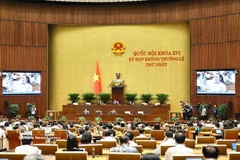
Vice Chairman of the National Assembly Nguyen Doan Anh (standing) presides over the session on August 8. (Photo: VNA)

National Assembly reviews bill on WMD non-proliferation

Most deputies agreed on the need for the law, saying it will help complete the legal framework for implementing Vietnam’s international commitments and proactively prevent, detect and stop the proliferation of nuclear, chemical and biological weapons and related delivery systems.

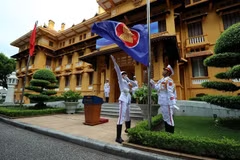
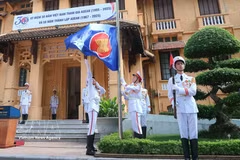
The ASEAN flag hoisting ceremony held in Hanoi on July 31, 2026 to mark the 59th founding anniversary of ASEAN and the 31st anniversary of Vietnam's accession to the bloc. (Photo published by VNA)

Vietnam to remain active player in shaping ASEAN’s future: minister

Entering a new era of national development with the aspiration of building a strong and prosperous country, the mindset of "growing alongside ASEAN" will guide Vietnam’s more proactive, positive, and substantive contributions to the ASEAN Community and the co-creation of the region’s shared future, noted Minister of Foreign Affairs Le Hoai Trung.

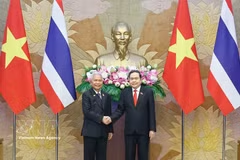
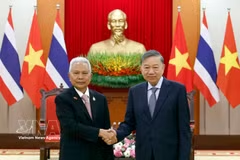
National Assembly Chairman Tran Thanh Man (R) and President of the National Assembly and Speaker of the House of Representatives of Thailand Sophon Zaram in Hanoi during the latter's official visit to Vietnam from August 5-7, 2026. (Photo: VNA)

Thailand's parliamentary leader concludes official visit to Vietnam

Thailand attaches great importance to its Comprehensive Strategic Partnership with Vietnam, and the two countries share a solid foundation of friendship, many common strategic interests and significant potential for cooperation, said President of the National Assembly and Speaker of the House of Representatives of Thailand Sophon Zaram.

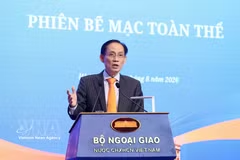
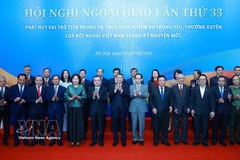
Politburo member and Minister of Foreign Affairs Le Hoai Trung speaks at the 33rd Diplomatic Conference's closing session in Hanoi on August 7, 2026. (Photo: VNA)

33rd Diplomatic Conference wraps up in Hanoi

Foreign relations are no longer viewed simply as relations with the outside world but as an integral component of national comprehensive strength and a responsibility shared by the entire Party, people, armed forces and political system.

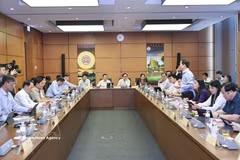
Lawmakers in a group discussion (Photo: VNA)

Lawmakers seek legal reforms to promote telecom infrastructure data sharing

A deputy of Ha Tinh province said there is currently no clear legal basis for sharing technical infrastructure data. While the issue may be less apparent under normal circumstances, it could hamper local coordination and response during storms, floods and other disasters when detailed infrastructure data is not readily available.

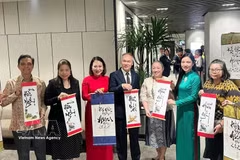
Consuls general of ASEAN countries in Ho Chi Minh City show calligraphy works presented to them at the gathering on August 7. (Photo: VNA)

Get-together celebrates 59th founding anniversary of ASEAN

​Despite differences in history, culture, languages, religions, levels of development, and social conditions, ASEAN member states have chosen to respect one another, build consensus, and pursue shared regional interests. It’s the unity in diversity that has shaped ASEAN’s identity, strength, resilience, and central role in the regional architecture.

Vina Nadjibulla, former Vice President for Research and Strategy at the Asia Pacific Foundation of Canada (Photo; VNA)

33rd Diplomatic Conference: Vietnam's foreign policy wins praise from Canadian expert

Vina Nadjibulla, former Vice President for Research and Strategy at the Asia Pacific Foundation of Canada, credited pragmatic diplomacy with allowing Vietnam to build relationships with a range of partners without becoming overly dependent on any single country. That approach, she noted, has become more relevant as major-power rivalry heats up, the global economy fragments, and pressure mounts on countries to pick sides.

Minister of Agriculture and Environment Trinh Viet Hung speaks at the session (Photo: VNA)

Legislators review bills to streamline administrative procedures in agriculture, environment

Presenting the draft law on amending and supplementing several articles of 10 laws concerning administrative procedures and business conditions in the agriculture and environment sector, Minister of Agriculture and Environment Trinh Viet Hung said it is designed to institutionalise the Party's policy of reducing and simplifying administrative procedures and business conditions, while promoting decentralisation, innovation, and more effective state governance.

General Secretary of the Communist Party of Vietnam (CPV) Central Committee (right) hosts a reception for Australian Governor-General Sam Mostyn in Hanoi during her state visit to Vietnam in September last year (Photo: VNA)

Vietnam, Australia to further strengthen cooperation

The messages posted on Australian Government media platforms highlighted Australia and Vietnam as close regional partners with a long-standing friendship. This will be General Secretary and President Lam’s first visit to Australia since being appointed as President in April and it is also the first in-person meeting between the two leaders.

Lawmakers discuss bills in groups (Photo: VNA)

Lawmakers mull over various bills in group debates

The legislative package includes a draft Law on Urban Development, a bill amending and supplementing several articles of 10 laws that govern administrative procedures and business conditions in agriculture and environment, and the draft Law amending and supplementing several articles of the Law on Radio Frequencies, the Law on Telecommunications, the Law on E-Transactions, and the Law on Technology Transfer.

A flag-raising ceremony is held to mark the 58th founding anniversary of the Association of Southeast Asian Nations (ASEAN) on August 8, 2025 (Photo: VNA)

Vietnam remains active contributor to ASEAN Community Vision 2045

Vietnam's 31-year journey with ASEAN stands as compelling testimony to its strong commitment to regional integration, as well as its pioneering spirit, sense of responsibility, and proactive contributions to building a united and resilient ASEAN Community.

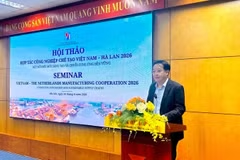
Bui Quang Hung, Deputy Director General of the Trade Promotion Agency, addresses the seminar. (Photo courtesy of the Ministry of Industry and Trade)

Vietnam, Netherlands seek deeper manufacturing cooperation

Manufacturing remains one of Vietnam's core industries, making a major contribution to economic growth, exports and foreign direct investment. The country has become an important production base for multinational corporations in electronics, precision engineering, electrical equipment and high-tech industries.

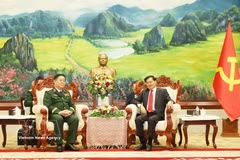
Lao Party General Secretary and President Thongloun Sisoulith (right) receives General Nguyen Trong Nghia, Chairman of the General Department of Politics of the Vietnam People's Army on August 6 (Photo: VNA)

Vietnam, Laos strengthen political, defence ties

The Lao leaders expressed satisfaction with the steady development of bilateral ties, noting that political relations have become increasingly close, deep and trustworthy, serving as the guiding force for overall cooperation.

Collins Chong Yew Keat, a foreign affairs, security and strategy analyst at the University of Malaya (Photo: VNA)

Malaysia-Vietnam defence ties set for more practical cooperation: expert

According to the expert, another key outcome was the reaffirmation of the 2023 defence cooperation MoU and the Action Programme for implementing the Comprehensive Strategic Partnership as the principal roadmap for future collaboration. The framework builds on existing cooperation in delegation exchanges, consultation mechanisms, military education, defence industry, and coordination within ASEAN and other multilateral forums.