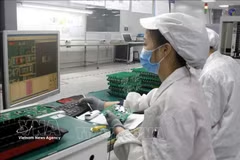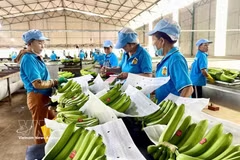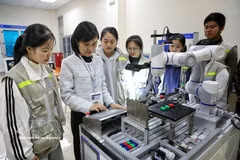
Hanoi (VNA) - Science, technology, innovation and digital transformation have become strategic imperatives directly linked to labour productivity, competitiveness, growth quality and the economy's self-reliance, with sci-tech application and innovation by small and medium-sized enterprises (SMEs) playing an important role.
Politburo Resolution No. 57-NQ/TW on breakthroughs in the development of science, technology, innovation and national digital transformation, together with Politburo Resolution No. 68-NQ/TW on private-sector development, has established an important policy framework by identifying science and technology as a key driver, the private sector as one of the most important driving forces of the economy, and businesses as the force directly responsible for bringing technology into production, business and the market.
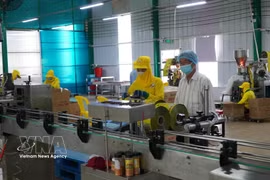
At the Ba Vi Golden Cow Milk Joint Stock Company, fresh milk undergoes strict quality inspections before processing. Director Dao Cong Truong said that when the company established a milk-cake production facility in 2007, all processes were carried out manually. Milk was cooked on traditional stoves, cakes were rolled by hand and wrapped in simple parchment paper. As a result, 100kg of fresh milk produced only about 13kg of milk cakes. The establishment of the Ba Vi Golden Cow Milk Joint Stock Company in 2019 marked a transition from manual production to modern processing.
The company now works with 45 households raising nearly 300 dairy cows and purchases around 5.3 tonnes of fresh milk every day. It uses freeze-drying technology at minus 40 degrees Celsius to preserve the milk's nutritional content.
Recently, Hanoi had nine products recognised as five-star OCOP (One Commune One Product) products at the national level, with five of them produced by the company. It also has 15 products rated four-star OCOP products at the municipal level.
According to Dr. To Hoai Nam, Standing Vice Chairman and Secretary General of the Vietnam Association of Small and Medium Enterprises (VINASME), SMEs currently account for around 98% of all businesses nationwide, while the private sector contributes approximately 51% of GDP and provides jobs for more than 40 million workers.
However, the sector faces significant pressure in terms of capital, technology, digital human resources, innovation and digital transformation.
A survey by VINASME and various business representative organisations found that around 60-70% of SMEs have difficulty accessing credit. Meanwhile, investment costs for management software, digital data, information security, automation, e-commerce platforms, traceability and artificial intelligence applications are relatively high compared with the financial capacity of small businesses.
Many businesses still have to prioritise maintaining operating cash flow, labour costs and orders before considering investment in technology.
Nam said it is necessary to develop a financial ecosystem for technological innovation and digital transformation among SMEs and household businesses, combining resources from the State, commercial banks, investment funds and technology companies.
He proposed establishing national- and regional-level funds to support SME digital transformation, developing shared platforms and setting up digital transformation support centres in key economic regions. These centres could provide consultancy, training, technology solution testing and practical implementation support.
Most private businesses are small in scale and therefore lack sufficient resources for long-term research, said Dr. Nguyen Duy Tuan of the National Economics University.
He suggested that support policies for SME digital transformation should focus on practical needs. Many businesses do not need to begin with sophisticated technologies, but rather with basic solutions such as digital accounting, inventory management, e-invoices, e-commerce, digital marketing, cybersecurity and customer data management.
The State could provide support through digital transformation vouchers, shared platforms, standardisation consultancy and training for business owners, he said.
The goal of building a development model based on science, technology, innovation and digital transformation will be difficult to achieve if SMEs and millions of household businesses remain outside the process.
Therefore, a broad ecosystem will be developed encompassing manufacturing enterprises, service providers, technology companies, supporting businesses, startups and household businesses transitioning into formal ones. This will create a foundation for science, technology and digital transformation to become increasingly integrated into production and business activities./.