Vietnam’s pepper exports grow strongly, spice industry eyes higher value

During January-July, the country exported 168,429 tonnes of pepper worth 1.087 billion USD, a 16.1% surge in volume and a 10.1% climb in value compared to the same period last year.

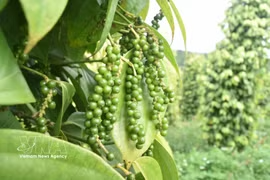
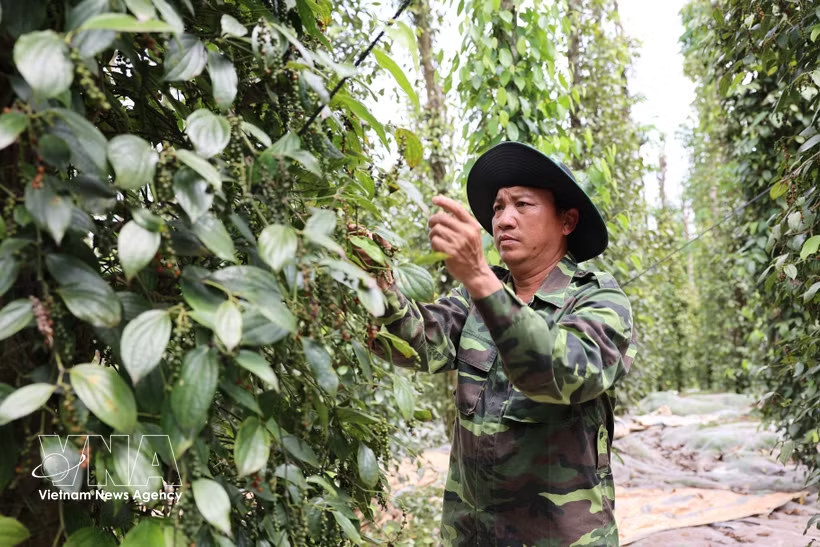
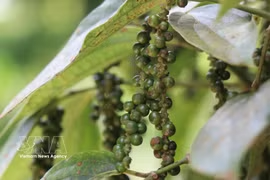
Harvesting pepper in Ho Chi Minh City (Photo; VNA)

Ho Chi Minh City (VNA) - Vietnam shipped 22,743 tonnes of pepper in July, raking in 147.3 million USD, marking a modest 1.6% drop in volume and 2.6% slide in value from June, but an 8.8% year-over-year volume jump, according to the Vietnam Pepper and Spice Association (VPSA).

During January-July, the country exported 168,429 tonnes of pepper worth 1.087 billion USD, a 16.1% surge in volume and a 10.1% climb in value compared to the same period last year.

Asia remained the top buyer, soaking up 76,845 tonnes, a 12.3% year-over-year rise that grabbed 45.6% of total exports. The America took 45,470 tonnes, rocketing 34% higher for a 27% share. Europe imported 36,140 tonnes, up 7.5% and claiming 21.5%, while shipments to Africa rose 10% to 9,964 tonnes.

Zooming in, the US held firm as the single biggest market, buying 40,712 tonnes and notching a 31.8% year-over-year gain. China followed with 17,110 tonnes, up 55.8%, the Netherlands with 6,136 tonnes, up 48.8%, and Thailand with 6,913 tonnes, soaring 88.7%. On the flip side, exports to Germany tumbled 18.1%, while those to India slid 26.4%.

On the import front, Vietnamese companies brought in 3,614 tonnes of pepper valued at 21.6 million USD in July, a steep decline from June but still a 13.8% year-over-year volume hike. Over the first seven months, pepper imports totaled 48,812 tonnes valued at 279.3 million USD, leaping 55.1% in volume and 43% in value from the same period in 2025. Cambodia dominated as the top supplier, shipping 25,413 tonnes, up a staggering 256.9% and accounting for 52.1% of all inbound pepper.

The numbers confirm that beyond just growing pepper, Vietnam is rapidly cementing its role as a processing and trading hub for value-added products in the global supply chain.

While pepper roared ahead, cinnamon showed signs of cooling. July saw 11,788 tonnes of cinnamon exported for 30.3 million USD, down 6.5% in volume and 5.1% in value from the previous month, though still up 13.6% in volume year-over-year. Over January-July, cinnamon exports reached 73,085 tonnes worth 186.5 million USD, slipping a slight 1% in volume and 0.6% in value compared to a year earlier.

Asia continued to dominate cinnamon purchases with 50,085 tonnes, or 68.5% of all exports, but that figure fell 9.1% year-over-year. In contrast, shipments to the America hit 15,108 tonnes, surging 32.8%; Europe bought 5,644 tonnes, up 1.6%; and Africa absorbed 2,248 tonnes, a 28.3% leap.

India stood as the top individual cinnamon buyer, taking 29,530 tonnes, or 40.4% of total exports though that was down by 0.9%. The data signals clear room to grow cinnamon sales in the America and Africa, especially as Asian demand softens.

Star anise faced a bumpier road. Vietnam exported 1,191 tonnes worth 4.8 million USD in July, down 19.2% in volume and 19% in value from June, but up a blistering 97.8% in volume year-over-year. For the first seven months, star anise exports totaled 8,434 tonnes valued at 33.4 million USD, declining 9.1% in volume and 6.2% in value from the same period a year ago.

Asia remained star anise’s main outlet with 6,474 tonnes, or 76.8% of exports, though that represented an 18.4% drop. India alone imported 5,220 tonnes, equivalent to 61.9% of the total but that was a 25.2% contraction.
vnanet-v.jpg
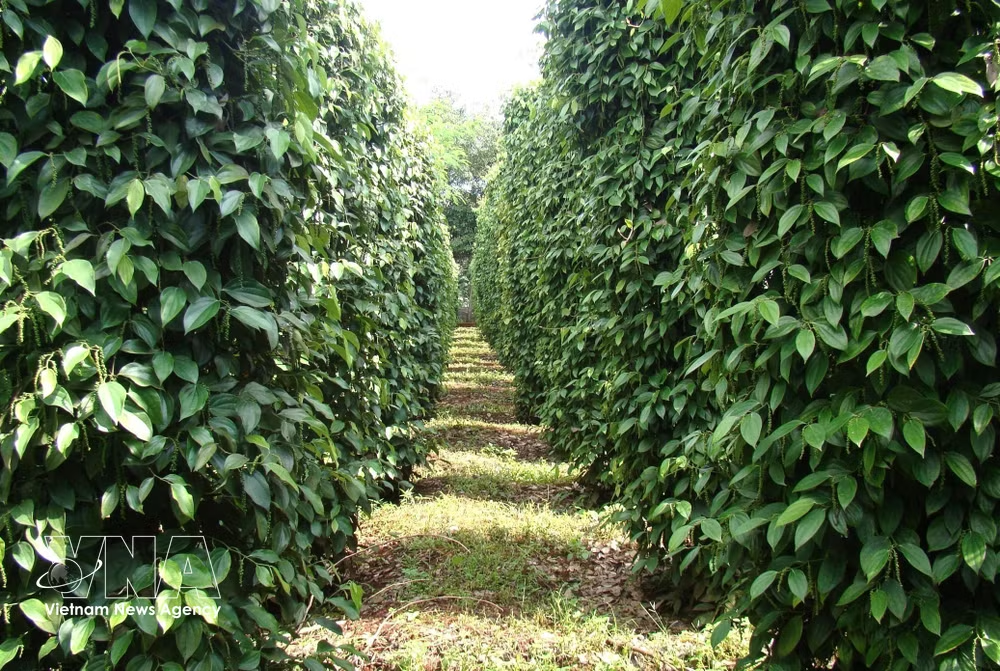
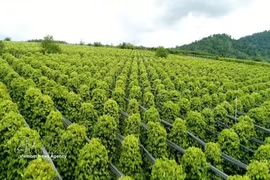
A pepper farm in Gia Lai province (Photo: VNA)

In a sharp contrast, star anise shipments to the America climbed 33.2% to 1,280 tonnes, and exports to Europe soared 81.9% to 633 tonnes. The trend pointed to swelling demand outside traditional Asian markets, offering companies a clear lane to diversify and cut their reliance on traditional buyers.

VPSA Chairman Le Viet Anh said pepper prices should hold steady in the near term barring any major geopolitical shocks. US-bound pepper exports are expected to remain stable over the medium and long haul.

A bright spot emerged on the regulatory front as EU warnings tied to Vietnamese pepper and spices fell from 34 cases in the first half of 2025 to 22 in the same period of 2026. For pepper alone, alerts dropped from five to three. That progress underscores real improvements in quality control, pesticide residue management, and compliance awareness among farmers and exporters.

Longer-term, Anh stressed that the industry’s core challenge has shifted. After more than two decades as the world’s top pepper exporter, Vietnam has almost no room left to expand planted acreage. Land is increasingly scarce, other crops compete for space, and new rules, especially the European Union Deforestation Regulation (EUDR), are piling on tougher requirements.

The pepper sector can no longer bet on higher output or low pricing. Instead, it must pivot to a growth engine fueled by quality, branding, and deeper value addition.

The same pivot applies to cinnamon, star anise, and other spices. The VPSA urged companies to ramp up investment in certified raw material zones, tighten partnerships with farmers, enforce stricter pesticide residue controls, build out traceability systems, and hit every technical standard demanded by importing markets.

At the same time, the industry should get ahead of the green consumption wave by embracing regenerative agriculture, circular economy models, lower carbon emissions, and smarter water use./.
VNA

See more

New Zealand apples on sale at a supermarket in Vietnam (Photo: VNA)

Vietnamese consumers develop taste for Australian, New Zealand fruit

According to statistics from the Department of Customs, in the first six months of 2026, Vietnam imported 102.8 million USD worth of fruit, vegetables and flowers from Australia, up 55.7% from the same period last year. Australia's share of total imports rose from 5.5% to 6.51%, highlighting the growing position of the market as a supplier. Imports from New Zealand reached 78.04 million USD, up 20.4% year-on-year.

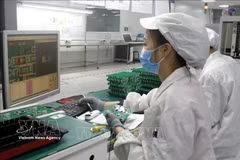
Semiconductor products, chips and components displayed at a ceremony to launch a national centre for semiconductor chip pilot production support in Hanoi on June 26. (Photo: VNA)

US semiconductor push offers Vietnam opportunities, policy challenges

The Vietnam-US semiconductor partnership is therefore not simply a “golden opportunity” arising from geopolitical shifts, but also a long-term test of Vietnam’s institutional reform and implementation capacity. If domestic capacity cannot keep pace, adjusting targets toward quality and execution, rather than simply expanding the number of projects, will be essential.

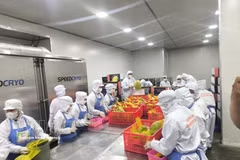
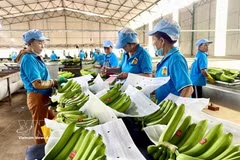
Workers process fruit for export at the Chanh Thu factory in Cho Lach commune, Vinh Long province. (Photo: VNA)

Vietnam works to maintain edge in key agricultural market

According to Le Hang, Deputy Secretary-General of the Vietnam Association of Seafood Exporters and Producers (VASEP), China and Hong Kong (China) remained bright spots for Vietnam’s aquatic exports in July, with revenue exceeding 267 million USD, up 24.7% year-on-year.

An estimated 6,300 workers are needed by the semiconductor industry in Bac Giang province during the 2025-2030 period. (Photo: VNA)

India's semiconductor strategy complementary to Vietnam's chip sector: expert

Sudhanshu Mittal, Director of Engineering Solutions at the National Association of Software and Service Companies (Nasscom) of India, noted that during the state visit to India by General Secretary of the Communist Party of Vietnam Central Committee and President To Lam in May, the two countries signed a number of cooperation agreements, with semiconductors identified as a priority area alongside artificial intelligence (AI), cybersecurity, and advanced technologies.

At the working session between Vietnamese Minister of Finance Ngo Van Tuan (right) and RMIT University’s Vice-Chancellor and President Professor Alec Cameron in Sydney on August 10 (Photo: tapchikinhtetaichinh.vn)

Vietnam, Australia seek to expand investment in rice value chain

During General Secretary of the Communist Party of Vietnam Central Committee and President To Lam’s state visit to Australia from August 9-12, Vietnamese Minister of Finance Ngo Van Tuan, authorised by the General Secretary and President, held working sessions with SunRice Group CEO Paul Serra and RMIT University’s Vice-Chancellor and President Professor Alec Cameron in Sydney on August 10.

Students practice microcontroller programming at the Vietnam-Korea College of Technology in Bac Ninh province (Photo: VNA)

Vietnam – one of most attractive destinations for leading US semiconductor companies: expert

Vietnam has built a solid semiconductor and electronics industry before joining ITSI, attracting major US semiconductor companies. Intel Products Vietnam is one of Intel's largest assembly and testing facilities worldwide, while chip design companies such as Synopsys, Cadence, Marvell and Qualcomm have established engineering and research centres in the Southeast Asian country.

Lawmakers on August 9 discuss a draft law amending and supplementing a number of articles of the Law on the State Bank of Vietnam, the Law on Anti-Money Laundering and the Law on Credit Institutions. (Photo: VNA)

Lawmakers discuss measures to ensure banking system safety, support digital economy

The draft law sets out provisions to control conflicts of interest when commercial banks act as agents managing collateral for corporate bonds. In this regard, Deputy Le Van The of Ninh Binh province said he supported the move, noting that it could provide a more professional approach to collateral management and help strengthen investor confidence if properly regulated.

A company in Da Nang operates a customer relationship management system supported by AI chatbots. (Photo: VNA)

AI drives rise of sleepless enterprises in Vietnam

The concept of a sleepless enterprise does not necessarily mean making employees stay on the job all the time. Instead, it's about building intelligent systems that can respond to customers, process transactions, monitor operations, analyse data and flag risks continuously.

Head of the Vietnam Trade Office in Australia Tran Thi Thanh My (Photo: VNA)

Vietnam, Australia eye 20 bln USD trade target

The head of the Vietnam Trade Office in Australia hoped that the visit by Party General Secretary and State President To Lam will mark a new milestone, opening the door for firms on both sides to forge stronger links and launch concrete cooperation agendas, helping hit that 20 billion USD trade goal sooner rather than later.