Hanoi (VNA) - The US’s strategy to rebuild its semiconductor industry is creating great opportunities for Vietnam to deepen its role in global supply chains, while also clearly highlighting the differences in institutional capacity, resources, and implementation capabilities between Vietnam and more advanced economies.
Semiconductor development strategies are emerging as a central pillar of technological and geopolitical competition among major economies, with the US and its Asian partners playing leading roles. The US CHIPS and Science Act, which provides 52.7 billion USD in semiconductor support alone, is a notable example of combining fiscal policy, tax incentives and economic security tools to restructure supply chains and reduce external dependence.
Of the act’s funding, 52.7 billion USD is earmarked for semiconductors over five years from fiscal 2022. About 39 billion USD supports domestic chip manufacturing and related materials and equipment, 11 billion USD goes to research, development and shared R&D infrastructure, and 2 billion USD supports microelectronics initiatives for defence purposes.
Recent policy proposals of the US have also focused on Section 48D tax credits for advanced semiconductor manufacturing, including higher support and expanded direct-pay mechanisms. Incentives are tied to project commencement and clawback provisions when investment shifts to countries deemed security risks. This combination of tax incentives and security conditions offers a policy lesson for Vietnam, particularly regarding the predictability of the tax framework.
For Vietnam, however, the most important lesson lies not in the scale of US support, but in how difficult it is to turn policy into production capacity.
Despite substantial incentives, major US semiconductor projects have faced delays caused by shortages of skilled workers, infrastructure constraints and limited practical experience in operating sophisticated equipment. McKinsey, SEMI and the US National Science Foundation estimate that the US industry could face a shortage of about 157,000 full-time workers by 2030 under current growth scenarios.
Delays at TSMC’s Arizona fabs and Intel’s Ohio complex further show that even experienced manufacturers cannot eliminate structural risks through financial incentives alone. For Vietnam, this suggests that ambitions to rapidly expand semiconductor manufacturing, particularly fabs, need to be matched with realistic assessments of domestic capacity.
Advanced packaging technology provides another challenge. Key technologies such as CoWoS and HBM remain concentrated mainly in Taiwan (China), the Republic of Korea and other Asian centres. Even when wafers are produced in the US, dependence on Asian packaging capacity limits the supply-chain autonomy the US seeks to build.
This bottleneck also points to an opportunity for Vietnam. Its geographical proximity to major production centres in Asia, large electronics export base and expanding cooperation with the US create favourable conditions for Vietnam to gradually move from an “electronics manufacturing hub” to a mid- and downstream link in the global semiconductor ecosystem, especially advanced testing and packaging (ATP).
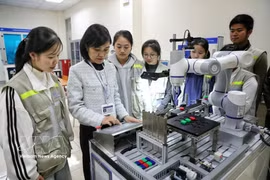
Under the Comprehensive Strategic Partnership with the US, Vietnam is among the key beneficiaries of the ITSI Fund under the US CHIPS and Science Act. A 13.8 million USD grant from the US Department of State to Arizona State University (ASU), together with the operation of the itsi-skillsaccelerator.org portal, aims to support faculty training and enhance Vietnam’s ATP capabilities to international standards. The Developing Electronics & Leading Technology Advancement Partnerships (DELTA) network directly connects Vietnamese supporting industries with US chip designers, helping turn the southeast Asian country’s labour advantages and existing electronics manufacturing base into greater capacity to join more deeply in the semiconductor value chain.
The lesson for Vietnam is therefore to build on areas where it has comparative advantages rather than pursue semiconductor development across the board. Under favourable conditions, Vietnam’s share of global packaging and testing could rise from about 1% currently to 8–9% by 2030, although this will depend heavily on FDI, infrastructure and trade-policy stability.
This points to four key policy priorities for Vietnam - designing incentives around major investment costs rather than relying mainly on tax reductions; treating reliable and clean power for hi-tech zones as strategic infrastructure; linking semiconductor training with talent attraction and retention; and using rare earths as an industrial and negotiating lever alongside deep processing and strong environmental safeguards.
The US experience shows that Vietnam’s semiconductor strategy should be measured not by the number of projects announced, but by its ability to convert policy commitments into sustainable domestic capacity. The Vietnam-US semiconductor partnership is therefore not simply a “golden opportunity” arising from geopolitical shifts, but also a long-term test of Vietnam’s institutional reform and implementation capacity. If domestic capacity cannot keep pace, adjusting targets toward quality and execution, rather than simply expanding the number of projects, will be essential./.
VNA