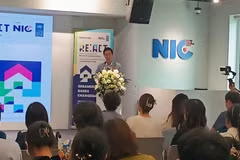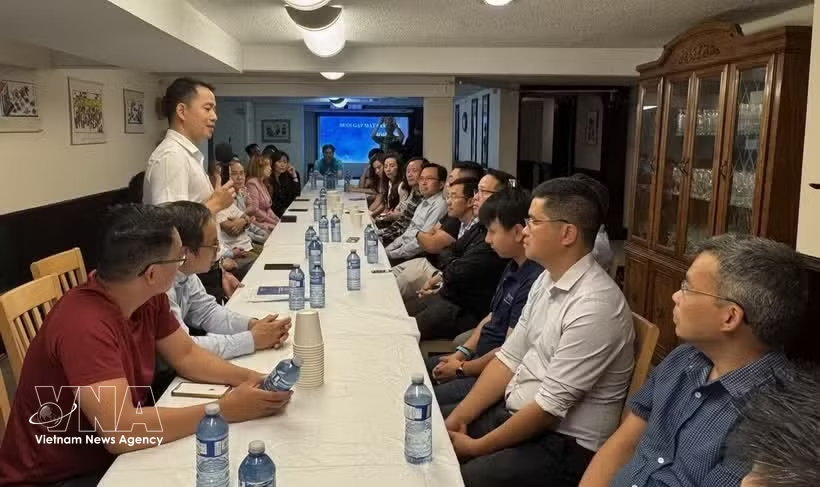
Ottawa (VNA) – Science – technology and innovation are poised to become a new pillar of Vietnam–Canada ties, a recent meeting between the Vietnam Science and Technology Representative Office in Canada and the Canadian Vietnamese Scholars and Experts Network (CVSE) was told.
To turn that potential into action, both countries need to pinpoint areas that can produce concrete projects fast, establish co-funding mechanisms, and leverage the resources and expertise of the Vietnamese community in Canada.
The meeting took place as Vietnam and Canada look to upgrade their relationship after more than half a century of diplomatic ties and nearly a decade of operating under their Comprehensive Partnership framework. The two nations have already built a solid foundation in politics, the economy, education and people-to-people exchanges. Their Prime Ministers recently agreed to pursue an early upgrade of bilateral ties and identified new cooperation areas, including artificial intelligence, quantum technology, semiconductors, energy, the green economy and aerospace.
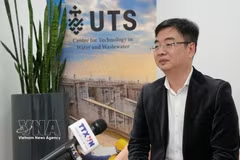
Speaking to Vietnam News Agency reporters based in Ottawa, CVSE Chairman Assoc. Prof. Vu Viet Hung called clean energy an area where Vietnam can move immediately with Canada.
He noted that Canada is an energy powerhouse armed with strengths in clean technology, energy efficiency, environmental technology and emissions reduction solutions. It is also stepping up market diversification, hunting for new partners beyond the US, and pouring major resources into research, development and technology commercialisation.
Vietnam, meanwhile, faces surging demand for energy transition, lower production costs, climate adaptation and compliance with carbon standards in top export markets. The collision of Canada’s technological firepower and Vietnam’s development needs could open the door for highly practical joint projects, Hung said.
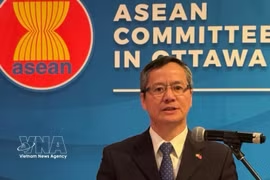
Le Quoc Dung, head of the representative office in Canada, stressed the need for specific pilot projects such as “green factories” or “green agricultural processing” facilities inside Vietnam within 12 to 18 months. Vietnamese firms could provide sites, identify needs and directly deploy technologies while Canadian companies supply solutions for energy, water and waste management or emissions measurement. Universities and technical bodies from both countries would evaluate the results.
Project success, Dung argued, must be measured by hard numbers, including reductions in electricity and water consumption, cuts in emissions, operating cost savings, the model’s scalability, and the volume of commercial contracts, technology licensing deals or purchase orders generated after the pilot phase.
This approach would drag sci-tech cooperation beyond workshops, delegation exchanges and memoranda of understanding and into the creation of tangible products and real economic value, he added.
Alongside clean energy, Hung identified aerospace as a long-term strategic area. Canada’s commitment to promoting peace, security and stability in the Indo-Pacific gives Vietnam an opening to drive cooperation in civilian and dual-use technologies.
The two sides could cooperate in satellites, remote sensing, Earth observation, disaster early warning, airspace and maritime surveillance, maritime security and resource management, he said, adding that Vietnam could connect with Canadian corporations and agencies such as Telesat, MDA, Transport Canada, NAV CANADA and the National Research Council to gain experience in space infrastructure, unmanned aircraft management, planning, standards, testing and safety certification.
To lay a financial and institutional foundation for joint projects, Dung proposed creating an innovation co-funding mechanism between Vietnam’s National Innovation Centre (NIC) and Innovation, Science and Economic Development Canada (ISED), together with relevant agencies.
The mechanism could run on a “two focal points, one project portfolio” model, without immediately requiring a new administrative structure or a fixed headquarters. Vietnamese or Canadian companies could propose projects, provided they have a substantive partner in the other country. They would be responsible for identifying market demand and driving commercialisation while universities, tech centres and scientists would handle research, development and solution testing.
A distinct advantage in Vietnam–Canada ties is the nearly 300,000-strong Vietnamese-origin community, including many professors, scientists, engineers and tech entrepreneurs. Hung said the CVSE could serve as an advisory and connecting platform and contribute to the 10 strategic technology groups Vietnam has mapped out.
With experts already working in semiconductors, AI, biotechnology, energy and aerospace, the network could help Vietnam identify partners, vet technologies, give feedback on training courses, link laboratories and accelerate the transfer of research results.
However, Hung cautioned that the expert community’s ability to deliver would depend heavily on macro-level commitments and the specific cooperation agendas hammered out by the two countries’ leaders. Rather than simply pooling experts for one-off exchanges or seminars, assignments should come with concrete deadlines, funding, responsibilities and deliverables.
The 2026–2028 Action Plan adopted at the third meeting of the Vietnam–Canada Joint Economic Committee has already placed hi-technology, innovation, digital transformation, energy and green growth among priority areas. That provides the basis for turning science – technology from an area of high potential into a pillar backed by dedicated programmes, resources and coordination mechanisms, according to the expert./.