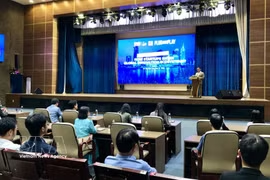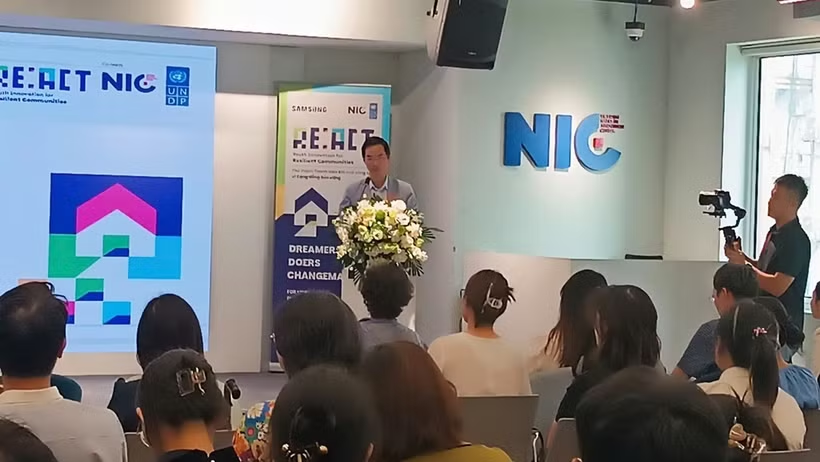
Hanoi (VNA) – The Vietnam National Innovation Centre (NIC), in partnership with the United Nations Development Programme (UNDP) in Vietnam and Samsung, launched RE:ACT – a youth innovation challenge for sustainable communities – in Hanoi on August 7.
The programme aims to identify and support youth-led solutions to real-world community challenges across the country. Through the initiative, young innovators will receive support to develop their ideas, test their solutions in real-life settings, and create lasting, positive impacts for society.
Unlike conventional idea-based competitions, RE:ACT focuses on deploying solutions that have already reached the minimum viable product stage through Living Labs – community-based pilot environments where innovations are tested under real-world conditions.
At the launch, NIC Deputy Director Do Tien Thinh said that as Vietnam speeds up science – technology development, innovation, and digital transformation, it is important to create practical ways to turn innovative ideas into real-world applications. He stressed young people are the driving force behind innovation and that the programme is designed to move beyond paper-based competitions by bringing solutions directly into communities through the Living Labs model, helping prevent promising ideas from becoming "shelved projects".
As the agency responsible for promoting Vietnam's national innovation ecosystem, NIC expects RE:ACT to support youth-led initiatives throughout the entire innovation journey – from identifying problems and generating ideas to developing prototypes, piloting them in real-world settings, and refining them for practical application, Thinh said.
Participating teams will focus on solutions in two key areas: inclusive economy, including bridging the digital divide and supporting people with disabilities, and sustainable community development such as energy conservation, safe chemical management, and the circular economy.
Following the application period, which runs until September 15, organisers will select 20 teams to join a six-month mentoring and pilot programme. In addition to receiving grants of up to 15,000 USD per team, participants will benefit from monthly mentoring by technology experts and access to a network of partner organisations.
As the initiator and implementing partner of RE:ACT, UNDP in Vietnam remains committed to promoting people-centred innovation for sustainable development while ensuring that no one is left behind, said Francesca Nardini, Deputy Resident Representative at UNDP Vietnam.
Pham Thu Trang, UNDP Vietnam's National Youth Coordinator, noted that alongside the pilot phase, representatives of the most outstanding teams will join a study visit to the Republic of Korea's innovation ecosystem in February and March 2027.
Trang said the greatest value for participating start-ups lies not only in the seed funding of up to 15,000 USD, but also in the opportunity to connect with a network of experts who can help bring their products into practical use.
Eligible teams would have one to five members, with founders, co-founders, or key members aged between 18 and 35, and at least one founding member being a Vietnamese citizen. Entries will be assessed against six criteria: relevance to community needs, solution readiness, technology and innovation, impact potential, feasibility, and team capability./.
See more
Vietnam approves national programme on strategic technologies
The programme seeks to master, develop, perfect and commercialise highly competitive strategic technology products, with priority given to core technologies. It also aims to build a strategic technology ecosystem and strengthen linkages among the State, businesses and science and technology organisations.
FPT named an OpenAI Select Partner
Under the partnership, FPT and OpenAI will work together to help businesses develop AI transformation roadmaps, build AI platforms, strengthen workforce capabilities and deploy responsible AI solutions tailored to their operational needs.
Vietnam draws hyperscalers, cloud titans, AI players
These developments highlight growing confidence in Vietnam as a destination for hyperscale, cloud, and AI infrastructure. The broader digital infrastructure ecosystem also strengthened during the period.
Da Nang seeks to become a strategic investment destination
Da Nang is accelerating efforts to attract investment and mobilise social resources for new development models, leveraging expanded development space, special policy mechanisms and institutional reforms to position itself as a strategic investment destination and a pioneer in Vietnam's economic growth in the new era.
PM urges stronger coordination in cybersecurity response
PM Le Minh Hung pushed for the Regional Counter Cybercrime Hub for Asia-Pacific to be put into operation in 2027, a “Cybersecurity Economy” initiative to be prepped for APEC 2027, stronger specialised cybersecurity agencies, and an expansion of the national cybersecurity operations centre by the second quarter of 2028.
Israeli expert suggests Vietnam prioritise chip design, talent development
Drawing on Israel’s experience, Mel Shalev said Vietnam should focus on developing talent, scientific research, and chip design capabilities instead of rushing into building fabrication facilities.
Trust emerges as one of modern cybersecurity’s biggest challenges
Speaking at the event, VSEC Chairman Truong Duc Luong said this was the second time BSides has been held in Hanoi, continuing to attract strong interest from the cybersecurity community. BSides Hanoi 2026 was designed as a platform connecting Vietnam’s cybersecurity community with international networks, encouraging knowledge sharing and contributing to the sustainable development of the cybersecurity ecosystem.
Hai Phong promotes int’l cooperation in technology transfer, business innovation
Nguyen Cao Thang, Director of the municipal Department of Science and Technology, said the city is accelerating its development strategy based on science, technology and innovation in line with the Politburo's Resolution No. 57-NQ/TW.
Vietnam positioned to harness AI wave, World Bank report says
The WB report identifies Vietnam as one of the few economies outside the European Union (EU) to have adopted a comprehensive AI regulatory framework as early as 2025. Vietnam applies a risk-tiered approach similar to that of the EU AI Act, imposing different obligations depending on whether an AI system poses “unacceptable,” “high,” “low” or “minimal” risks. The approach is viewed as a strategic step towards ensuring safe and transparent AI governance.
Construction sector advances digital transformation with integrated data ecosystem
As digital transformation becomes a key growth driver, the construction sector has come under increasing pressure to modernise its management model to keep pace with the rapid expansion of transport infrastructure, urbanisation and the real estate market.
Politburo’s Resolution 57-NQ/TW powers new growth momentum
NSO Director Nguyen Thi Huong said alongside foreign investment and the green economy, science – technology, innovation, the digital economy and digital transformation are the new drivers that can can pack a serious second-half punch.
Drastic measures taken to turn Resolution 57 into action
A recent meeting of the Central Steering Committee on science, technology, innovation and digital transformation, chaired by Party General Secretary and State President To Lam, marked a new phase in implementing Resolution 57 following the committee’s restructuring.
Bac Ninh targets world's top 50 smart cities by 2030
According to Chairman of the provincial People's Committee Pham Hoang Son, the province will pursue a people-centred smart city model driven by science, technology, innovation and digital transformation to improve public services, urban management and competitiveness.
Vietrade signs cooperation agreement with Meta to support SMEs
Under the agreement, the two sides will share expertise on trade promotion and digital tools, coordinate programmes supporting small and medium-sized enterprises (SMEs), and jointly organise promotional and communication activities.
France-based expert offers strategic insights for Vietnam’s semiconductor development
Dr Nguyen Van Minh, Founding Head, Hardware-Efficient AI & AI-Native Wireless, at Huawei’s Research Centre in France, suggested that Vietnam shift its focus from strategic planning to implementation.
Vietnam expected to fast-track mastery, rollout of 6G technology
Vietnam has so far deployed more than 40,000 5G base transceiver stations (BTSs), providing coverage for about 92% of the population, making it one of the world's fastest countries in this regard. By comparison, many advanced economies typically take two to three years to extend 5G coverage to more than 80% of their populations.
Vietnam strengthens legal framework to accelerate comprehensive digital transformation
July marked an important milestone in the country's digital transformation journey, with a series of new policies, strategies and technical standards introduced to support the Law on Digital Transformation and speed up implementation nationwide.
Deputy PM chairs meeting on establishment of Hung Yen High-Tech Park
Chairman of the Hung Yen provincial People’s Committee Nguyen Manh Quyen said the proposed high-tech park will cover about 496.1 hectares in Hoan Long and Viet Yen communes. The location is expected to attract high-quality talent and innovation resources from Hanoi while strengthening production and logistics links across the Northern Key Economic Region, including Bac Ninh, Hai Phong, Quang Ninh, Phu Tho and Ninh Binh.
Investing in core capabilities key to elevating Vietnam's semiconductor industry: expert
Vietnam's ultimate goal should not simply be to establish a presence in the semiconductor industry, but to gradually master high-value, knowledge-intensive segments of the value chain and become a key link in the global semiconductor supply chain. This would provide a launch pad for strengthening the country's competitiveness in artificial intelligence, electronics and the digital economy.
Building a digital ecosystem for foreigners in Vietnam
Registering residence, applying for an electronic visa (e-Visa), obtaining an electronic identity account or completing administrative procedures online can now all be done conveniently in the digital environment. For many foreigners, these changes have made it easier to enter, live and work in Vietnam while also reflecting the initial results of implementing the Politburo's Resolution No. 57.