Israeli expert suggests Vietnam prioritise chip design, talent development

Drawing on Israel’s experience, Mel Shalev said Vietnam should focus on developing talent, scientific research, and chip design capabilities instead of rushing into building fabrication facilities.

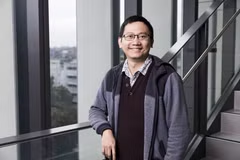
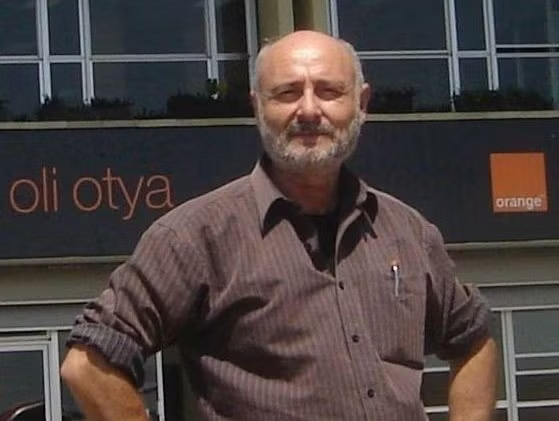
Israeli technology expert Mel Shalev (Photo published by VNA)

Tel Aviv (VNA) – Focusing on chip design and talent development, instead of rushing into semiconductor manufacturing, is the best approach for Vietnam to join the global semiconductor supply chain, says Israeli technology expert Mel Shalev.

In an interview granted to the Vietnam News Agency, Shalev, a former senior technology specialist with more than 40 years of experience, including 37 years at IBM, shared Israel’s experience in developing its semiconductor industry and discussed prospects for high-tech cooperation between the two countries.

He noted that Israel hosts more than 250 semiconductor companies, most being quite small and highly specialised. Intel and Nvidia are major employers in the sector, which accounts for nearly 8% of the country’s technological workforce. The country now has around 32,000 engineers, including 10,000 software specialists, along with some 2,500 scientists and 10,500 technicians.

Shalev said Israel’s focus is shifting from Intel-led manufacturing/research and development (R&D) towards artificial intelligence (AI), high-speed networking and data centre chips, areas where Nvidia is strong at.

Israel’s original motivation to invest in the semiconductor industry was a mixture of two compelling strategic necessities: defence and defence export economics, he said, adding that while there was no plan to make Israel a global semiconductor power or hub, the sector evolved from several converging pressures and opportunities.

The defence-electronics ecosystem created the demand, the engineers, the universities, and the industrial culture that made semiconductors a natural choice. Israeli defence R&D had an outsized effect on the country's semiconductor technological and industrial capabilities, including its supply of scientists and engineers.

While a fab that requires billions of US dollars, water, power, infrastructure, and long-term state incentives, design centres are much less capital-intensive than fabs. Given this, Israel used fabs sparsely as anchors and in parallel, ramped up the sector mainly through design, verification, embedded software, communications chips, AI accelerators, and specialty semiconductors.

Drawing on Israel’s experience, he said Vietnam should focus on developing talent, scientific research, and chip design capabilities instead of rushing into building fabrication facilities.

On bilateral cooperation, Shalev identified research, talent development, and technology transfer as three priority areas.

He suggested Vietnam expand partnerships with leading Israeli universities, including the Technion, Tel Aviv University, and the Hebrew University of Jerusalem, while promoting joint research programmes with Vietnamese institutions.

The expert voiced his belief that technology transfer will be the natural next step to successful joint talent development and joint research.

Shalev also highlighted promising cooperation in medical devices, electric vehicles (EVs), smart agriculture, financial technology, and defence technology.

Among these, he described EVs as the most promising field, noting that Vietnam has a rapidly growing EV ecosystem while Israel has strong automotive R&D capabilities.

He cited Israeli company REE Automotive, which has developed a modular EV platform featuring a flat bottom chassis on which different (initially commercial) vehicle bodies can be mounted. Its key innovation is a wheel module combining steering, braking, suspension, powertrain and control into compact units near the wheels. This "roll by wire" architecture enables considerable freedom of body design.

Electric aviation is another area with strong potential, with companies such as Israel Aerospace Industries, AIR, and Eviation identified as potential partners for future joint research and development, according to the expert.

Regarding the Vietnam–Israel Free Trade Agreement (VIFTA), Shalev described the agreement as an important milestone that enhances the confidence and trust needed to initiate major joint development projects.

Beyond high technology, he said the agreement also opens up opportunities in tourism and agriculture. Israelis of all generations, especially the generation of young adults, are inveterate travellers, and Vietnam offers many choices to these active travellers. Meanwhile, there is much room for Vietnam's expansion of coffee, seafood, and agricultural products to Israel while deepening cooperation in agricultural technology.

He added that improving logistics links, particularly maritime routes connecting Vietnam with Israel’s Port of Eilat, will reduce transport costs and further strengthen bilateral economic ties./.

VNA

See more

An overview of BSides Hanoi 2026 on August 5 (Photo: baodautu.vn)

Trust emerges as one of modern cybersecurity’s biggest challenges

Speaking at the event, VSEC Chairman Truong Duc Luong said this was the second time BSides has been held in Hanoi, continuing to attract strong interest from the cybersecurity community. BSides Hanoi 2026 was designed as a platform connecting Vietnam’s cybersecurity community with international networks, encouraging knowledge sharing and contributing to the sustainable development of the cybersecurity ecosystem.

AI Day 2026 product showcase area. (Photo: VNA)

Vietnam positioned to harness AI wave, World Bank report says

The WB report identifies Vietnam as one of the few economies outside the European Union (EU) to have adopted a comprehensive AI regulatory framework as early as 2025. Vietnam applies a risk-tiered approach similar to that of the EU AI Act, imposing different obligations depending on whether an AI system poses “unacceptable,” “high,” “low” or “minimal” risks. The approach is viewed as a strategic step towards ensuring safe and transparent AI governance.

Thai Binh Seed Group JSC is one of Vietnam’s leading crop seed producers, holding rights for 30 varieties and operating three globally certified plants. (Photo: VNA)

Politburo’s Resolution 57-NQ/TW powers new growth momentum

NSO Director Nguyen Thi Huong said alongside foreign investment and the green economy, science – technology, innovation, the digital economy and digital transformation are the new drivers that can can pack a serious second-half punch.

Research lab of the Vietnam National University Ho Chi Minh City. (Illustrative photo published by VNA)

Drastic measures taken to turn Resolution 57 into action

A recent meeting of the Central Steering Committee on science, technology, innovation and digital transformation, chaired by Party General Secretary and State President To Lam, marked a new phase in implementing Resolution 57 following the committee’s restructuring.

A view of Kinh Bac Ward in Bac Ninh Province. (Photo: VNA)

Bac Ninh targets world's top 50 smart cities by 2030

According to Chairman of the provincial People's Committee Pham Hoang Son, the province will pursue a people-centred smart city model driven by science, technology, innovation and digital transformation to improve public services, urban management and competitiveness.

Illustrative photo: VNA

Vietnam expected to fast-track mastery, rollout of 6G technology

Vietnam has so far deployed more than 40,000 5G base transceiver stations (BTSs), providing coverage for about 92% of the population, making it one of the world's fastest countries in this regard. By comparison, many advanced economies typically take two to three years to extend 5G coverage to more than 80% of their populations.

Deputy Prime Minister Ho Quoc Dung chairs the meeting in Hanoi on July 31 to discuss the establishment of a high-tech park in the northern province of Hung Yen. (Photo: VNA)

Deputy PM chairs meeting on establishment of Hung Yen High-Tech Park

Chairman of the Hung Yen provincial People’s Committee Nguyen Manh Quyen said the proposed high-tech park will cover about 496.1 hectares in Hoan Long and Viet Yen communes. The location is expected to attract high-quality talent and innovation resources from Hanoi while strengthening production and logistics links across the Northern Key Economic Region, including Bac Ninh, Hai Phong, Quang Ninh, Phu Tho and Ninh Binh.

Dr Nguyen Minh Triet, Chair of Academic Council at the Vietnam Australia Innovation Network (NIC AU) and a research engineer at Archer Materials in Australia (Photo published by VNA)

Investing in core capabilities key to elevating Vietnam's semiconductor industry: expert

Vietnam's ultimate goal should not simply be to establish a presence in the semiconductor industry, but to gradually master high-value, knowledge-intensive segments of the value chain and become a key link in the global semiconductor supply chain. This would provide a launch pad for strengthening the country's competitiveness in artificial intelligence, electronics and the digital economy.

Building a digital ecosystem for foreigners in Vietnam

Building a digital ecosystem for foreigners in Vietnam

Registering residence, applying for an electronic visa (e-Visa), obtaining an electronic identity account or completing administrative procedures online can now all be done conveniently in the digital environment. For many foreigners, these changes have made it easier to enter, live and work in Vietnam while also reflecting the initial results of implementing the Politburo's Resolution No. 57.

Deputy Prime Minister Ho Quoc Dung (right) receives Linda Tan, President of the Southeast Asia Semiconductor Association. (Photo: VNA)

Vietnam, Southeast Asia Semiconductor Association deepen semiconductor cooperation

Welcoming the SEMI Southeast Asia delegation, Deputy Prime Minister Ho Quoc Dung commended the association and its members for supporting Vietnamese ministries and agencies in advancing cooperation in science, technology, innovation and digital transformation, which he described as key drivers of the country's next phase of economic growth.

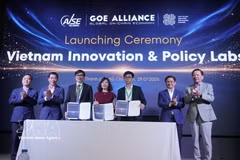
Representatives of participating organisations sign an agreement and officially launch the Vietnam Innovation & Policy Labs, an independent policy research and advisory organisation, at the Vietnam Global Innovation Connect (VGIC) 2026 in Ho Chi Minh City on July 29. (Photo: VNA)

Technology, talent to drive Vietnam’s digital leap forward: forum

The Vietnam Global Innovation Connect (VGIC) 2026 serves as a platform for dialogue among policymakers, enterprises, startups, investors and the global Vietnamese expert community to transform knowledge, technology and resources into practical initiatives and projects that contribute to the country's development.

Delegates mark the launch of Gia Lai Quantum Year 2026. (Photo: VNA)

Gia Lai launches Quantum Year 2026

Held under the theme "Quantum Connectivity – Mastering Technology – Breakthrough Development", Quantum Year 2026 centres on four pillars: science, technology, education and training, and innovation ecosystem development.

AI offers both opportunities, challenges for Vietnam’s growth

AI offers both opportunities, challenges for Vietnam’s growth

Dr. Ho Duc Thang, a full-time member of the National Assembly’s Committee for Cultural and Educational, said productivity is the key to sustaining double-digit economic growth, and AI has greater potential to improve productivity than any previous technology.