Vietnam launches first semiconductor chip manufacturing plant

The plant, developed by Viettel Group in line with the mission assigned by the Ministry of Defence and based on the government’s resolution, is located on a 27-hectare site within the Hoa Lac High-Tech Park and is expected to serve national industries such as aerospace, telecommunications, Internet of Things (IoT), automotive manufacturing, medical equipment, and automation.

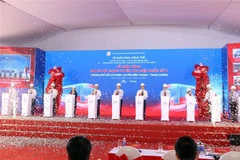
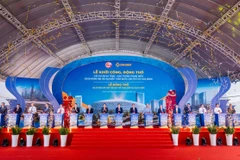
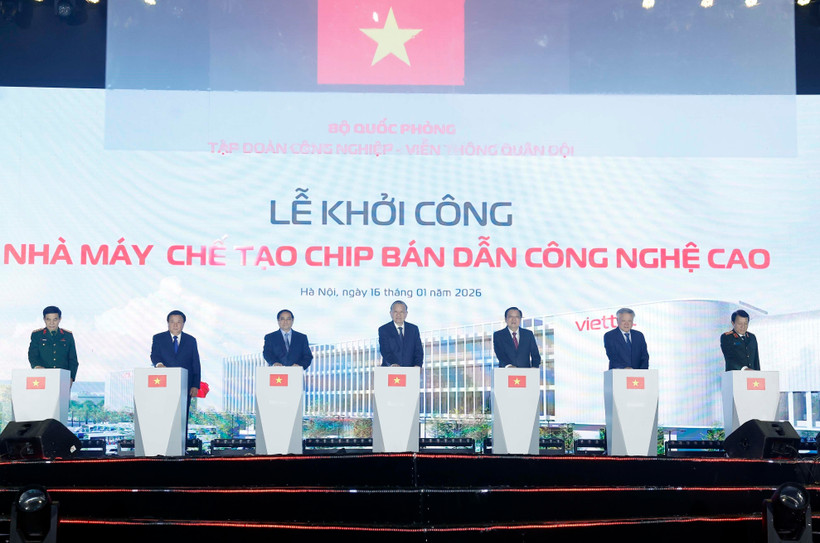
Party General Secretary To Lam (C) and Prime Minister Pham Minh Chinh (third from left) and other delegates break ground Vietnam’s first semiconductor chip manufacturing plant (Photo: VNA)

Hanoi (VNA) – Party General Secretary To Lam and Prime Minister Pham Minh Chinh on January 16 attended the ground-breaking ceremony of Vietnam’s first semiconductor chip manufacturing plant, part of a series of works in celebration of the upcoming 14th National Party Congress.

The event, held at the Hoa Lac High-Tech Park in Hanoi, marks the country’s first step toward building domestic capabilities in semiconductor chip manufacturing, laying the foundation for long-term technology mastery and the development of a semiconductor ecosystem.

The plant, developed by Viettel Group in line with the mission assigned by the Ministry of Defence and based on the government’s resolution, is located on a 27-hectare site within the Hoa Lac High-Tech Park and is expected to serve national industries such as aerospace, telecommunications, Internet of Things (IoT), automotive manufacturing, medical equipment, and automation. The plant’s establishment represents a critical leap in Vietnam's ambition to master core technologies and join the global semiconductor supply chain.

Speaking at the ceremony, PM Chinh underscored the profound significance of the plant, describing it as not merely an investment project but as a strategic initiative, demonstrating Vietnam's determination to actively and practically participate in the global semiconductor value chain, and aiming to achieve the goals set forth in the Vietnam Semiconductor Industry Development Strategy by 2030, with a vision to 2050.

He emphasised that semiconductor chips, though small in size, play a decisive role in national power across various dimensions: economic, industrial, and defence-security capabilities.

The global semiconductor industry, now valued at approximately 2.3 trillion USD, has been not merely an economic sector but has evolved into a matter of geopolitics, national security, and a symbol of technological power for each nation. Those that lack domestic semiconductor production capacity face significant strategic vulnerabilities, limiting their economic development and national security, he noted.

Vietnam’s participation in the global semiconductor value chain has already seen significant progress. The country has developed a strong ecosystem of semiconductor design companies, with nearly 60 firms, including 13 domestic enterprises. Vietnam is now the third-largest exporter of chips to the US, a testament to its growing prominence in the semiconductor industry.

The ground-breaking of the plant marks a significant milestone, affirming that Vietnam is fully capable of gradually mastering high-end technology. This development completes a critical link in the semiconductor value chain - the manufacturing of chips - signifying a shift from participation to mastery, from assembly to innovation, thus contributing to enhancing Vietnam's capabilities and global standing in the digital age, PM Chinh stressed.

The Government leader outlined a clear vision for the future, stressing the need for comprehensive and coordinated efforts between the government, businesses, and academia to ensure success in this ambitious project. By 2030, Vietnam aims to have at least 100 semiconductor design companies and one semiconductor chip manufacturing plant, as well as 10 assembly and testing facilities.

The country will focus on developing both the quantity and quality of its semiconductor workforce, ensuring sufficient manpower for all stages, from design and manufacturing to packaging, testing, and research and development. The goal is to train over 50,000 engineers and graduates by 2030 and prepare a high-quality workforce for the period from 2030 to 2050. By 2030, the semiconductor industry aims to achieve annual revenues exceeding 25 billion USD, with added value in Vietnam ranging from 10-15%. The electronics industry is set to surpass 225 billion USD in annual revenue.
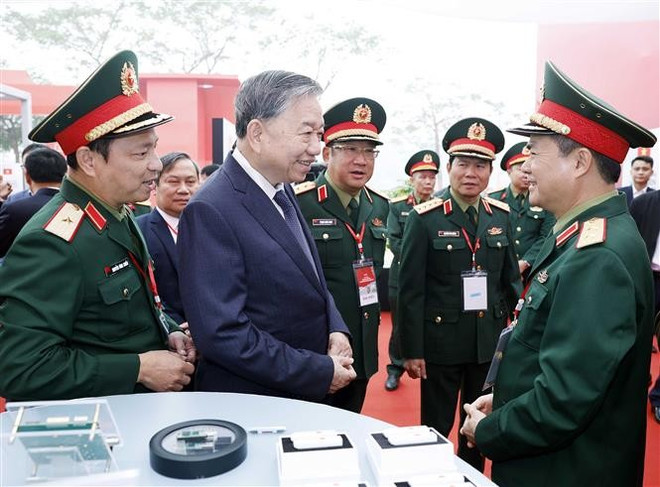
to-lam.jpg
Party General Secretary To Lam visits the exhibition area at the ground-breaking ceremony. (Photo: VNA)

Lieut. Gen. Tao Duc Thang, Chairman and General Director of Viettel, said the group will move swiftly to implement the project following the groundbreaking, with the aim of completing construction, receiving technology transfer and beginning trial production by the end of 2027.

From 2028 to 2030, the project will focus on completing and optimising processes and improving production-line efficiency to meet industry standards, laying the groundwork for research into more advanced chipmaking technologies./.

VNA

See more

Vietnam’s cashew exports in 2025 are estimated at 766,600 tonnes, generating more than 5.2 billion USD (Photo: VNA)

Cashew sector faces economic efficiency challenge despite high export revenue

Vietnam’s cashew industry has faced a pressing challenge despite an export revenue of over 5 billion USD for the first time in 2025, as this impressive figure has yet to translate into commensurate economic efficiency for exporting enterprises, especially when the industry seeks to ensure that its position as the world’s leading cashew exporter is matched by sustainable profitability.

Deputy Director General of Vietnam National Authority of Tourism Nguyen Thi Hoa Mai (centre) chairs an online meeting on the organisation of ITE HCMC 2026. (Photo: TITC)

International Travel Expo HCM City 2026 set for August

The expo will feature key activities including on-site and online exhibition booths; a digital business-to-business (B2B) buyer–seller matching programme; Vietnam Night; the opening ceremony; programmes for international buyers and media representatives; forums and thematic seminars introducing key source markets and emerging tourism trends; and a tourism consumer festival.

An illustrative image showing a Crystal Bay Airlines plane. (Photo: dantri.com.vn)

New Vietnamese airline takes off with charter capital of 11.4 million USD

According to the company's registration documents, Crystal Bay Airlines Joint Stock Company was established on November 6, 2025, with a charter capital of 300 billion VND (11.4 million USD). The firm operates in 51 business sectors, with its main focus being air passenger transportation.

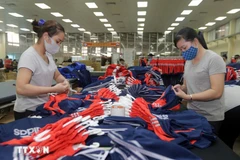
Garment production for export at the Thai Nguyen Garment Company. (Photo: VNA)

Spring Fair 2026 strengthens Vietnam – India cooperation

The seminar aimed to help the Indian business community gain a clearer understanding of the scale, role and potential of the Spring Fair 2026 one of Vietnam’s major trade promotion events hosted by the Government and the Ministry of Industry and Trade.

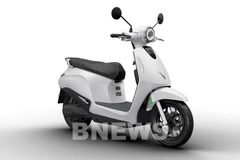
VinFast Evo battery-swap electric motorbike (Photo: VNA)

VinFast rolls out four new electric motorbike models

The automaker introduced three battery-swappable models, Evo, Feliz II and Viper, designed for different customer segments. It also launched the Amio, a compact pedal-assisted model that does not require a driving licence, aimed primarily at students and short-distance urban commuters.

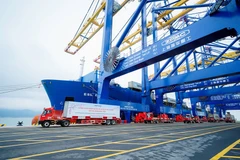
Handling export cargo at Lach Huyen Port, Hai Phong city. (Photo: hanoimoi.vn)

Internal strength crucial for building export resilience

In the new era, strengthening domestic capacity will be crucial to ensuring that Vietnam’s exports grow not only rapidly, but also sustainably, contributing meaningfully to the country’s development aspirations in the new era.

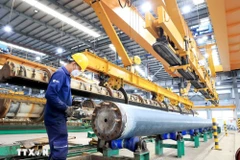
Production activities at a centrifugal concrete pillar manufacturing plant (Photo: VNA)

Rising FDI, investor optimism reinforce Vietnam’s appeal for inflows

Commenting on Vietnam’s FDI performance in 2025, Dr. Nguyen Quoc Viet, a public policy expert at the University of Economics under the Vietnam National University, Hanoi, said that the strong growth in disbursed capital, particularly additional funding for ongoing projects, reflects sustained confidence among international investors.

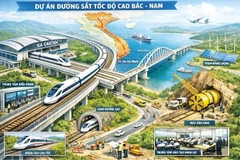
An illustration of the North-South high-speed railway project (Image created by AI)

Vietnam fast-tracks key national railway projects

With the completion of a key legal framework, Vietnam's major national railway projects have kicked off the new year of 2026 with an accelerated implementation phase, notably the North-South high-speed railway and the Lao Cai-Hanoi-Hai Phong railway line

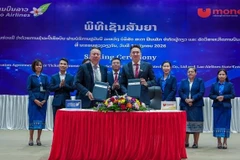
The signing ceremony of a cooperation agreement between Star Fintech and Lao Airlines in Vientiane on January 14 (Photo: VNA)

Vietnamese firm provides digital airline ticket payment services in Laos

Under the agreement, payments for Lao Airlines tickets will be made through the Umoney e-wallet provided by Star Fintech. The partnership marks an important step forward in Laos’ aviation digital transformation roadmap, while helping remove long-standing monopolistic barriers in the country’s airline payment system.

A corner of Ho Chi Minh City (Photo: VNA)

Vietnam gears up for full-force growth push in 2026

A growth path for 2026 has been outlined in line with the National Assembly’s resolution setting a target of more than 10% expansion. Under this scenario, gross domestic product (GDP) would need to rise 9.1% in the first quarter and 10.2% in the second.