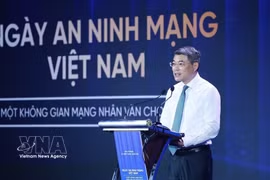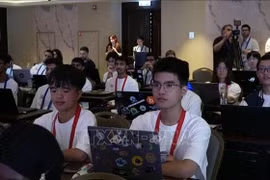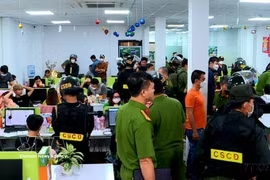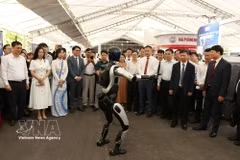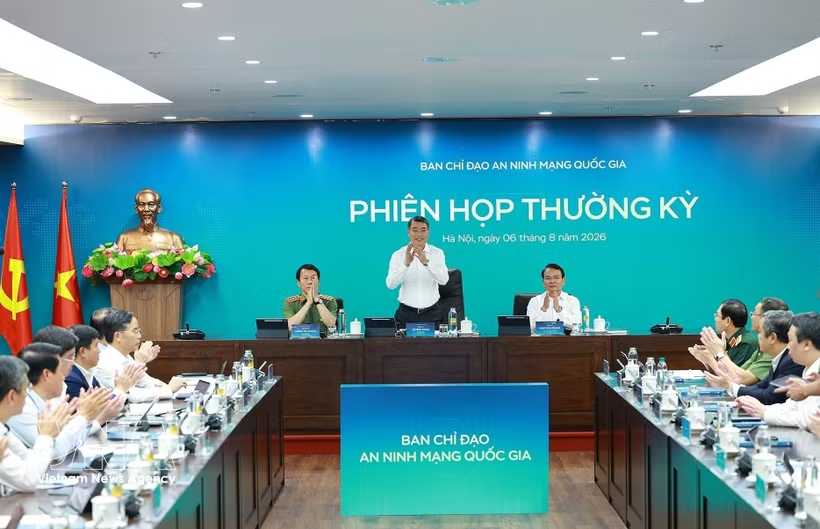
Hanoi (VNA) – Prime Minister Le Minh Hung has ordered the National Cybersecurity Steering Committee to bolster its capacity for unified nationwide leadership and coordination when responding to online threats.
PM Hung, who heads the committee, chaired its second meeting in Hanoi on August 6, which virtually linked with cybersecurity subcommittees in all 34 provinces and cities.
He lauded ministries, agencies, localities, specialised cybersecurity teams, businesses, industry associations, and experts for their efforts in safeguarding cybersecurity during the first half, saying that they played a big role in maintaining political stability, social safety and order, advancing digital transformation, and fostering public trust in the country's digital space.
Competition among countries in cyberspace will keep expanding well beyond technology into control over data, digital platforms, standards, supply chains, computing capacity, artificial intelligence (AI), and cryptography, he said, adding that cyberattacks, cyber espionage, information warfare, cognitive manipulation, and hi-tech crime will only converge further, threatening not just cybersecurity but socio-economic progress and national security.
The PM told members of the steering committee, ministries, agencies and local authorities to review and nail down operating rules, reporting requirements, and command-and-coordination procedures between the national committee and the subcommittees at the ministry and local level by the end of August.
He also directed the committee’s office to deliver quarterly progress reports on how ministries, agencies and localities are handling their assigned tasks.
On the legal and policy side, the Ministry of Public Security was assigned to fast-track a draft Law on Data Security and submit it to the National Assembly for approval during the parliament's October session. It was also told to develop a national AI security framework and build specialised AI security capabilities in 2027. In the meantime, it must issue guidelines on the safe use of AI within state agencies by late 2026.
The Ministry of Science and Technology was required to swiftly submit special mechanisms and policies to support domestic cybersecurity technology firms and startups, with completion targeted in the third quarter.
He also pushed for the Regional Counter Cybercrime Hub for Asia-Pacific to be put into operation in 2027, a “Cybersecurity Economy” initiative to be prepped for APEC 2027, stronger specialised cybersecurity agencies, and an expansion of the national cybersecurity operations centre by the second quarter of 2028.
Ministries, agencies and localities must update their action plans for the rest of 2026 based on clear roles, tasks, timelines, accountability, outcomes and authority. He stressed that agency heads must assume direct responsibility rather than offloading cybersecurity entirely onto technology units, with the plans to be finalised by end-August.
Other specific tasks were also handed to relevant ministries./.
See more
Israeli expert suggests Vietnam prioritise chip design, talent development
Drawing on Israel’s experience, Mel Shalev said Vietnam should focus on developing talent, scientific research, and chip design capabilities instead of rushing into building fabrication facilities.
Trust emerges as one of modern cybersecurity’s biggest challenges
Speaking at the event, VSEC Chairman Truong Duc Luong said this was the second time BSides has been held in Hanoi, continuing to attract strong interest from the cybersecurity community. BSides Hanoi 2026 was designed as a platform connecting Vietnam’s cybersecurity community with international networks, encouraging knowledge sharing and contributing to the sustainable development of the cybersecurity ecosystem.
Hai Phong promotes int’l cooperation in technology transfer, business innovation
Nguyen Cao Thang, Director of the municipal Department of Science and Technology, said the city is accelerating its development strategy based on science, technology and innovation in line with the Politburo's Resolution No. 57-NQ/TW.
Vietnam positioned to harness AI wave, World Bank report says
The WB report identifies Vietnam as one of the few economies outside the European Union (EU) to have adopted a comprehensive AI regulatory framework as early as 2025. Vietnam applies a risk-tiered approach similar to that of the EU AI Act, imposing different obligations depending on whether an AI system poses “unacceptable,” “high,” “low” or “minimal” risks. The approach is viewed as a strategic step towards ensuring safe and transparent AI governance.
Construction sector advances digital transformation with integrated data ecosystem
As digital transformation becomes a key growth driver, the construction sector has come under increasing pressure to modernise its management model to keep pace with the rapid expansion of transport infrastructure, urbanisation and the real estate market.
Politburo’s Resolution 57-NQ/TW powers new growth momentum
NSO Director Nguyen Thi Huong said alongside foreign investment and the green economy, science – technology, innovation, the digital economy and digital transformation are the new drivers that can can pack a serious second-half punch.
Drastic measures taken to turn Resolution 57 into action
A recent meeting of the Central Steering Committee on science, technology, innovation and digital transformation, chaired by Party General Secretary and State President To Lam, marked a new phase in implementing Resolution 57 following the committee’s restructuring.
Bac Ninh targets world's top 50 smart cities by 2030
According to Chairman of the provincial People's Committee Pham Hoang Son, the province will pursue a people-centred smart city model driven by science, technology, innovation and digital transformation to improve public services, urban management and competitiveness.
Vietrade signs cooperation agreement with Meta to support SMEs
Under the agreement, the two sides will share expertise on trade promotion and digital tools, coordinate programmes supporting small and medium-sized enterprises (SMEs), and jointly organise promotional and communication activities.
France-based expert offers strategic insights for Vietnam’s semiconductor development
Dr Nguyen Van Minh, Founding Head, Hardware-Efficient AI & AI-Native Wireless, at Huawei’s Research Centre in France, suggested that Vietnam shift its focus from strategic planning to implementation.
Vietnam expected to fast-track mastery, rollout of 6G technology
Vietnam has so far deployed more than 40,000 5G base transceiver stations (BTSs), providing coverage for about 92% of the population, making it one of the world's fastest countries in this regard. By comparison, many advanced economies typically take two to three years to extend 5G coverage to more than 80% of their populations.
Vietnam strengthens legal framework to accelerate comprehensive digital transformation
July marked an important milestone in the country's digital transformation journey, with a series of new policies, strategies and technical standards introduced to support the Law on Digital Transformation and speed up implementation nationwide.
Deputy PM chairs meeting on establishment of Hung Yen High-Tech Park
Chairman of the Hung Yen provincial People’s Committee Nguyen Manh Quyen said the proposed high-tech park will cover about 496.1 hectares in Hoan Long and Viet Yen communes. The location is expected to attract high-quality talent and innovation resources from Hanoi while strengthening production and logistics links across the Northern Key Economic Region, including Bac Ninh, Hai Phong, Quang Ninh, Phu Tho and Ninh Binh.
Investing in core capabilities key to elevating Vietnam's semiconductor industry: expert
Vietnam's ultimate goal should not simply be to establish a presence in the semiconductor industry, but to gradually master high-value, knowledge-intensive segments of the value chain and become a key link in the global semiconductor supply chain. This would provide a launch pad for strengthening the country's competitiveness in artificial intelligence, electronics and the digital economy.
Building a digital ecosystem for foreigners in Vietnam
Registering residence, applying for an electronic visa (e-Visa), obtaining an electronic identity account or completing administrative procedures online can now all be done conveniently in the digital environment. For many foreigners, these changes have made it easier to enter, live and work in Vietnam while also reflecting the initial results of implementing the Politburo's Resolution No. 57.
Vietnam, Southeast Asia Semiconductor Association deepen semiconductor cooperation
Welcoming the SEMI Southeast Asia delegation, Deputy Prime Minister Ho Quoc Dung commended the association and its members for supporting Vietnamese ministries and agencies in advancing cooperation in science, technology, innovation and digital transformation, which he described as key drivers of the country's next phase of economic growth.
Foreigners experience Vietnam’s digital government through level-2 e-ID services
Since July 2025, immigration authorities have processed 84,831 applications, with Republic of Korean, Chinese and Japanese nationals accounting for the largest numbers of registered users.
Technology, talent to drive Vietnam’s digital leap forward: forum
The Vietnam Global Innovation Connect (VGIC) 2026 serves as a platform for dialogue among policymakers, enterprises, startups, investors and the global Vietnamese expert community to transform knowledge, technology and resources into practical initiatives and projects that contribute to the country's development.
Gia Lai launches Quantum Year 2026
Held under the theme "Quantum Connectivity – Mastering Technology – Breakthrough Development", Quantum Year 2026 centres on four pillars: science, technology, education and training, and innovation ecosystem development.
AI offers both opportunities, challenges for Vietnam’s growth
Dr. Ho Duc Thang, a full-time member of the National Assembly’s Committee for Cultural and Educational, said productivity is the key to sustaining double-digit economic growth, and AI has greater potential to improve productivity than any previous technology.