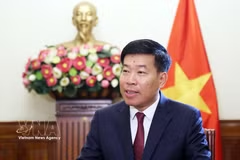
London (VNA) – The four strategic shifts that General Secretary of the Communist Party of Vietnam and State President To Lam laid out at the recent third plenum of the 14th Party Central Committee clearly indicate to development partners that Vietnam is continuing to develop and strengthen key areas that make working with Vietnam easier, said Kyril Whittaker, a British researcher.
In an interview granted to a Vietnam News Agency correspondent in London, he stated that these shifts also show that people are at the centre of policymaking, ensuring that the country's development always puts people first.
Regarding the first shift, Vietnam is working to ensure a more streamlined and effective administrative process, building on the achievements of the reorganisation of government, the British researcher said. This was done to ensure better processes for those who interact with government departments, including smooth processes for formalising documents and accessing government services, meaning more effective government-citizen and citizen-government communication and fewer bottlenecks for businesses.
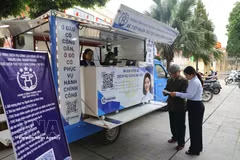
The quality of governance is also supported by the technological revolution that Vietnam has undergone in governance. The VNeID app is a good example, as it allows citizens to store their ID and perform many types of government-related operations from their phones, including sending suggestions to the government on recent policies, registering a foreign citizen staying in a Vietnamese home, and assisting in the search for information regarding fallen soldiers, he stated. It is also reinforced by recent work on Regulation No. 207-QD/TW on things Party members must not do, and other policies such as Directive 07-CT/TW on promoting the study and practice of Ho Chi Minh's thought, ethics, methods and style in the new development age and Regulation 19-QD/TW on political and ideological work within the Party.
According to the British researcher, strengthening the leadership capacity and quality of State governance ensures that these transitions are smooth and stable, and that Vietnam can be seen as a reliable economic partner which, whilst undergoing rapid changes in the "era of the nation's rise", is doing so in a smooth and orderly way, ensuring that citizens are not left behind and that new legislation is both clear and consistent, not only in its drafting but also in its application.
The second shift focuses on using natural resources effectively and managing the country's development space as a single whole. The word "effectively" must be focused on here, he said.
Take forestry, for example, something for which Vietnam is quite renowned, especially when it comes to afforestation. When one talks about effective utilisation of resources, this does not mean slash and burn to make as much profit as possible, nor does it mean to protect a tiny portion of forests whilst decimating others as had happened to the country before the revolution. Instead "effective" means the logical utilisation and protection of natural resources to ensure maximum benefit to the people's wellbeing, both in terms of ecology and maintaining Vietnam's biodiversity and green spaces, and, in addition, in terms of rational exploitation of these resources to enable the Vietnamese economy to continue to make new strides.
This orientation is also in line with the spirit of the 14th National Party Congress, which placed sustainable development and environmental protection on an equal footing with national defence, showcasing the depth of Vietnam’s commitment not merely to development, but to sustainable, people-first development.
The third shift is in line with Vietnam’s economic growth objectives. Accordingly, Vietnam aims to move from a growth model heavily reliant on “capital, resources, outsourcing and cheap labour” towards one driven by “productivity, knowledge, data, technology, innovation, high-quality human resources and modern management.”
This shows that Vietnam is looking to further enhance its role in the technology market and produce world-class products manufactured by companies with modern, high-tech operations, in line with the goals set in Resolution 79-NQ/TW, which targets 50 State-owned enterprises (SOEs) among the 500 largest companies in Southeast Asia by 2030, including one to three ranked among the world’s 500 largest companies.
The transition is also being supported by the synchronous development of infrastructure. Existing and future projects, including the Can Tho-Ca Mau expressway, the Lao Cai-Hanoi-Hai Phong railway, the Vientiane-Vung Ang railway, the North-South high-speed railway, and seven new airports expected to become operational before 2030, will help strengthen connectivity and enable the faster and more convenient movement of goods and people nationwide.
The fourth shift is important given the world situation and focuses on addressing climate change through "forecasting" and "preventing" rather than "responding to" and "mitigating". The researcher said that this shift makes clearer Vietnam’s commitment to environmental protection and the seriousness with which it is taken.
He noted that these four shifts are seen as influencing one another, he stated. For example, the second shift is strongly linked to the fourth, while the third and fourth are linked through ensuring that green agriculture and green economic development support people’s livelihoods and protect the country while developing the economy. The first shift is linked to the fourth, as General Secretary and President Lam pointed out the importance of the central government’s role in closely identifying risks and working effectively with other agencies.
For investors and development partners, these four shifts suggest that Vietnam is seriously abiding by its commitments to the environment, economic growth and investment opportunities, the researcher said, adding they are creating new impetus for trade through large infrastructure programmes and showcasing Vietnamese talent and wealth to other countries./.