Four strategic shifts show top Vietnamese leader’s profound strategic vision: Chinese scholar

China and Vietnam, both socialist nations led by communist parties, are each hunting for a development path that fits their own conditions. Mutual learning is an invaluable asset in the relationship between the two Parties and nations, said Prof. Huang Rihan, Director of the Maritime Silk Road Institute at Huaqiao University in China’s Fujian province.

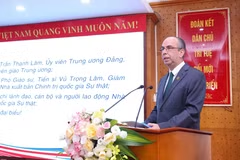
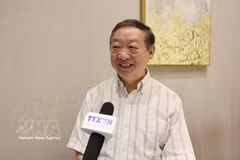
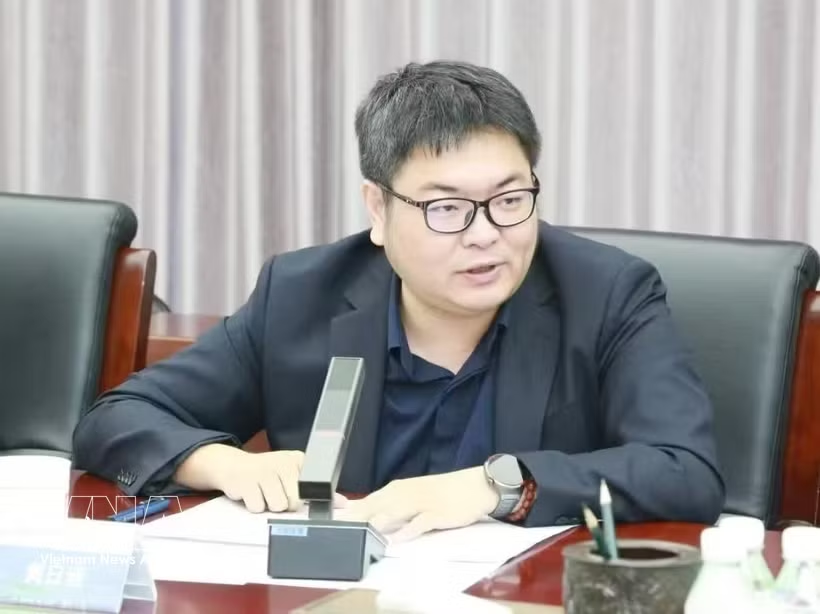
Prof. Huang Rihan, Director of the Maritime Silk Road Institute at Huaqiao University (Photo: VNA)

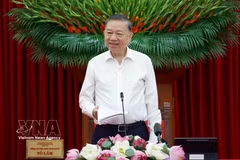
Beijing (VNA) – Party General Secretary and State President To Lam has shown a profound strategic vision when calling for a transformation of Vietnam’s development model to keep growth humming, Prof. Huang Rihan, Director of the Maritime Silk Road Institute at Huaqiao University in China’s Fujian province, told the Vietnam News Agency.

The “four strategic shifts” that General Secretary and President Lam laid out at the recent third plenum of the 14th Party Central Committee form a unified chain to modernise governance, he said.

The first shift targets stronger Party leadership and sharper institutional operations. It builds on two years of aggressive apparatus streamlining and a new two-tier local administration model. With the framework in place, the focus now is getting it to run smoothly.

The second aims to unify governance of development spaces. It takes on the fragmented oversight of land, seas and natural resources that has long caused bottlenecks and wasted valuable resources.

The third pivots the economy toward a model powered by productivity, knowledge, technology and a quality workforce. It strikes at the core issue as national prosperity ultimately hinges on innovation and highly skilled talent.

The fourth moves risk management from reaction to proactive prevention, spotting trouble early and acting well before a crisis hits. In a world where risks can go viral in an instant, that’s a practical play.

Huang stressed that China and Vietnam, both socialist nations led by communist parties, are each hunting for a development path that fits their own conditions. Mutual learning is an invaluable asset in the relationship between the two Parties and nations.

Real transformation isn’t hard to announce, but hard to deliver. The top Vietnamese leader’s insistence that the plenum's outcomes must be reflected in tangible changes shows Vietnamese leaders have a sharp read on both the global and domestic pictures. That, Huang added, has given foreign scholars, including those in China, a lot more faith in Vietnam’s economic future.

For neighbouring China, Vietnam’s economic momentum is genuinely good news, he said.

First and foremost, execution has to be all-in. The recent mergers and institutional reforms touched every level of government, but the new structure needs real backup, especially personnel, funding and data at the commune and ward level - the front line closest to citizens. In fact, those resources often fail to meet demand.

Decentralisation and delegation of authority must go hand in hand with granting autonomy over financial resources, personnel and information systems. Otherwise, the stronger the transfer of authority downward, the more likely grassroots authorities will hit bottlenecks.

The top leader’s rule that every decision must spell out its goals, tasks, authority, responsibilities and deadlines targets a familiar problem: policies that look great on paper but collapse during rollout. This, he stressed, is a clear and important compass.

Second, the transformation must be substantive. Jumping from a cheap labour model to one driven by productivity and innovation demands a long-term commitment to education and sci-tech investment. When courting foreign capital, Vietnam shouldn’t settle for building assembly plants. Instead, negotiations should incorporate technology transfer, links to domestic supply chains and talent development, thus gradually building its own growth drivers. China and Vietnam have plenty of room to team up on all of that. Railways, digital economy and green energy are huge doors for Vietnam’s industrial upgrade.

Third, Vietnam must hold its ground. In today’s world, traditional and non-traditional security issues are tightly intertwined, while supply chain, climate and data risks can easily trigger chain reactions. By pursuing a foreign policy of independence and self-reliance and maintaining a peaceful and stable external environment, Vietnam is creating the space necessary to carry out its domestic transformation, which is particularly important amid a volatile global landscape.

As the two countries build a China-Vietnam community with a shared future that carries strategic significance, Vietnam’s successful makeover will also lift regional prosperity and stability, he said.

The two sides have a lot of potential to win together by sharing experience in national governance and connecting the Belt and Road Initiative with the “Two corridors, one economic belt” plan. If done right, each country’s growth becomes a wide-open door for the other, he added./.
VNA

See more

Party General Secretary and State President To Lam (right) receives outgoing Ambassador of Malaysia to Vietnam Tan Yang Thai on August 5. (Photo: VNA)

Top leader highlights dynamic growth in Vietnam–Malaysia relations

General Secretary and President Lam congratulated the ambassador on the successful completion of his mission in Vietnam and wished him further success in his new position, expressing confidence that he will continue contributing to Malaysia's diplomacy and the development of bilateral ties.

Assoc. Prof. Dr Le Hai Binh, Member of the Party Central Committee and Permanent Vice President of the Ho Chi Minh National Academy of Politics, speaks at the session. (Photo: VNA)

33rd Diplomatic Conference: Party, people-to-people diplomacy play pioneering role

Citing Party General Secretary and State President To Lam’s assertion that diplomacy is now a component of national comprehensive strength, Binh dissected Party diplomacy’s strategic role across three levels, including building the political foundation for the broader diplomatic landscape, feeding policy formulation, and safeguarding ideological footing and strategic autonomy.

Cuban Ambassador to Vietnam Rogelio Polanco Fuentes speaks at the event. (Photo: VNA)

Selected works of Fidel Castro Ruz collection introduced in Hanoi

The collection brings together the Cuban leader’s speeches, articles, interviews, messages and other important documents produced throughout his revolutionary career. Spanning nearly 15,000 pages, the series is organised into four major historical periods corresponding to the development of the Cuban Revolution and Fidel Castro's revolutionary life.

Workers at a factory producing garments for export. (Photo: VNA)

Lawmakers propose stronger safeguards for Vietnamese workers abroad

Some workers use labour contracts to enter a foreign country before absconding, either shortly after arrival or when their contracts are about to expire, in search of higher wages. Meanwhile, Vietnamese companies that win contracts abroad often face difficulties in determining which authority is responsible for handling procedures for Vietnamese workers overseas.

☕ Afternoon briefing on August 5

☕ Afternoon briefing on August 5

The first meeting of the Central Steering Committee for reviewing practice and considering the amendment and supplementation of the Party Statutes; the meeting between General Nguyen Tan Cuong, Chief of the General Staff of the Vietnam People's Army and Deputy Minister of National Defence, and Admiral Samuel Paparo, Commander of the US Pacific Command; and Vietnam's fishery exports in the first seven months are among news highlights on August 5.

Politburo member and Permanent member of the Party Central Committee’s Secretariat Tran Cam Tu (centre) and leaders of the Ministry of Foreign Affairs at the plenary session on Party and people-to-people diplomacy on August 5, part of the 33rd Diplomatic Conference. (Photo: VNA)

Party, people-to-people diplomacy urged to contribute more effectively to national development

Party diplomacy has made breakthroughs in expanding and deepening relations with political parties around the world, helping consolidate political foundations and orient State-level relations. Meanwhile, people-to-people diplomacy has seen positive changes in its thinking, content and methods, with an expanding network of partners and more active and substantive participation in regional and international people-to-people mechanisms.

Party General Secretary and State President To Lam addresses the first meeting of the Central Steering Committee for reviewing practice and considering the amendment and supplementation of the Party Statutes on August 5. (Photo: VNA)

Party Statutes must be practical, future-ready: Top leader

Party General Secretary and State President To Lam said the current Party Statutes remain fundamentally valid but must also respond to emerging issues such as administrative apparatus restructuring, the two-tier local administration model, decentralisation, control over the exercise of power and digital transformation.

General Nguyen Tan Cuong (right), Chief of the General Staff of the Vietnam People's Army and Deputy Minister of National Defence, welcomes Admiral Samuel Paparo, Commander of the US Pacific Command, in Hanoi on August 5, 2026. (Photo: VNA)

Vietnam prioritises post-war recovery cooperation with US: general staff chief

Defence cooperation between Vietnam and the US has developed positively and been implemented effectively across a range of areas, including post-war recovery, dialogue and consultations, training, United Nations peacekeeping, cooperation between military services and branches, military medicine, defence industry, and humanitarian assistance and disaster relief.

SBV Governor Pham Duc An presents a proposal on a draft law amending and supplementing a number of articles of the Law on the State Bank of Vietnam, the Law on Anti-Money Laundering, and the Law on Credit Institutions at the 16th National Assembly’s first extraordinary session on August 5 (Photo: VNA)

Legal amendments aim to strengthen banking, anti-money laundering framework

The Government said the amendments focus on urgent issues arising from the restructuring of the state apparatus, addressing legal bottlenecks in money laundering prevention and combat in line with recommendations from the Financial Action Task Force (FATF), the Asia/Pacific Group on Money Laundering (APG) and the Organisation for Economic Co-operation and Development (OECD), ahead of the OECD’s review in October 2026 and Vietnam’s eighth progress report to FATF slated for September.

As of June 2026, Vietnam had 499 licensed enterprises providing overseas employment services. (Photo: VNA)

Draft law eases rules for overseas labour services

The Ministry of Home Affairs has proposed amendments that maintain the law's core policies while focusing on three priorities: decentralising state management, cutting and simplifying administrative procedures, and strengthening the application of digital technologies.

President of the National Assembly and Speaker of the House of Representatives of Thailand Sophon Zaram arrives in Hanoi on August 5 morning. (Photo: VNA)

Thai NA President arrives in Hanoi for official visit

The visit underscores Thailand's high regard to its ties with Vietnam and highlights both legislatures' determination to advance parliamentary diplomacy while implementing agreements reached by the high-ranking leaders of the two countries, including the 2023–2028 cooperation agreement between the Vietnamese NA and the Thai House of Representatives.

A plenary discussion during the first extraordinary session of the 16th National Assembly (Photo: VNA)

Legislators discuss law revisions to better support Vietnam's overseas workers

The draft amendments to the Law on Vietnamese Guest Workers under Contract aim to strengthen the legal framework and promote decentralisation, science and technology application, digital transformation and the shift from a pre-approval to a post-approval inspection approach while addressing shortcomings in the current law.

The meeting between Minister of Public Security General Luong Tam Quang and a delegation from US-based American Kestrel Global Strategies Group and leading American defence, security, technology and energy companies in Hanoi on August 4 (Photo: bocongan.gov.vn)

Vietnam, US firms seek closer cooperation in defence, security industries

US companies are committed to strengthening dialogue and cooperation with Vietnam's Ministry of Public Security, supporting the country's development objectives while contributing to the deepening of the Vietnam–US Comprehensive Strategic Partnership for the mutual benefit of both governments, businesses and peoples.

☀️ Morning digest on August 5

☀️ Morning digest on August 5

Party General Secretary and State President To Lam's reception for ASEAN ambassadors and chargés d'affaires, Prime Minister Le Minh Hung's attendance at the 33rd Diplomatic Conference, and proposals on the establishment of Quang Ninh, Bac Ninh cities to be submitted to the legislature are among news highlights on August 5 evening.

Nguyen Van Khoi, Vice Chairman of the municipal People's Committee, speaks at the ceremony. Photo: VNA

Can Tho marks 50 Years of Vietnam–Thailand diplomatic relations

During the first six months of 2026, Can Tho exported 13.9 million USD worth of goods to Thailand, mainly rice, seafood, agricultural products, and processed foods. Its imports from this market totalled about 3.8 million USD, consisting primarily of textiles, chemicals, and production materials.

An overview of the talks between the delegations of the Ho Chi Minh National Academy of Politics and the Lao National Academy of Politics and Public Administration on August 4. (Photo: VNA)

Vietnam, Laos step up cooperation in political theory, training

The two central theory councils of Vietnam and Laos should step up joint research on strategic issues of mutual concern, closely link theoretical studies with practical reviews and policy consultation, build cooperation networks, connect young theory researchers and publish bilingual research works.

Party General Secretary and State President To Lam meets with ASEAN ambassadors and chargés d'affaires in Hanoi on August 4, 2026. (Photo: VNA)

Top leader meets ASEAN diplomats, calls for united, resilient ASEAN Community

Party General Secretary and State President To Lam highly valued the bloc’s achievements across political, security-defence, economic, socio-cultural and other areas through numerous programmes and initiatives. He voiced confidence that member states would uphold solidarity, strengthen cooperation, reinforce ASEAN's centrality, and successfully realise the ASEAN Community Vision 2045.