33rd Diplomatic Conference: Party, people-to-people diplomacy play pioneering role

Citing Party General Secretary and State President To Lam’s assertion that diplomacy is now a component of national comprehensive strength, Binh dissected Party diplomacy’s strategic role across three levels, including building the political foundation for the broader diplomatic landscape, feeding policy formulation, and safeguarding ideological footing and strategic autonomy.

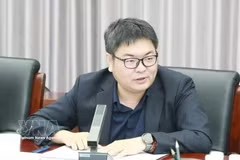
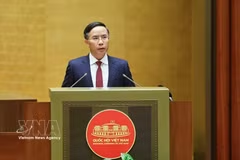
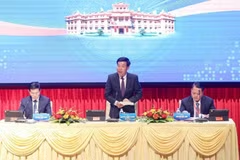
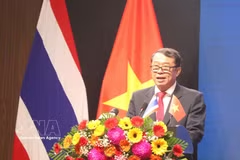
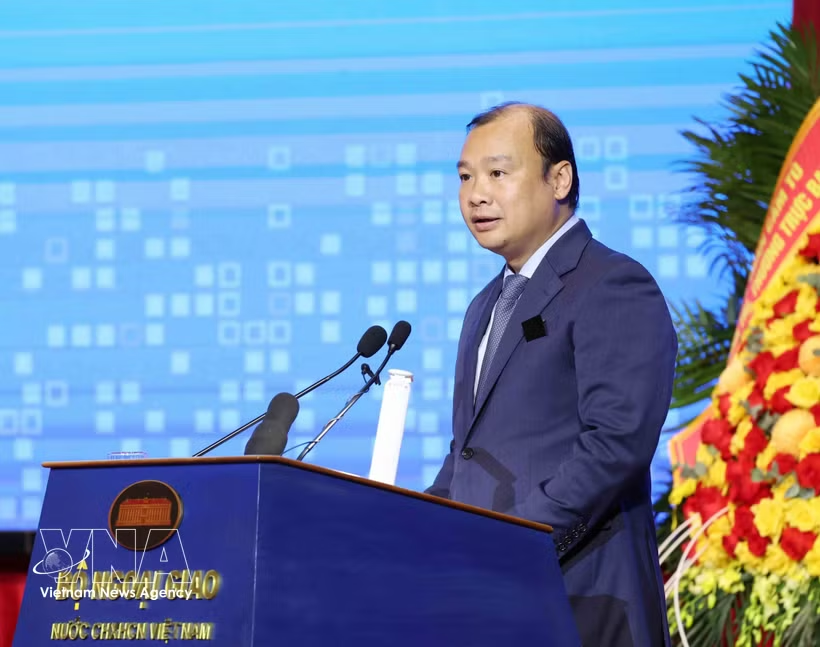
Assoc. Prof. Dr Le Hai Binh, Member of the Party Central Committee and Permanent Vice President of the Ho Chi Minh National Academy of Politics, speaks at the session. (Photo: VNA)

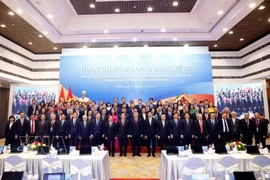
Hanoi (VNA) - The Ministry of Foreign Affairs (MoFA) held a plenary session on Party and people-to-people diplomacy in Hanoi on August 5 as part of the 33rd Diplomatic Conference. The hybrid event was connected to the municipal and provincial Party Committees, and Vietnamese representative agencies abroad.

​Politburo member and Permanent member of the Party Central Committee’s Secretariat Tran Cam Tu attended the event. Minister of Foreign Affairs Le Hoai Trung delivered the opening speech.

Mining soft power for trust and consensus

​Assoc. Prof. Dr Le Hai Binh, member of the Party Central Committee and Permanent Vice President of the Ho Chi Minh National Academy of Politics, flagged a mindset breakthrough by the 14th National Party Congress that defines foreign affairs as a core, regular task and stresses proactive shaping over simply participating and adapting.

​Citing Party General Secretary and State President To Lam’s assertion that diplomacy is now a component of national comprehensive strength, Binh dissected Party diplomacy’s strategic role across three levels, including building the political foundation for the broader diplomatic landscape, feeding policy formulation, and safeguarding ideological footing and strategic autonomy.

​People-to-people diplomacy, Binh said, is a channel for converting soft power into trust, international consensus and resources for national development.

​To upgrade external engagement, he proposed broadening the concept of academic diplomacy so that every Vietnamese scholar, at home or abroad, becomes a stakeholder, building a global network of informed voices that use scientific arguments to push back directly against disinformation in international forums.

​He also laid out four breakthrough solutions, including distilling Party diplomacy outcomes into concise advisory reports sent directly to the Central Steering Committee, elevating external relations training in the academy system with specialised courses for Party diplomacy officials, compiling standardised reference materials for academic debates, building a unified database to manage a strategic overseas personnel network, and adding effectiveness metrics based on tangible outputs and long-term impact.
vnanet-xuan-thao.jpg
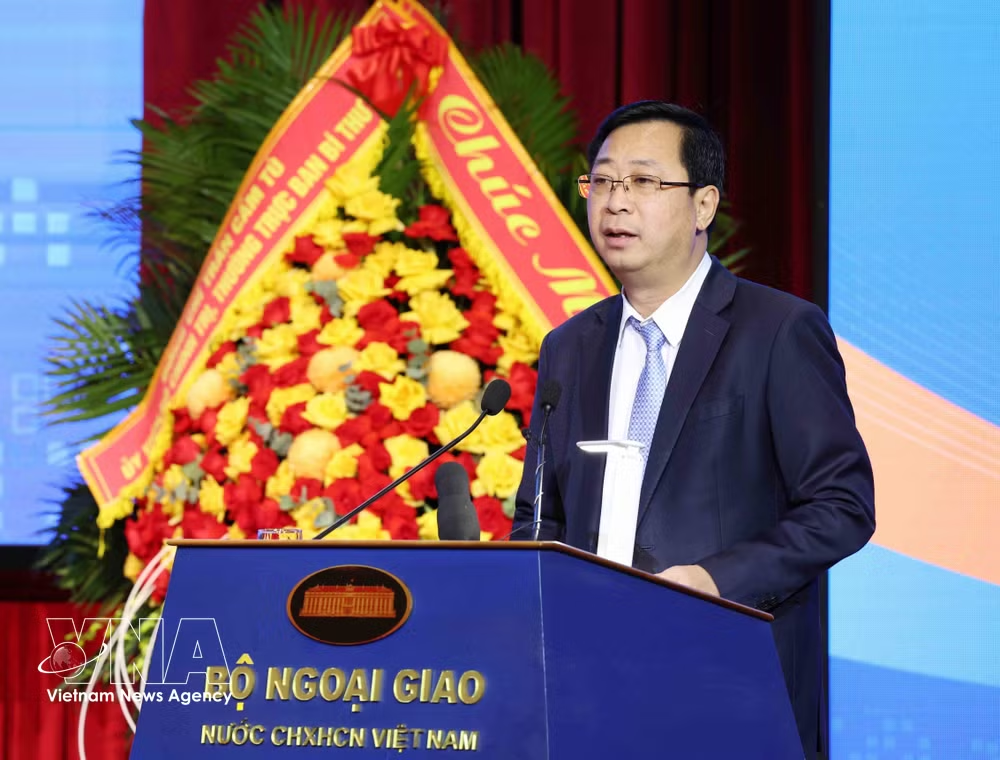
Cao Xuan Thao, Vice President of the Vietnam Fatherland Front (VFF)’s Central Committee, speaks at the event. (Photo: VNA)

Building a solid social base for State and Party diplomacy

​Cao Xuan Thao, Vice President of the Vietnam Fatherland Front (VFF)’s Central Committee, spotlighted the VFF’s role and position in people-to-people diplomacy. A new operating model launched in mid-2025 has enabled the VFF to revamp working methods and reach consensus on a clear division of labour among its member chapters, he said.

​The VFF is working to strengthen the social foundation for Party and State diplomacy by making people-to-people efforts more professional. It is moving beyond traditional exchanges to include knowledge, science, culture, and even digital and creative diplomacy. Alongside maintaining traditional ties, it is also building new connections with foreign social organisations, research institutes, and businesses in emerging fields like green transition, digital transformation, and tackling climate change.

​Thao said the VFF views the community of more than 6.5 million overseas Vietnamese as a vital source of intellectual and technological resources to foster connectivity and showcase the nation. It will exercise its central role in mobilising, guiding and coordinating the diplomatic plans of its chapters to ensure coherence with Party and State diplomacy - a key direction for lifting the effectiveness of people-to-people diplomacy in the new period.

Fortifying security-development belt

​Vu Hoang Anh, Vice Secretary of the Lang Son provincial Party Committee, shared local experience in managing its border with China’s Guangxi, a critical gateway connecting Vietnam to ASEAN and reinforcing the country’s “security-development belt".

​Anh said Lang Son has drawn key lessons in upholding the Party Committee’s direct, unified leadership and leveraging Party diplomacy through annual spring meetings and cooperation mechanisms with Guangxi, thus deepening political trust and directing relevant forces to intensify border cooperation.

​The province is also renewing people-to-people diplomacy by sustaining village-to-village twinning models along the frontier, laying a foundation for friendship and cooperation while tapping local advantages and promoting economic diplomacy to fuel the security-development belt.

​To firmly consolidate the belt, Lang Son proposed the Party Central Committee refine mechanisms compatible with the two-tier local administration model, giving commune-level authorities, especially border communes, sufficient legal grounds to sign and launch international agreements on friendly cooperation and tap local potential effectively.

​It also urged sustained investment in road and high-speed rail infrastructure, as well as border gate infrastructure at international and bilateral crossings, paired with digital transformation. It further called for continued study and guidance on expanding effective, substantive friendship exchanges and twinning models among localities, organisations and border communities.

From cultural diplomacy and heritage to hard power

​Le Tri Thanh, Vice Secretary of the Hue municipal Party Committee and Chairman of the Hue People’s Committee, stressed the imperative of turning cultural diplomacy and heritage into internal resources that fuel socio-economic development.

​Blessed with distinct competitive advantages from UNESCO-recognised heritage sites, Hue city is pursuing international cooperation to capture conservation expertise and sustainable development models while forcefully pivoting people-to-people diplomacy from mere friendship exchanges toward substantive, value-generating cooperation. The city is betting on residents as cultural ambassadors and on digital technologies to digitise heritage and deliver multilingual communications, pulling Hue’s culture closer to global audiences.

​He proposed the MoFA take the lead, coordinating with the Ministry of Culture, Sports and Tourism, localities and relevant agencies to build a Vietnam Heritage Diplomacy Network, connecting localities with standout heritage and broadening connections to UNESCO, conservation funds, financial bodies and international partners.

Party diplomacy as strategic anchor

​Vietnamese Ambassador to China Pham Thanh Binh described Party diplomacy as a strategic anchor that steers the overall direction of bilateral ties.

​Binh said the Vietnamese representative mission in China has proactively sharpened research and policy recommendations, pushed exchanges through Party channels, and leveraged dialogue mechanisms and theoretical seminars to connect localities and pull in resources.

​Through people-to-people diplomacy, the mission has kept signature events humming, such as Vietnam Cultural Day in China, the Vietnam-China People’s Forum and the Border People’s Festival, to solidify a social foundation for the relationship.

​Binh proposed embedding people-to-people diplomacy within the broader strategic framework, deepening links with Chinese localities which have strengths in technology and logistics, ramping up digital external communications, activating the overseas Vietnamese community as a vital bridge for friendship with host countries, and focusing on building a corps of officials in charge of foreign affairs with deep professional expertise and understanding of political systems and cultures of the host countries.

​Turning to Africa, Ambassador Hoang Sy Cuong said the Communist Party of Vietnam has established official relations with roughly 40 political parties across 24 African countries, playing a key role in constructing the political foundation for advancing state-to-state relations and economic cooperation.

​Despite headwinds arising from vast geography, thin staffing at missions and complex domestic politics in some host nations, Vietnam’s standing is consistently highly valued by African countries, which have shown an appetite for learning from Vietnam’s Doi Moi (renewal) model.

​To amplify the power of Party diplomacy, Cuong advocated increasing Party delegation exchanges, embedding Party cooperation into high-level activities, signing additional cooperation agreements with major political and left-wing parties, accelerating information sharing and online theoretical exchanges, and sustaining training courses while inviting partner delegations to Vietnam to study and share experience./.
VNA

See more

Workers at a factory producing garments for export. (Photo: VNA)

Lawmakers propose stronger safeguards for Vietnamese workers abroad

Some workers use labour contracts to enter a foreign country before absconding, either shortly after arrival or when their contracts are about to expire, in search of higher wages. Meanwhile, Vietnamese companies that win contracts abroad often face difficulties in determining which authority is responsible for handling procedures for Vietnamese workers overseas.

☕ Afternoon briefing on August 5

☕ Afternoon briefing on August 5

The first meeting of the Central Steering Committee for reviewing practice and considering the amendment and supplementation of the Party Statutes; the meeting between General Nguyen Tan Cuong, Chief of the General Staff of the Vietnam People's Army and Deputy Minister of National Defence, and Admiral Samuel Paparo, Commander of the US Pacific Command; and Vietnam's fishery exports in the first seven months are among news highlights on August 5.

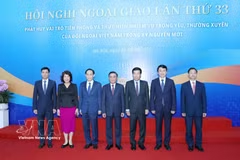
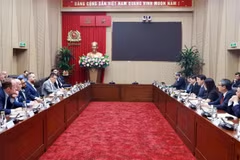
Politburo member and Permanent member of the Party Central Committee’s Secretariat Tran Cam Tu (centre) and leaders of the Ministry of Foreign Affairs at the plenary session on Party and people-to-people diplomacy on August 5, part of the 33rd Diplomatic Conference. (Photo: VNA)

Party, people-to-people diplomacy urged to contribute more effectively to national development

Party diplomacy has made breakthroughs in expanding and deepening relations with political parties around the world, helping consolidate political foundations and orient State-level relations. Meanwhile, people-to-people diplomacy has seen positive changes in its thinking, content and methods, with an expanding network of partners and more active and substantive participation in regional and international people-to-people mechanisms.

Party General Secretary and State President To Lam addresses the first meeting of the Central Steering Committee for reviewing practice and considering the amendment and supplementation of the Party Statutes on August 5. (Photo: VNA)

Party Statutes must be practical, future-ready: Top leader

Party General Secretary and State President To Lam said the current Party Statutes remain fundamentally valid but must also respond to emerging issues such as administrative apparatus restructuring, the two-tier local administration model, decentralisation, control over the exercise of power and digital transformation.

General Nguyen Tan Cuong (right), Chief of the General Staff of the Vietnam People's Army and Deputy Minister of National Defence, welcomes Admiral Samuel Paparo, Commander of the US Pacific Command, in Hanoi on August 5, 2026. (Photo: VNA)

Vietnam prioritises post-war recovery cooperation with US: general staff chief

Defence cooperation between Vietnam and the US has developed positively and been implemented effectively across a range of areas, including post-war recovery, dialogue and consultations, training, United Nations peacekeeping, cooperation between military services and branches, military medicine, defence industry, and humanitarian assistance and disaster relief.

SBV Governor Pham Duc An presents a proposal on a draft law amending and supplementing a number of articles of the Law on the State Bank of Vietnam, the Law on Anti-Money Laundering, and the Law on Credit Institutions at the 16th National Assembly’s first extraordinary session on August 5 (Photo: VNA)

Legal amendments aim to strengthen banking, anti-money laundering framework

The Government said the amendments focus on urgent issues arising from the restructuring of the state apparatus, addressing legal bottlenecks in money laundering prevention and combat in line with recommendations from the Financial Action Task Force (FATF), the Asia/Pacific Group on Money Laundering (APG) and the Organisation for Economic Co-operation and Development (OECD), ahead of the OECD’s review in October 2026 and Vietnam’s eighth progress report to FATF slated for September.

As of June 2026, Vietnam had 499 licensed enterprises providing overseas employment services. (Photo: VNA)

Draft law eases rules for overseas labour services

The Ministry of Home Affairs has proposed amendments that maintain the law's core policies while focusing on three priorities: decentralising state management, cutting and simplifying administrative procedures, and strengthening the application of digital technologies.

President of the National Assembly and Speaker of the House of Representatives of Thailand Sophon Zaram arrives in Hanoi on August 5 morning. (Photo: VNA)

Thai NA President arrives in Hanoi for official visit

The visit underscores Thailand's high regard to its ties with Vietnam and highlights both legislatures' determination to advance parliamentary diplomacy while implementing agreements reached by the high-ranking leaders of the two countries, including the 2023–2028 cooperation agreement between the Vietnamese NA and the Thai House of Representatives.

A plenary discussion during the first extraordinary session of the 16th National Assembly (Photo: VNA)

Legislators discuss law revisions to better support Vietnam's overseas workers

The draft amendments to the Law on Vietnamese Guest Workers under Contract aim to strengthen the legal framework and promote decentralisation, science and technology application, digital transformation and the shift from a pre-approval to a post-approval inspection approach while addressing shortcomings in the current law.

The meeting between Minister of Public Security General Luong Tam Quang and a delegation from US-based American Kestrel Global Strategies Group and leading American defence, security, technology and energy companies in Hanoi on August 4 (Photo: bocongan.gov.vn)

Vietnam, US firms seek closer cooperation in defence, security industries

US companies are committed to strengthening dialogue and cooperation with Vietnam's Ministry of Public Security, supporting the country's development objectives while contributing to the deepening of the Vietnam–US Comprehensive Strategic Partnership for the mutual benefit of both governments, businesses and peoples.

☀️ Morning digest on August 5

☀️ Morning digest on August 5

Party General Secretary and State President To Lam's reception for ASEAN ambassadors and chargés d'affaires, Prime Minister Le Minh Hung's attendance at the 33rd Diplomatic Conference, and proposals on the establishment of Quang Ninh, Bac Ninh cities to be submitted to the legislature are among news highlights on August 5 evening.

Nguyen Van Khoi, Vice Chairman of the municipal People's Committee, speaks at the ceremony. Photo: VNA

Can Tho marks 50 Years of Vietnam–Thailand diplomatic relations

During the first six months of 2026, Can Tho exported 13.9 million USD worth of goods to Thailand, mainly rice, seafood, agricultural products, and processed foods. Its imports from this market totalled about 3.8 million USD, consisting primarily of textiles, chemicals, and production materials.

An overview of the talks between the delegations of the Ho Chi Minh National Academy of Politics and the Lao National Academy of Politics and Public Administration on August 4. (Photo: VNA)

Vietnam, Laos step up cooperation in political theory, training

The two central theory councils of Vietnam and Laos should step up joint research on strategic issues of mutual concern, closely link theoretical studies with practical reviews and policy consultation, build cooperation networks, connect young theory researchers and publish bilingual research works.

Party General Secretary and State President To Lam meets with ASEAN ambassadors and chargés d'affaires in Hanoi on August 4, 2026. (Photo: VNA)

Top leader meets ASEAN diplomats, calls for united, resilient ASEAN Community

Party General Secretary and State President To Lam highly valued the bloc’s achievements across political, security-defence, economic, socio-cultural and other areas through numerous programmes and initiatives. He voiced confidence that member states would uphold solidarity, strengthen cooperation, reinforce ASEAN's centrality, and successfully realise the ASEAN Community Vision 2045.

National Assembly Chairman Tran Thanh Man speaks at the meeting with leaders of the Ministry of Foreign Affairs, Vietnamese ambassadors and heads of representative missions abroad. (Photo: VNA)

NA Chairman urges stronger parliamentary, economic diplomacy

The National Assembly always stands alongside and supports the diplomatic sector. It will continue to proactively improve the legal framework governing foreign affairs, international treaties and agreements, as well as the operations of Vietnamese representative missions abroad, while paying attention to policies and working conditions for officials serving overseas, said NA Chairman Tran Thanh Man.