Party, people-to-people diplomacy urged to contribute more effectively to national development

Party diplomacy has made breakthroughs in expanding and deepening relations with political parties around the world, helping consolidate political foundations and orient State-level relations. Meanwhile, people-to-people diplomacy has seen positive changes in its thinking, content and methods, with an expanding network of partners and more active and substantive participation in regional and international people-to-people mechanisms.

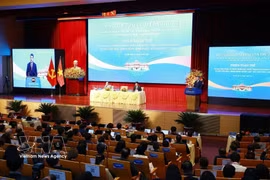
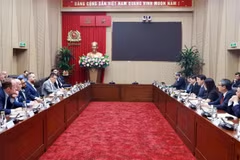
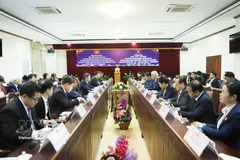
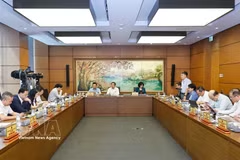
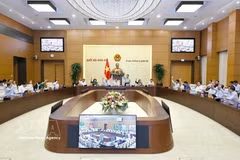
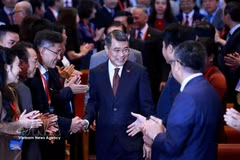
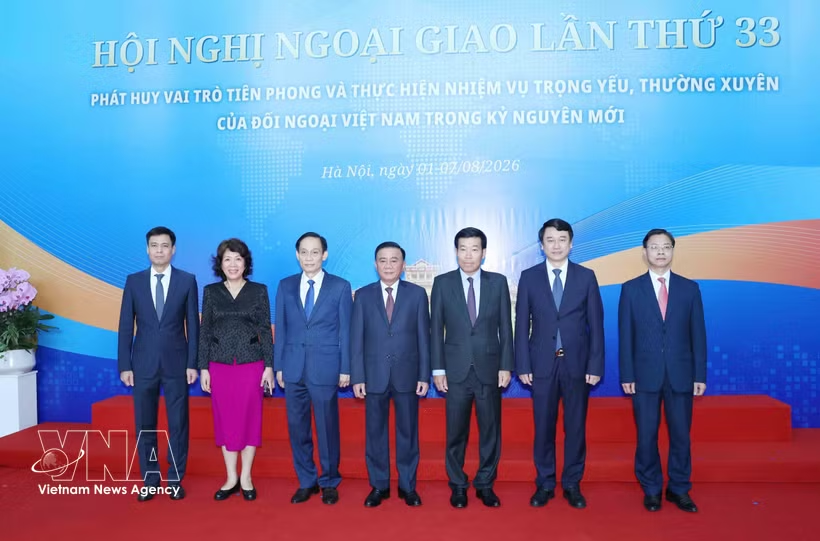
Politburo member and Permanent member of the Party Central Committee’s Secretariat Tran Cam Tu (centre) and leaders of the Ministry of Foreign Affairs at the plenary session on Party and people-to-people diplomacy on August 5, part of the 33rd Diplomatic Conference. (Photo: VNA)

Hanoi (VNA) – Politburo member and Permanent member of the Party Central Committee’s Secretariat Tran Cam Tu on August 5 called for stronger efforts to renew thinking and improve the effectiveness of Party diplomacy and people-to-people diplomacy, contributing more to the country’s rapid and sustainable development.

Speaking at a plenary session on Party and people-to-people diplomacy held in Hanoi as part of the 33rd Diplomatic Conference, Tu stressed that Vietnam’s diplomacy has made important contributions throughout different historical periods, helping maintain a peaceful and stable environment, safeguard national independence, sovereignty, unity and territorial integrity, mobilise external resources for development, and enhance the country’s international stature.

Party diplomacy has made breakthroughs in expanding and deepening relations with political parties around the world, helping consolidate political foundations and orient State-level relations. Meanwhile, people-to-people diplomacy has seen positive changes in its thinking, content and methods, with an expanding network of partners and more active and substantive participation in regional and international people-to-people mechanisms.

According to the leader, the 14th National Party Congress identified foreign affairs as a “key and regular task.” The Politburo’s strategic resolutions on foreign affairs and international integration have concretised the foreign policy orientations set out by the Congress. The requirements and tasks in the new situation require deeper awareness, stronger determination, more vigorous innovation, and greater proactiveness and creativity.

He called for thorough and effective implementation of the six key tasks outlined by Party General Secretary and State President To Lam at the opening session of the 33rd Diplomatic Conference, with a focus on strategic issues.

He stressed the need to shift from primarily expanding relations to improving their quality, effectiveness and added value, with concrete outcomes serving as a measure of performance.

Party and people-to-people diplomacy should take a more proactive role in strengthening political trust and international consensus, while helping identify and address at an early stage risks that could affect national interests. Greater efforts should also be made to connect Vietnam with priority partners in high-quality human resources development, innovation, digital transformation, rapid and sustainable development, responses to non-traditional security challenges, Party building and improving national governance capacity.

He underlined the importance of closely coordinating the three pillars of Vietnam’s comprehensive diplomacy – Party diplomacy, State diplomacy and people-to-people diplomacy. Each has its own role, mission, target groups and methods, but all must work towards the common goal of promoting the country’s overall strength and effectively realising national foreign policy objectives.
vnanet-trancamtu2.jpg
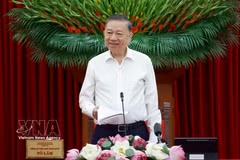
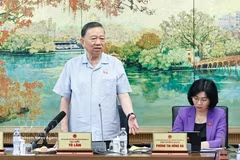
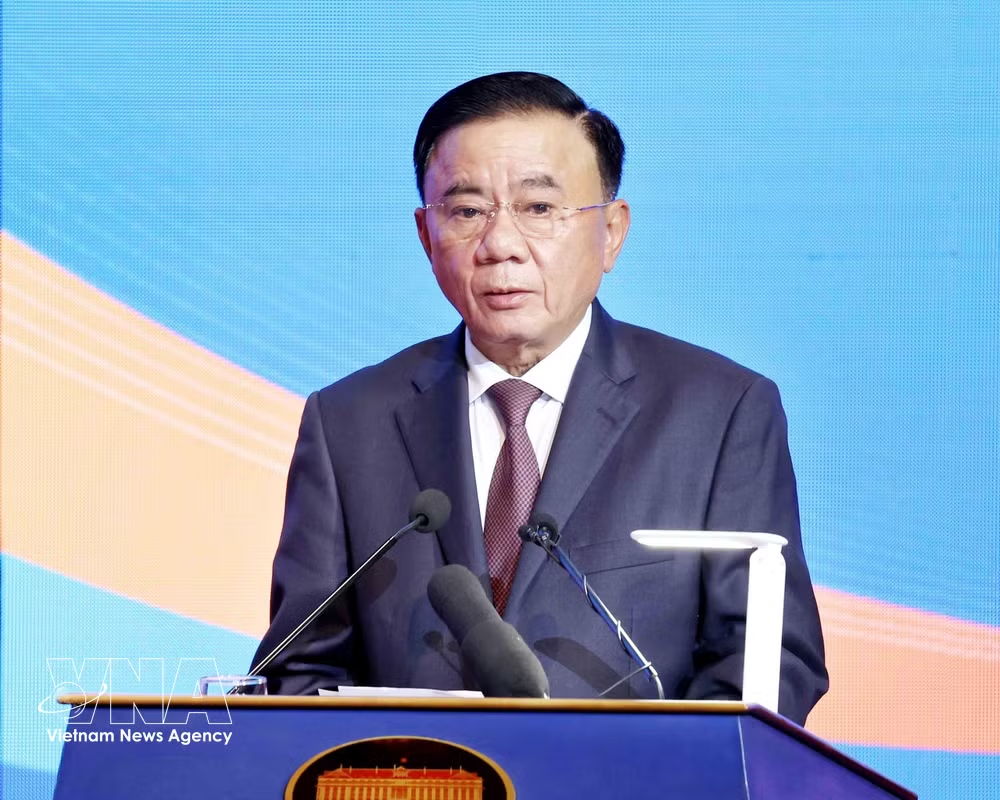
Politburo member and Permanent member of the Party Central Committee’s Secretariat Tran Cam Tu speaks at the plenary session on Party and people-to-people diplomacy on August 5, part of the 33rd Diplomatic Conference. (Photo: VNA)

Regarding Party diplomacy, Tu called for further deepening ties with political parties, particularly ruling parties in neighbouring countries, influential parties in major powers and parties in countries with which Vietnam has established cooperation frameworks. He urged flexible and effective use of high-level meetings, strategic dialogues, political consultations, theory exchanges, cadre training and multilateral mechanisms.

For people-to-people diplomacy, he called for a shift from friendship exchanges and advocacy towards connecting interests and creating sustainable cooperation opportunities. He also urged stronger participation in regional and international networks and mechanisms, greater involvement of localities, businesses, citizens and overseas Vietnamese, and closer links between people-to-people diplomacy and local-level cooperation.

He further stressed the need to strengthen external information work, improve Vietnam’s international image, and promote innovation, professionalism and comprehensive digital transformation in people-to-people diplomacy.

Tu also called for building a pure and strong Party organisation within the Ministry of Foreign Affairs and developing a professional diplomatic workforce with firm political mettle, strong expertise and credibility. He said national interests must remain the guiding principle, while greater attention should be paid to training specialists in key geographical areas and emerging fields and to attracting and effectively using talent./.
VNA

See more

Party General Secretary and State President To Lam addresses the first meeting of the Central Steering Committee for reviewing practice and considering the amendment and supplementation of the Party Statutes on August 5. (Photo: VNA)

Party Statutes must be practical, future-ready: Top leader

Party General Secretary and State President To Lam said the current Party Statutes remain fundamentally valid but must also respond to emerging issues such as administrative apparatus restructuring, the two-tier local administration model, decentralisation, control over the exercise of power and digital transformation.

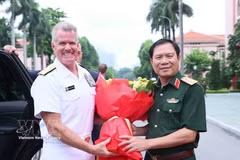
General Nguyen Tan Cuong (right), Chief of the General Staff of the Vietnam People's Army and Deputy Minister of National Defence, welcomes Admiral Samuel Paparo, Commander of the US Pacific Command, in Hanoi on August 5, 2026. (Photo: VNA)

Vietnam prioritises post-war recovery cooperation with US: general staff chief

Defence cooperation between Vietnam and the US has developed positively and been implemented effectively across a range of areas, including post-war recovery, dialogue and consultations, training, United Nations peacekeeping, cooperation between military services and branches, military medicine, defence industry, and humanitarian assistance and disaster relief.

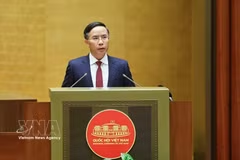
SBV Governor Pham Duc An presents a proposal on a draft law amending and supplementing a number of articles of the Law on the State Bank of Vietnam, the Law on Anti-Money Laundering, and the Law on Credit Institutions at the 16th National Assembly’s first extraordinary session on August 5 (Photo: VNA)

Legal amendments aim to strengthen banking, anti-money laundering framework

The Government said the amendments focus on urgent issues arising from the restructuring of the state apparatus, addressing legal bottlenecks in money laundering prevention and combat in line with recommendations from the Financial Action Task Force (FATF), the Asia/Pacific Group on Money Laundering (APG) and the Organisation for Economic Co-operation and Development (OECD), ahead of the OECD’s review in October 2026 and Vietnam’s eighth progress report to FATF slated for September.

As of June 2026, Vietnam had 499 licensed enterprises providing overseas employment services. (Photo: VNA)

Draft law eases rules for overseas labour services

The Ministry of Home Affairs has proposed amendments that maintain the law's core policies while focusing on three priorities: decentralising state management, cutting and simplifying administrative procedures, and strengthening the application of digital technologies.

President of the National Assembly and Speaker of the House of Representatives of Thailand Sophon Zaram arrives in Hanoi on August 5 morning. (Photo: VNA)

Thai NA President arrives in Hanoi for official visit

The visit underscores Thailand's high regard to its ties with Vietnam and highlights both legislatures' determination to advance parliamentary diplomacy while implementing agreements reached by the high-ranking leaders of the two countries, including the 2023–2028 cooperation agreement between the Vietnamese NA and the Thai House of Representatives.

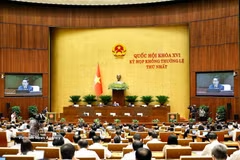
A plenary discussion during the first extraordinary session of the 16th National Assembly (Photo: VNA)

Legislators discuss law revisions to better support Vietnam's overseas workers

The draft amendments to the Law on Vietnamese Guest Workers under Contract aim to strengthen the legal framework and promote decentralisation, science and technology application, digital transformation and the shift from a pre-approval to a post-approval inspection approach while addressing shortcomings in the current law.

The meeting between Minister of Public Security General Luong Tam Quang and a delegation from US-based American Kestrel Global Strategies Group and leading American defence, security, technology and energy companies in Hanoi on August 4 (Photo: bocongan.gov.vn)

Vietnam, US firms seek closer cooperation in defence, security industries

US companies are committed to strengthening dialogue and cooperation with Vietnam's Ministry of Public Security, supporting the country's development objectives while contributing to the deepening of the Vietnam–US Comprehensive Strategic Partnership for the mutual benefit of both governments, businesses and peoples.

☀️ Morning digest on August 5

☀️ Morning digest on August 5

Party General Secretary and State President To Lam's reception for ASEAN ambassadors and chargés d'affaires, Prime Minister Le Minh Hung's attendance at the 33rd Diplomatic Conference, and proposals on the establishment of Quang Ninh, Bac Ninh cities to be submitted to the legislature are among news highlights on August 5 evening.

Nguyen Van Khoi, Vice Chairman of the municipal People's Committee, speaks at the ceremony. Photo: VNA

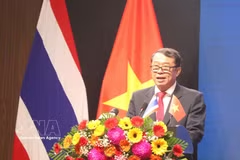
Can Tho marks 50 Years of Vietnam–Thailand diplomatic relations

During the first six months of 2026, Can Tho exported 13.9 million USD worth of goods to Thailand, mainly rice, seafood, agricultural products, and processed foods. Its imports from this market totalled about 3.8 million USD, consisting primarily of textiles, chemicals, and production materials.

An overview of the talks between the delegations of the Ho Chi Minh National Academy of Politics and the Lao National Academy of Politics and Public Administration on August 4. (Photo: VNA)

Vietnam, Laos step up cooperation in political theory, training

The two central theory councils of Vietnam and Laos should step up joint research on strategic issues of mutual concern, closely link theoretical studies with practical reviews and policy consultation, build cooperation networks, connect young theory researchers and publish bilingual research works.

Party General Secretary and State President To Lam meets with ASEAN ambassadors and chargés d'affaires in Hanoi on August 4, 2026. (Photo: VNA)

Top leader meets ASEAN diplomats, calls for united, resilient ASEAN Community

Party General Secretary and State President To Lam highly valued the bloc’s achievements across political, security-defence, economic, socio-cultural and other areas through numerous programmes and initiatives. He voiced confidence that member states would uphold solidarity, strengthen cooperation, reinforce ASEAN's centrality, and successfully realise the ASEAN Community Vision 2045.

Politburo member and Minister of Public Security General Luong Tam Quang (R) welcomes Secretary of State at the Cambodian Ministry of Interior Santibindit Chan Ean in Hanoi on August 4. (Photo: VNA)

Vietnam, Cambodia strengthen security cooperation, law enforcement coordination

​ Politburo member and Minister of Public Security General Luong Tam Quang spoke highly of the annual conference of the Ministers of Public Security/Interior of Cambodia, Laos and Vietnam, describing it as an important cooperation mechanism for strengthening coordination in safeguarding national security and maintaining social order and safety, thereby contributing to a stable environment for socio-economic development.

The National Assembly Standing Committee votes and approves the submission of the proposals on the establishment of Quang Ninh and Bac Ninh cities to the 16th-tenure legislature. (Photo: VNA)

Proposals on establishment of Quang Ninh, Bac Ninh cities to be submitted to legislature

Presenting the Government’s proposals, Minister of Home Affairs Nguyen Tien Hai said the establishment of the two cities and Bac Ninh’s 12 wards has met all political and legal requirements. The proposals are also consistent with the national master plan, plans on the urban and rural system and the Red River Delta region, provincial plans, and general urban planning schemes.

Party General Secretary and State President To Lam, a National Assembly deputy of Hanoi, speaks at the 16th National Assembly's first extraordinary session. (Photo: VNA)

Lawmakers move to tackle traditional, non-traditional security threats

To avoid squandering opportunities and falling behind, the legal and institutional systems must undergo a top-to-bottom review, with legislation brought closer to reality and, where needed, designed to “stay ahead” to create growth rather than scrambling to plug holes after a crisis hits, said top leader To Lam.