Hanoi (VNA) – More than a year into the restructuring and streamlining of the administrative apparatus and the operation of the two-tier local administration model, the focus is now shifting from organisational rearrangement to making the new system work more efficiently, with authority matched by responsibility, resources and capacity to better serve the people.
While initial results have been recorded over the past year, challenges remain in power decentralisation, personnel arrangements, public asset management, digital transformation and education.
Recently, the third plenum of the 14th Party Central Committee called for further internal refinement and a shift of the focus to operational quality, governance capacity and the effectiveness of public services. The Political Bureau issued Plan No. 06-KH/TW, setting out 72 groups of tasks, with clear identification of the agencies in charge, timelines and implementation roadmaps. As the apparatus has been streamlined and made more compact, its operations must become more efficient, with capacity and responsibility matching the extent of authority delegated.
The principle of “the central level sets the direction, the provincial level coordinates, and the commune level implements” needs to be translated into concrete action through measures such as these. Each level assigned a task must be provided with the authority, personnel and resources needed to carry it out. Delegating authority without sufficient resources or clearly defined responsibilities can easily lead to delays and buck-passing, particularly at the grassroots level.
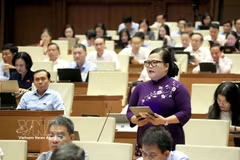
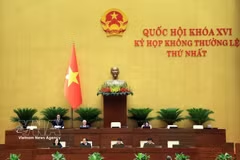
At the National Assembly sessions, deputies also stressed that cutting administrative procedures must not mean reducing management responsibilities, while decentralisation must not lead to fragmented management. Under the two-tier local administration model, provincial-level authorities should serve as the focal point for making decisions, operating databases, and bearing legal responsibility, while commune-level authorities should stay close to local communities, receive public feedback, detect violations, and coordinate in post-licensing inspection efforts.
Each administrative procedure should have a single point of submission, a single electronic dossier and a single result. Information already held by the State should be shared among State agencies themselves, rather than requiring people to seek or provide it again.
Streamlining the organisational apparatus cannot be separated from digital transformation. The Government has requested data to be “accurate, complete, clean, updated, unified and shared”, but achieving this requires civil servants to be capable of using data and working in a digital environment. Without interconnected data, decentralisation will be difficult to implement smoothly. Meanwhile, if civil servants lack the necessary capacity, delegated authority can easily become additional work and pressure.
Ultimately, it is about people. Inspections and supervision of personnel work in Tuyen Quang, Cao Bang and Ca Mau provinces have all focused on personnel arrangements following the restructuring. The apparatus may have changed, and administrative areas may be new, but personnel remain those who directly translate policies into reality.
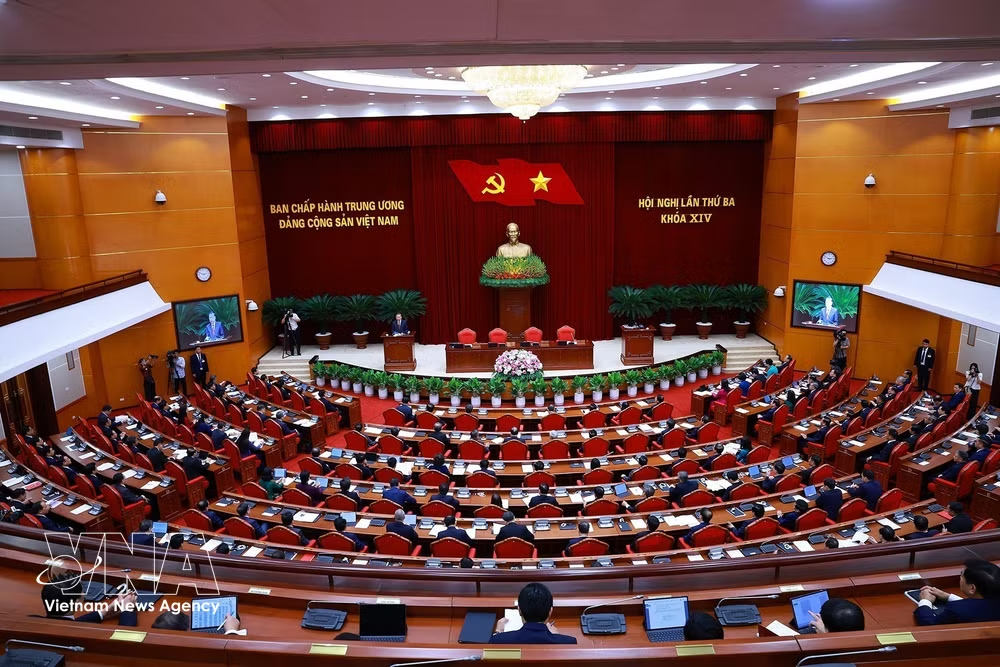
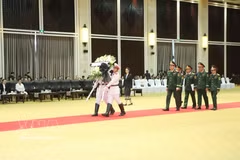
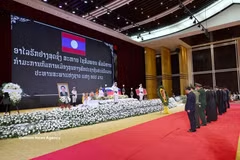
A view of the closing session of the 14th Party Central Committee's third plenum (Photo: VNA)
Ca Mau is a case in point. Since January 1, 2025, the southernmost province has transferred, appointed or nominated 774 cadres to meet operational requirements following the restructuring. It has also reorganised its village and residential quarter system, reducing the number to 830 units, down by 563, while arranging positions and resolving policy entitlements for 1,287 part-time commune-level personnel.
These figures reflect the scale of the restructuring, but streamlining cannot be measured simply by the number of organisations eliminated. Civil servants must be assigned to positions suited to their skills and expertise, while commune-level authorities must have sufficient personnel and professional capacity to carry out their assigned tasks. For areas with large territories, dispersed populations and differing development conditions, staffing and resource allocation cannot be based rigidly on a one-size-fits-all model. The central authorities have requested staffing levels to be managed based on data, population, geographical area, local characteristics and workload, avoiding across-the-board approaches.
Education is one of the areas that will directly test the organisation and operation of the two-tier local administration model. The 2026–2027 academic year is less than a month away. The Prime Minister’s Directive No. 31/CT-TTg has placed education among the areas requiring particular attention from the two-tier local authorities. From the new school year, the requirement is not only to ensure sufficient schools, classes and teachers, but also to change the way education is managed, shifting from “education management” to “governance for education development.”
Central Ha Tinh province is facing a major restructuring. From 652 public educational institutions as of June 30, 2026, it is expected to have 290 schools and five vocational education and continuing education centres after the restructuring, a reduction of 362 establishments. However, the province has stressed that reducing the number of administrative units is not an end in itself. Former school sites will be retained where necessary so that students do not have to travel long distances, while student consolidation or the closure of school sites will only be carried out when conditions are met, and consensus is reached.
Hanoi is also undertaking a major restructuring. In Cua Nam ward, nine public schools have been merged into four, while existing school sites have been maintained to avoid disruption. In Xuan Mai commune, 18 schools have been reorganised into seven.
Reducing the number of schools is only the first step; more importantly, the quality of teaching and learning must be maintained. A single management unit now has to oversee more school sites, a larger workforce and more students while maintaining educational quality. Therefore, the restructuring of schools and classes must take into account population, population distribution, travel distances and conditions in each area. Restructuring management personnel must go hand in hand with increasing the number of teachers directly engaged in teaching. Surplus facilities and assets following the restructuring need to be carefully considered to ensure that they continue to serve people, particularly in education, health care and grassroots institutions.
Another important issue that needs to be addressed is the surplus buildings and land left after the restructuring. A specialised inspection in Hanoi found that 70 building and land facilities already had plans for rearrangement and handling but has yet to be completed. In addition, 13 facilities under three municipal departments and agencies, and 263 facilities under authorities of 65 wards and communes have yet to complete their land-related legal dossiers and have not been granted or had their certificates of land use rights and land-attached asset ownership issued or adjusted.
Meanwhile, three municipal departments and agencies and 16 commune-level authorities still have buildings and land that have not been put into use or are being used inefficiently. Regarding the conversion of their functions, eight wards and communes have allocated surplus buildings and land for cultural and healthcare facilities that do not meet prescribed standards and norms. Hanoi currently has 29 buildings and land lots that need to be put into use soon to unlock resources.
The inspection conclusion on the management of buildings and land at the Ministry of Home Affairs also identified 12 surplus facilities, 10 had incomplete legal documents, some facilities had been left vacant, while disputes and encroachment had persisted in some locations.
These issues need to be addressed in the next phase, guided by the principle that streamlining is intended to make the apparatus work more efficiently. The central authorities will continue to improve institutional frameworks and link decentralisation with resources allocation and power control, while local authorities should proactively organise implementation and promptly report difficulties arising in practice.
Civil servants must be assigned in line with their capabilities and job requirements, data must serve governance, public assets must be dealt with thoroughly, and the necessary conditions for the new school year must be ensured.
After more than a year, the two-tier local administration system has moved beyond the initial restructuring phase and must now focus on the quality of its operations. The next task is to ensure that the new apparatus operates smoothly, with clear assignments and responsibilities, while delivering better services to the people./.