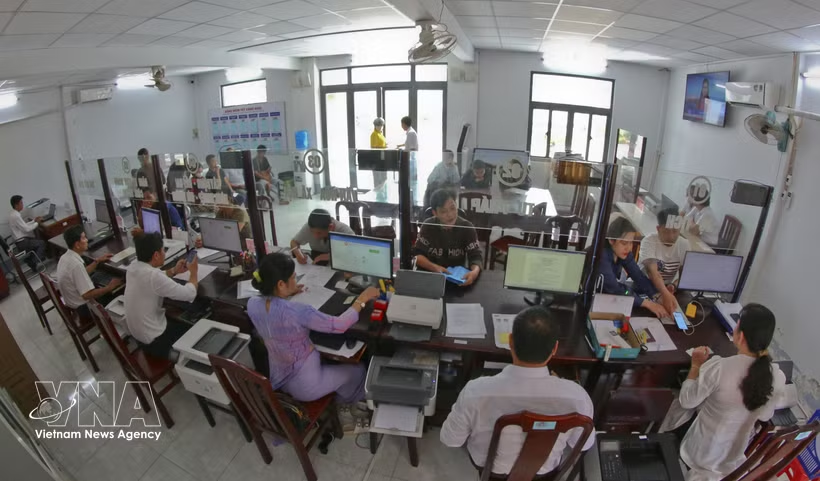
Hanoi (VNA) – Reforming the local administration model to make it leaner, more efficient and more effective is an urgent requirement as Vietnam seeks to accelerate administrative reform, modernise national governance and build a rule-of-law socialist State.
While the reform has produced encouraging initial results, the transition to the new model has inevitably encountered early difficulties and challenges. Hostile forces and political opportunists have sought to exploit these shortcomings by distorting and exaggerating them in an attempt to create public scepticism and undermine confidence in the Party's reform policy and the State's governance agenda.
Exaggerating isolated problems into systemic flaws
Former Vice Chairman of the National Assembly Office Dr. Nguyen Si Dung said reorganising local administration into a two-tier system is a major reform that directly affects the organisational structure of the state apparatus, leadership methods, the allocation of powers and the delivery of public services. It marks a historic step in streamlining the administrative system and improving national governance.
Bottlenecks emerging during implementation should not be viewed as evidence that the reform itself is flawed. Rather, they are natural challenges that accompany any large-scale institutional transition.
According to Dung, there are five main groups of bottlenecks now, including public awareness, legal and institutional frameworks, implementation capacity, digital infrastructure and data systems, and social psychology coupled with vested interests.
While these bottlenecks are objective and subjective issues that need to be addressed, hostile arguments deliberately distort them to deny the correctness of the Party and the State's policy. Such arguments often take genuine but isolated incidents out of their broader context, exaggerate them into systemic problems and then portray them as evidence that the overall reform has failed.
As Vietnam implements the two-tier local administration model, hostile forces have used online platforms and the concerns of some officials and members of the public to spread doubt, stir dissatisfaction and oppose the reform. They have claimed that the new model is "administratively imposed", "driven by political will rather than reality", and "lacks practical foundations".
In reality, these arguments ignore the fact that a multi-layered administrative system with overlapping functions and fragmented responsibilities has become a major obstacle to effective national governance. The reform is not intended simply to reduce administrative levels, but to improve management efficiency, accelerate decision-making, lower administrative costs and provide better public services.
Describing the two-tier local administration model as "subjective" or "voluntarist" is rejecting the objective need for administrative reform and national governance modernisation.
"Streamlining the apparatus does not make the system weaker. It makes the system stronger in a different way: fewer administrative layers but clearer accountability; fewer intermediaries but faster responses; fewer organisational units but greater coordinating capacity," Dung affirmed.
He emphasised that reforming the local administration model is about improving the way Vietnam's rule-of-law socialist State operates rather than changing the nature of the political regime. A leaner and more efficient administrative structure with better public services is intended to strengthen the Party's leadership and better uphold the principle that state power belongs to the people.
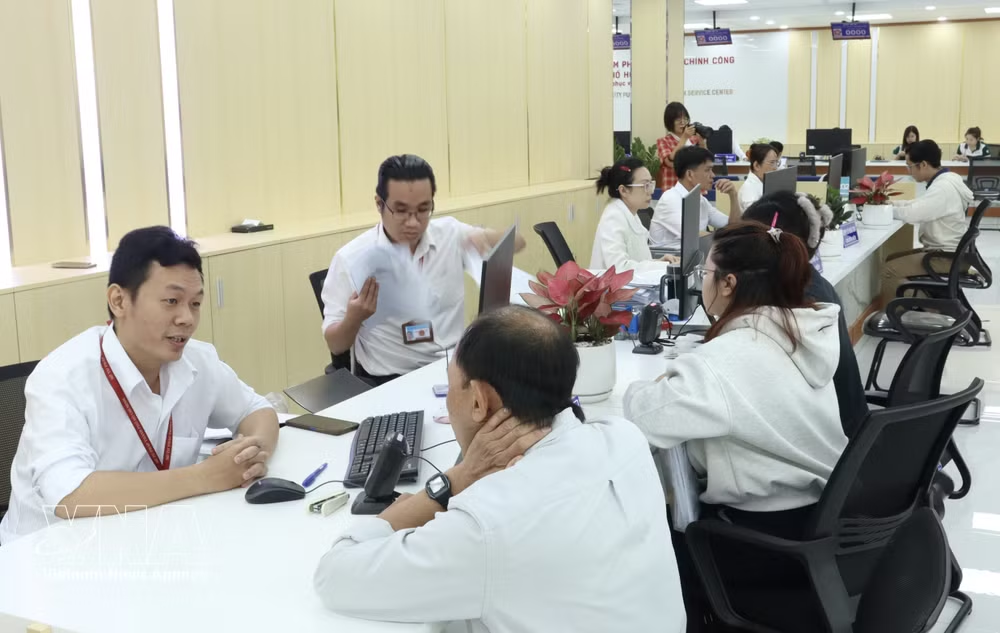
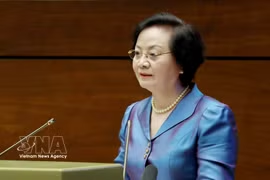
Deputy Prime Minister Pham Thi Thanh Tra said that after one year of operating under the new organisational model of the political system, the three-tier administration structure has demonstrated the soundness, scientific basis and strategic significance of the Party's historic reform policy.
Nationwide, authorities have processed more than 42.5 million administrative applications, with 91.74% submitted online. More than 95% of applications have been handled on schedule while over 16.5 million records, nearly 95% of the total, digitised.
As many as 3,466 administrative procedures and 1,754 business conditions have been cut or simplified, reducing processing time by 53% and compliance costs by 54.6%. Public satisfaction with administrative services has reached 83.08%; 89.09% of respondents said they no longer experienced harassment or unnecessary inconvenience from civil servants.
Refuting one-sided arguments
Dr. Le Thi Chien, Deputy Director of the Department of Science Management under the Ho Chi Minh National Academy of Politics, said that streamlining the apparatus is neither a "subjective wish" of the Party nor an "imposed" policy or a tool for "factional purges" as hostile, reactionary and politically opportunistic forces have claimed.
The policy is grounded in the creative application and development of Marxism-Leninism and the Ho Chi Minh ideology. It is also in line with global governance trends and stems from the country's pressing development needs as Vietnam enters a new era of development.
Restructuring the state apparatus is not a new policy in Vietnam. On October 25, 2017, the 12th Party Central Committee issued Resolution No. 18-NQ/TW on continuing to reform and reorganise the political apparatus into a lean, efficient and effective structure.
After seven years of implementing the resolution, the Party concluded that the organisational structures of Party agencies, State bodies, the Vietnam Fatherland Front and socio-political organisations, from the central to local levels, had been comprehensively reorganised and streamlined. The process reduced the number of agencies and units at both central and provincial levels, cut intermediate layers and gradually perfected the overall structure of the political system.
At the same time, the functions, responsibilities and powers of agencies and organisations were reviewed and clarified further. The number of leadership and management positions, particularly deputy positions, as well as staffing levels, was significantly reduced. Pilot organisational models and the consolidation of leadership positions have also provided valuable theoretical and practical lessons for further institutional reform.
Notably, as Vietnam accelerates the development of science – technology, innovation and digital transformation, the country needs a lean and agile administrative apparatus capable of supporting its aspirations for fast development. This also requires a contingent of civil servants with strong professional expertise, modern skills and innovative thinking so they can quickly adapt to global trends, master advanced technologies and drive breakthroughs in innovation. These are urgent requirements arising from Vietnam's own development realities as the country enters a new era.
Chien noted that the policy of streamlining the organisational apparatus is neither "hasty" nor "subjective", but a strategic decision that has sparked a comprehensive transformation in building the political system as Vietnam moves into a new stage of development.
The policy reflects the convergence of the Party's vision and the people's aspirations to build a political system that is lean, streamlined, effective, efficient and capable of serving national development.
This view was reaffirmed by the 14th National Party Congress, which concluded that the recent restructuring of the organisational apparatus and administrative units had achieved many strategic objectives and represented a historic reform. The policy is right, timely, decisive and effective. It had produced positive changes, won broad support from Party members, officials and the public, and received positive assessments from the international community.
Prof. Dr. Lai Quoc Khanh, Deputy Secretary General of the Central Theory Council, said that one year of operating under the two-tier local administration model has shown that apparatus reform must go hand in hand with changes in governance methods.
He said the reality demonstrates that streamlining the state apparatus and building a two-tier local administration system are not merely administrative reforms. Rather, they reflect Vietnam's transition from a traditional administrative management approach to a modern model of national governance.
The deeper significance of the reform lies in building a political system that is lean, efficient, effective and highly adaptable to the country's evolving development requirements while delivering better services to the people.
Khanh noted that in the current context, studying, understanding and properly implementing the Party's viewpoints on national governance is important both in theory and in practice. This requires officials, Party members and people from all walks of life to fully understand the nature, objectives and core values of modern national governance.
At the same time, they should actively challenge simplistic or one-sided interpretations, as well as distortions that deliberately equate national governance with the depoliticisation of social life, purely technocratic administration, or the denial of the Party's leadership role and the nature of Vietnam's rule-of-law socialist State.
Correctly understanding and effectively implementing the Party's thinking on national governance in line with the spirit of the 14th National Party Congress will help strengthen unity within the Party, build broader social consensus and create a solid foundation for Vietnam's fast and sustainable development in the new era./.