Hanoi (VNA) – Despite repeated allegations by hostile overseas organisations that Vietnam restricts religious freedom, the reality on the ground demonstrates the country's consistent policy of respecting and guaranteeing freedom of belief and religion. Enshrined in the Constitution and codified through the legal system, particularly the Law on Belief and Religion, this right is reflected in Vietnam's increasingly vibrant religious life and growing engagement with the international religious community.
In recent years, whenever the United Nations Human Rights Council (UNHRC) has convened its regular sessions in Geneva, Switzerland, organisations hostile to Vietnam have released one-sided reports distorting the country's human rights situation, particularly concerning freedom of religion and belief.
On the occasion of the 62nd session of the UNHRC, held from June 15 to July 8, the US-based International Christian Concern (ICC) issued a report alleging that Vietnam continues to impose restrictions on religious freedom; Christians in Vietnam still face prosecution and imprisonment for participating in religious groups not recognised by the authorities; and Montagnard communities in the Central Highlands are often forced to practice religion only within frameworks permitted by the Vietnamese State. It also put forward claims of the so-called "persecution of Christians in Vietnam."
Meanwhile, the US-based terrorism-linked organisation “Boat People SOS” (BPSOS) published an article distorting Vietnam's 2026 Law on Belief and Religion, which will take effect on January 1, 2027, claiming that the new law will pose a serious threat to religious organisations.
Notably, such allegations are nothing new and are little more than recycled claims. In its “2026 Annual Report on International Religious Freedom”, released during the 61st session of the UNHRC from February 23 – March 31, the US Commission on International Religious Freedom (USCIRF) also relied on unverified, biased and preconceived sources to conclude that religious freedom in Vietnam continued to deteriorate, while recommending that the US Congress and Government designate Vietnam as a “country of particular concern” (CPC) for religious freedom.
As the world becomes increasingly diverse in terms of culture, religion and governance models, interpretations and assessments of religious freedom have become a topic of debate in many international forums. Even among countries that frequently advocate religious freedom standards, there is no universally accepted interpretation of the concept.
France bans women from wearing headscarves in public places, including female athletes competing at the Paris 2024 Summer Olympics, and also prohibits female students in public schools from wearing garments covering the body from shoulders to ankles traditionally worn by Muslim women. However, many civil society and human rights organisations argued that these measures risk undermining the right of part of Muslims to express their religious identity.
In Sweden, a series of Quran burnings in 2023 triggered widespread protests across the Muslim communities, strained diplomatic relations, and sparked intense debate over the boundaries between freedom of expression and the responsibility to respect the religious beliefs of different communities.
A ruling by the Supreme Court of the US in 2022 allowing a public school football coach to pray on the field after games also sparked controversy. Supporters viewed the decision as protecting freedom of religion under the US Constitution, while critics argued that it could blur the line between state and religion in the public education system.
These examples demonstrate that any assessment of the religious situation in a given country must be viewed within its own historical, cultural, social and legal context. It must also be based on first-hand observation, direct dialogue, and a multi-dimensional approach, rather than relying solely on one-sided sources of information or preconceived judgments.
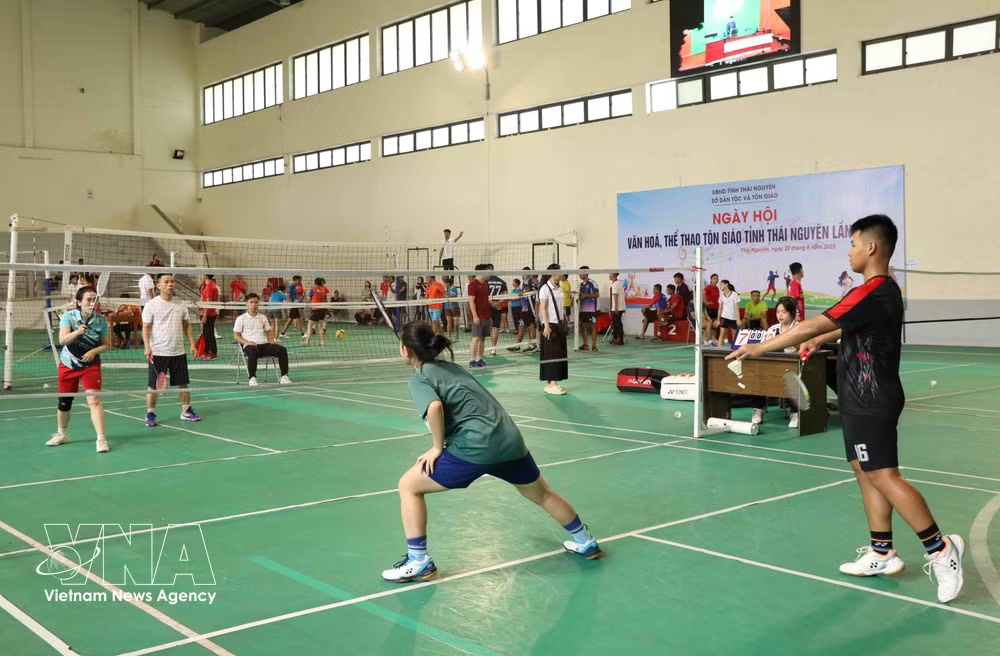
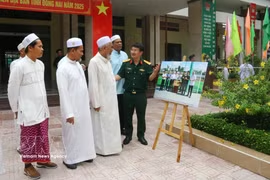
The 4th culture and sports festival of religious followers in Thai Nguyen province in 2025 (Photo: VNA)
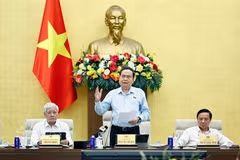
Regarding Vietnam, the above allegations of "restrictions on religious freedom" ignore the clear fact that Vietnam has consistently pursued a policy of respecting and guaranteeing the right to freedom of belief and religion for all. This is one of the fundamental rights of Vietnamese citizens, enshrined in the Constitution and codified through the legal system, particularly the Law on Belief and Religion. The passage of the revised Law on Belief and Religion by the 16th National Assembly at its first session in late April marked an important milestone, reflecting Vietnam's commitment to further improving its legal framework to better safeguard everyone's right to freedom of belief and religion, while creating more favourable conditions for religious organisations to operate stably in accordance with the law, and play an increasingly positive role in society.
The NA’s continuous efforts to establish a more transparent and open legal framework have created favourable conditions for religions to operate and develop in accordance with Vietnam's Constitution and law. Before 1990, Vietnam officially recognised only three religious organisations. To date, the State has recognised and granted registration certificates to 43 organisations representing 16 religions, with more than 27.7 million followers (accounting for about 27% of the population), over 61,000 dignitaries, nearly 145,000 subordinates, and almost 30,000 places of worship.
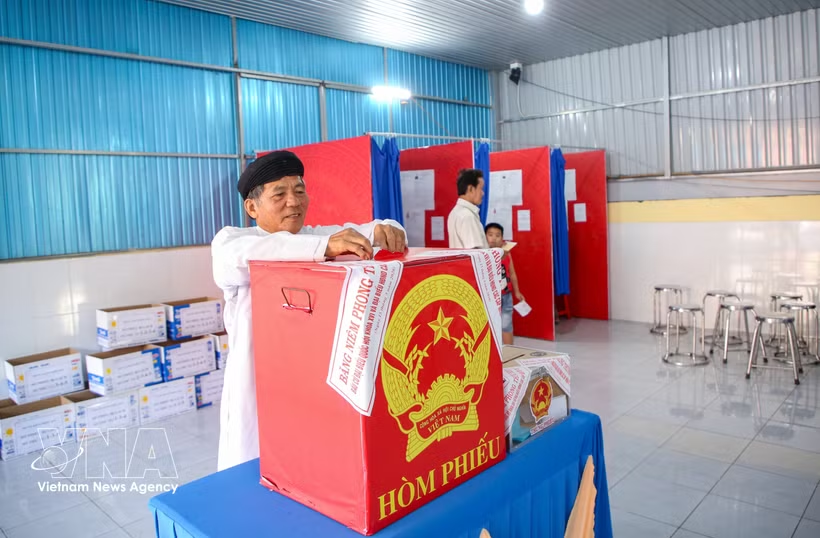
The Party and State have consistently provided alll possible conditions for religious followers to live a good secular and religious life, while accompanying the nation. Among the 500 deputies elected to the 16th NA are 16 religious dignitaries and followers representing Buddhism, Catholicism and Brahmanism.
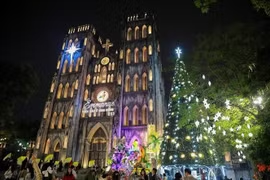
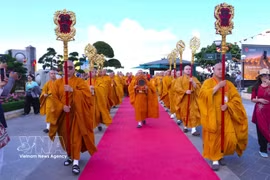
Major religious celebrations have been held on an increasingly larger scale, attracting growing numbers of believers and the public alike, including Vesak for Buddhists, Christmas and Easter for Catholics and Protestants. Many large religious facilities and new places of worship have been built or restored using social contributions and donations from believers, with the State facilitating land and construction procedures in accordance with the law.
Last year, Vietnam successfully hosted the 2025 United Nations Day of Vesak, welcoming more than 1,300 delegates from 85 countries and territories, including senior Buddhist dignitaries, scholars and leaders of international Buddhist organisations. During the event, participants directly experienced and learned about religious and belief practices in Vietnam.
The Ho Chi Minh City Declaration adopted at the event stated: "The fourth UN Day of Vesak held in Vietnam has enabled us to better understand the rich, diverse and free religious life in the country. We have clearly witnessed the strong commitment and practical efforts of the Party and State of Vietnam in respecting and guaranteeing every citizen's right to freedom of belief and religion."
Vietnam–Vatican relations were officially upgraded to the level of resident representative, and the Holy See appointed an Archbishop as its Resident Papal Representative in Vietnam in December 2023.
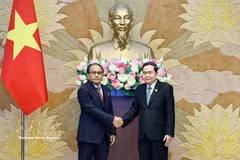
During a meeting with NA Chairman Tran Thanh Man during the high-ranking Vietnamese delegation's visit last April, Pope Leo XIV at the Vatican thanked the Vietnamese authorities for facilitating and supporting the Resident Papal Representative’s stable and effective operation in Vietnam.
Vatican Secretary of State Cardinal Pietro Parolin highly valued Vietnam's development achievements and its open religious policy, expressing particular appreciation for the consistent attention paid by the Vietnamese Party and State to vulnerable and disadvantaged groups.
In Vietnam, only organisations and individuals that exploit religion and belief to violate the law, undermine national security, sow division among ethnic groups, disrupt social order, and entice people to join heretical sects that run counter to the nation's cultural values and traditions are subject to legal action in accordance with the law.
These undeniable realities clearly demonstrate Vietnam's consistent respect for and protection of every citizen's right to freedom of belief and religion. This is an undeniable fact that no biased report can distort or misrepresent. Rather than repeatedly imposing outdated and distorted narratives about religious freedom in Vietnam, what is needed is to promote dialogue, enhance mutual understanding, and respect differences in history, culture and development conditions. Only on that basis can assessments of religious freedom accurately and comprehensively reflect the realities on the ground./.