Expert gives advice to Vietnam’s semiconductor sector from Malaysia’s experience

Malaysia, Vietnam, Singapore, Thailand and the Philippines could build an “ASEAN semiconductor corridor”, with each country contributing distinct strengths ranging from packaging and testing to electronics manufacturing and talent development, said Malaysian economist Samirul Ariff Othman.

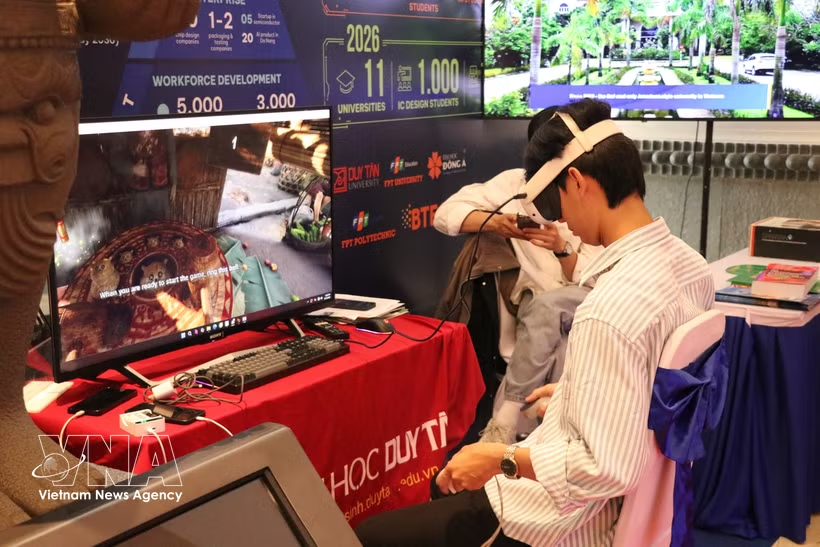
Visitors explore the exhibition area at the Da Nang Semiconductors and High-Tech Conference 2026 (Photo: VNA)

Kuala Lumpur (VNA) - Economist Samirul Ariff Othman, a policy and geopolitical analyst at Global Asia Consulting and visiting lecturer at Universiti Teknologi PETRONAS, has shared Malaysia’s 50-year experience in developing the semiconductor industry, highlighting that the key lesson for Vietnam is that building a semiconductor ecosystem requires patience, sequencing and depth.

The industry cannot be built through incentives alone; it requires coordinated development among universities, technical institutes, supplier networks, logistics infrastructure, utilities, management capabilities and consistent long-term policies, he underscored.

Othman said Malaysia’s National Semiconductor Strategy (NSS) sets concrete targets of attracting 125 billion USD in investment, providing 6.25 billion USD in fiscal support and training 60,000 highly skilled engineers to build at least 10 leading Malaysian semiconductor companies.

The strategy’s key strength, he said, lies in its pragmatism. Rather than immediately seeking to compete in advanced chip manufacturing with Taiwan (China), the Republic of Korea or the US, Malaysia is upgrading from an established position, currently accounting for around 13% of the global semiconductor testing and packaging market.

While downstream assembly creates jobs and export volumes, IC design and equipment generate deeper technological capabilities, higher margins and stronger domestic companies. However, he warned that Malaysia must avoid becoming merely an effective “home” for foreign companies while domestic suppliers and engineers remain only superficially integrated into the value chains.

Regarding Vietnam’s target of training 50,000 semiconductor workers by 2030, Othman described it as ambitious and comparable in scale with Malaysia’s goal of 60,000 engineers. However, he stressed that the key issue is not simply numbers. Vietnam needs specialised training for IC design engineers, process engineers, packaging specialists, equipment technicians, materials experts and production managers.

Another important lesson is the integration of domestic suppliers. Othman pointed out that many Malaysian companies remain beneath multinational corporations rather than being integrated into their high-value supply chains. He therefore recommended that Vietnam avoid becoming merely a low-cost assembly location and encourage domestic firms to move deeper into precision engineering, cleanroom services, chemicals, substrates, automation and maintenance.

Infrastructure is another critical factor. Semiconductor investors require highly reliable electricity, water and logistics, as well as predictable regulations, areas Vietnam needs to pay particular attention to as it seeks to attract major investors in the sector.

From a regional perspective, Othman sees Vietnam and Malaysia as both competitors and potential partners. While the two countries compete for FDI, talent and tax incentives, strategically they should view each other as complementary partners in a shared ASEAN semiconductor ecosystem. Malaysia has an advantage in the depth of its established electrical and electronics (E&E) ecosystem in Penang, while Vietnam offers scale, manufacturing momentum and strong geopolitical appeal.

Rather than pursuing isolated national projects, he suggested that Malaysia, Vietnam, Singapore, Thailand and the Philippines could build an “ASEAN semiconductor corridor”, with each country contributing distinct strengths ranging from packaging and testing to electronics manufacturing and talent development.

Othman said the real challenge is not competition from neighbouring countries, but whether ASEAN can transform itself from fragmented assembly hubs into an integrated semiconductor manufacturing region. He said he believes Vietnam’s ambitions and Malaysia’s NSS should be viewed as parts of the same regional story, reflecting Southeast Asia’s efforts to move from being merely a manufacturing base to becoming a strategic link in the global technology economy./.
VNA

See more

A view of the press conference. (Photo: VNA)

2026 Banking Sector Digital Transformation to open in Hanoi

The annual event, which will be held on August 18-19, 2026, at the ICE International Exhibition Centre, 91 Tran Hung Dao Street, Hanoi, is expected to attract around 324 delegates and feature 21 booths representing credit institutions, payment intermediary service providers, and technology companies.

SME products livestreamed on the digital platform of Ca Mau Radio and Television Station.( Photo: VNA)

Digital transformation key to unlocking SME growth in Vietnam

Science, technology, innovation and digital transformation have become strategic imperatives directly linked to labour productivity, competitiveness, growth quality and the economy's self-reliance, with sci-tech application and innovation by small and medium-sized enterprises (SMEs) playing an important role.

New Zealand apples on sale at a supermarket in Vietnam (Photo: VNA)

Vietnamese consumers develop taste for Australian, New Zealand fruit

According to statistics from the Department of Customs, in the first six months of 2026, Vietnam imported 102.8 million USD worth of fruit, vegetables and flowers from Australia, up 55.7% from the same period last year. Australia's share of total imports rose from 5.5% to 6.51%, highlighting the growing position of the market as a supplier. Imports from New Zealand reached 78.04 million USD, up 20.4% year-on-year.

Semiconductor products, chips and components displayed at a ceremony to launch a national centre for semiconductor chip pilot production support in Hanoi on June 26. (Photo: VNA)

US semiconductor push offers Vietnam opportunities, policy challenges

The Vietnam-US semiconductor partnership is therefore not simply a “golden opportunity” arising from geopolitical shifts, but also a long-term test of Vietnam’s institutional reform and implementation capacity. If domestic capacity cannot keep pace, adjusting targets toward quality and execution, rather than simply expanding the number of projects, will be essential.

Workers process fruit for export at the Chanh Thu factory in Cho Lach commune, Vinh Long province. (Photo: VNA)

Vietnam works to maintain edge in key agricultural market

According to Le Hang, Deputy Secretary-General of the Vietnam Association of Seafood Exporters and Producers (VASEP), China and Hong Kong (China) remained bright spots for Vietnam’s aquatic exports in July, with revenue exceeding 267 million USD, up 24.7% year-on-year.

An estimated 6,300 workers are needed by the semiconductor industry in Bac Giang province during the 2025-2030 period. (Photo: VNA)

India's semiconductor strategy complementary to Vietnam's chip sector: expert

Sudhanshu Mittal, Director of Engineering Solutions at the National Association of Software and Service Companies (Nasscom) of India, noted that during the state visit to India by General Secretary of the Communist Party of Vietnam Central Committee and President To Lam in May, the two countries signed a number of cooperation agreements, with semiconductors identified as a priority area alongside artificial intelligence (AI), cybersecurity, and advanced technologies.

At the working session between Vietnamese Minister of Finance Ngo Van Tuan (right) and RMIT University’s Vice-Chancellor and President Professor Alec Cameron in Sydney on August 10 (Photo: tapchikinhtetaichinh.vn)

Vietnam, Australia seek to expand investment in rice value chain

During General Secretary of the Communist Party of Vietnam Central Committee and President To Lam’s state visit to Australia from August 9-12, Vietnamese Minister of Finance Ngo Van Tuan, authorised by the General Secretary and President, held working sessions with SunRice Group CEO Paul Serra and RMIT University’s Vice-Chancellor and President Professor Alec Cameron in Sydney on August 10.

Lawmakers on August 9 discuss a draft law amending and supplementing a number of articles of the Law on the State Bank of Vietnam, the Law on Anti-Money Laundering and the Law on Credit Institutions. (Photo: VNA)

Lawmakers discuss measures to ensure banking system safety, support digital economy

The draft law sets out provisions to control conflicts of interest when commercial banks act as agents managing collateral for corporate bonds. In this regard, Deputy Le Van The of Ninh Binh province said he supported the move, noting that it could provide a more professional approach to collateral management and help strengthen investor confidence if properly regulated.