Education ministry reveals plan to develop elite universities

​A group of 25-30 key institutions will be responsible for training skilled workers that will provide leadership in their respective regions and sectors. The remaining institutions will focus on practical, career-oriented training.

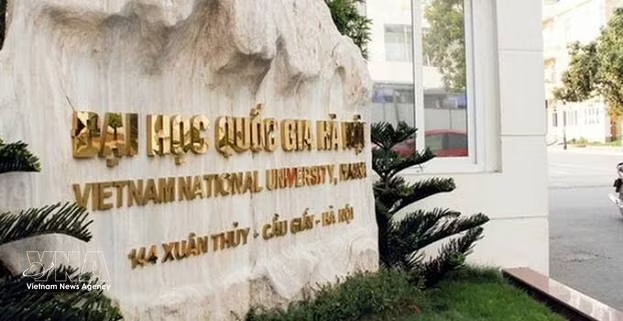
The Hanoi campus of Vietnam National University (VNU). The institution has been selected for development into one of the country's most elite universities by 2030. (Photo: VNA)

Hanoi(VNS/VNA) - A plan to stratify the higher education network and develop universities with unique strengths was revealed by the Ministry of Education and Training on August 10.

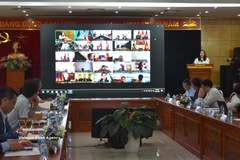
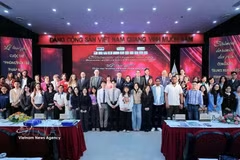
Education officials and university representatives gathered at a conference in Hanoi to discuss the plan.

It is one of several steps being taken to actualise goals set in the Political Bureau’s Resolution 71 on creating breakthroughs in education and training, as well as in the Government's the Higher Education Development Strategy and the master plan for building a higher education institution network.

Speaking at the event, Deputy Minister of Education and Training Le Quan said that quality must become a keyword and an inherent value in Vietnam’s higher education system.

“Quality should not be defined solely by each institution, but must align with standards that meet the development needs of the country and the world,” he said.

While Vietnam has a high proportion of students graduating with honours, there are still graduates who remain unemployed, or work in fields unrelated to their majors, preventing them from fully using their abilities.

To fix this, higher education needs to shift from degree-based training and recruitment to an assessment of competence, focusing on what students can actually do after graduation, Quan said.

On the other hand, the system will also be stratified to meet different development needs, he added.

Some higher education institutions will be given the opportunity to focus on boosting their unique strengths.

The education ministry will develop a set of criteria to screen and select these institutions to develop into elite or excellent universities across different disciplinary groups, according to Quan.

Selected institutions will be required to clearly define their admissions and graduation standards, training processes and conditions for ensuring student quality. They may also register and select their areas of strength for development.

The criteria will not be rigid and applied to all schools, Quan said. Instead, the country’s needs will be identified in a stage-based roadmap for the 2026-30 period, from which each institution can develop their specific strengths accordingly.

A key requirement of this strategy is that institutions concentrate resources on strategic areas rather than spreading them too thinly, Quan noted.

“Universities need to take on challenging tasks and reallocate resources to establish their excellence and key areas of specialisation,” he said.

The stratification of the higher education network has also been studied by the ministry’s Department of Higher Education, said department director Nguyen Tien Thao.

According to the department’s strategy for higher education development through 2035 and to 2045, in the next decade, Vietnam aims to establish a group of three to five elite universities that will focus on cutting-edge research, international competitiveness and core innovation.

A group of 25-30 key institutions will be responsible for training skilled workers that will provide leadership in their respective regions and sectors.
The remaining institutions will focus on practical, career-oriented training.

“The stratification is designed to be dynamic and competitive, involving periodic assessments linked to each institution's mission, objectives, key performance indicators, resources and outputs,” said Thao.

“The guiding principle is that institutions will be allowed greater autonomy, but that will be accompanied by greater accountability.”

According to vice President of Vietnam National University Hanoi Dao Thanh Truong, Prime Minister Le Minh Hung has approved the institution for development into an elite research university by 2030. Goals set include 80% of its academic staff holding doctoral degrees and research in specific fields, such as artificial intelligence and semiconductor development, ranked among the world's top 100.

“Becoming an elite university requires a qualitative transformation,” he said. “We will have to shift from fragmented operations to integrating systemic strength, from scaling up to prioritising quality and talent development, and from merely generating academic results to creating social impact.”

To reach these overall goals, VNU proposed that the Government and education ministry allocate resources based on specific tasks and requirements, while simultaneously establishing systems to identify, nurture and enable institutions to collaborate and leverage their strengths./.

VNA
See more

Head of the CPV Central Committee’s Commission for Publicity Trinh Van Quyet tours ABC facility (Photo: VNA)

Vietnam, Australia cultivate media cooperation in digital age

Vietnam always attaches importance to people’s right to access information and is committed to building a professional, humane, and modern press. Vietnamese media do not just deliver timely news but also play a crucial role in projecting Vietnamese culture, image, land, and people to the world.

Vietnam takes effective steps to build seamless digital ecosystem for foreigners

Vietnam takes effective steps to build seamless digital ecosystem for foreigners

Despite recognising Vietnam’s progress in digital transformation, many foreigners living in the country believe that digitising individual services is only the first step. What they expect is a seamlessly connected digital ecosystem in which a single electronic identity allows users to access services and conduct transactions conveniently and securely.

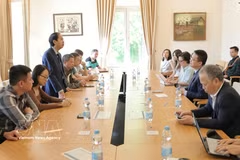
Assoc. Prof. Dr. Nguyen Van Tung, a member of the Members' Council of the Vietnam Education Publishing House, speaks at a meeting with the Vietnamese Embassy. (Photo: VNA)

Vietnam-Germany cooperation strengthened in educational publishing

The VEPH is conducting a working and study visit to Germany from August 8-14 to learn from advanced models for the production and distribution of e-books and digital learning materials. The delegation is led by Assoc. Prof. Dr. Nguyen Van Tung, a member of the VEPH Members' Council.

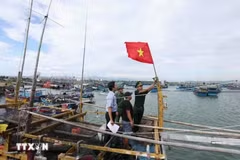
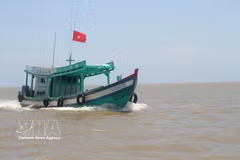
Border guards inspect vessel monitoring equipment on a fishing boat before it heads out to sea. (Photo: VNA)

Khanh Hoa aims at lifting EC ‘yellow card’, sustainable fisheries

According to the department, as of the end of June, 99.9% of eligible fishing vessels in the province had been issued fishing licences, while 100% of vessels measuring 15 metres or more had been fitted with vessel monitoring system (VMS) devices and all vessels had been marked and numbered in accordance with regulations.

Representatives of the General Association of Vietnamese People in Laos and the Association of Vietnamese People in Vientiane lay a wreath and observe a minute of silence in memory of Lao National Assembly President Xaysomphone Phomvihane. (Photo: VNA)

Vietnamese associations in Laos pay tribute to Lao NA President

In the condolence book, representatives of the General Association of Vietnamese People in Laos and the Association of Vietnamese People in Vientiane expressed their profound sorrow over the passing of comrade Xaysomphone Phomvihane, saying his passing was not only a great loss to the Lao Party, State and people, but also meant that Vietnam lost a close and trusted friend and comrade.

Overview of the workshop on building and developing networks of experts and intellectuals in strategic technology fields. (Photo: VNA)

Vietnam eyes global network of overseas Vietnamese experts in strategic technologies

In recent years, networks of OV experts and intellectuals have been established, with nearly 2,000 members. Five innovation and expert networks have also been formed in strategic technology areas such as artificial intelligence, semiconductors, quantum technology, cybersecurity, aviation, aerospace and unmanned aerial vehicles, connecting around 50 expert and intellectual associations overseas.

Young people take part in activities at the event to mark International Youth Day 2026 in Hanoi on August 9 (Photo: VNA)

Over 40 youth-led initiatives introduced at International Youth Day 2026

The event, organised by the Youth Advisory Group of the UN in Vietnam, brought together 44 youth groups, social enterprises, educational institutions and UN-supported programmes. Exhibition booths and interactive activities at the event introduced solutions created and led by young people.

The flag-raising ceremony at the A Pa Chai flagpole in Sin Thau commune, Dien Bien province (Photo: VNA)

“I Love My Fatherland” journey reaches Dien Bien

The "I Love My Fatherland" journey is an annual nationwide programme aimed at promoting patriotism, revolutionary ideals and civic responsibility among Vietnam's youth through visits to historical, cultural and sovereignty landmarks across the country.

Officers of the Dong Thap provincial Border Guard give gifts and provide information on IUU fishing control and prevention to fishermen at Vam Lang fishing port, Gia Thuan commune, Dong Thap province. (Photo: VNA)

Dong Thap tightens fishing vessel management

The provincial Department of Agriculture and Environment, acting as the standing agency of Dong Thap's IUU Steering Committee, has been tasked with reviewing and updating the province's action plan to address recommendations raised during the EC's fifth inspection mission on Vietnam's anti-IUU efforts.

At the launch ceremony (Photo: VNA)

French-language newspaper launches video contest

The contest, announced this week, is a video-based evolution of the newspaper's 'Jeunes Reporters Francophones' competition, which has run for ten seasons since its 2016 launch with backing from the Asia-Pacific regional office of the International Organisation of La Francophonie (OIF).

Since the beginning of the year, Ca Mau provinces have inspected 100% of fishing vessels arriving at and departing from designated fishing ports in accordance with regulations. (Photo: VNA)

Ca Mau launches peak campaign to combat IUU fishing

As one of Vietnam’s largest fishing centres, with an extensive coastline and a sizeable offshore fleet, Ca Mau considers combating IUU fishing a top political priority. Provincial authorities said recent efforts have yielded positive results, particularly in fisheries management and law enforcement.

A consumer scans a product code to check its origin (Photo: VNA)

Legal safeguards for consumers in digital economy strengthened

Part of the Government's plan to implement the Law on Protection of Consumers’ Rights for the 2024-2026 period, the event highlighted key provisions of the law and its guiding documents, while updating participants on decentralised state management, complaint handling, dispute resolution and inter-agency coordination.