📝 OP-ED: Foreign policy must serve the national interest

It is no coincidence that Resolution No. 06-NQ/TW identifies foreign affairs as a key, regular task. In a world changing rapidly and marked by uncertainty, any disagreement or shift in relations among major powers can have a direct impact on Vietnam’s development environment.

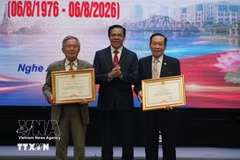
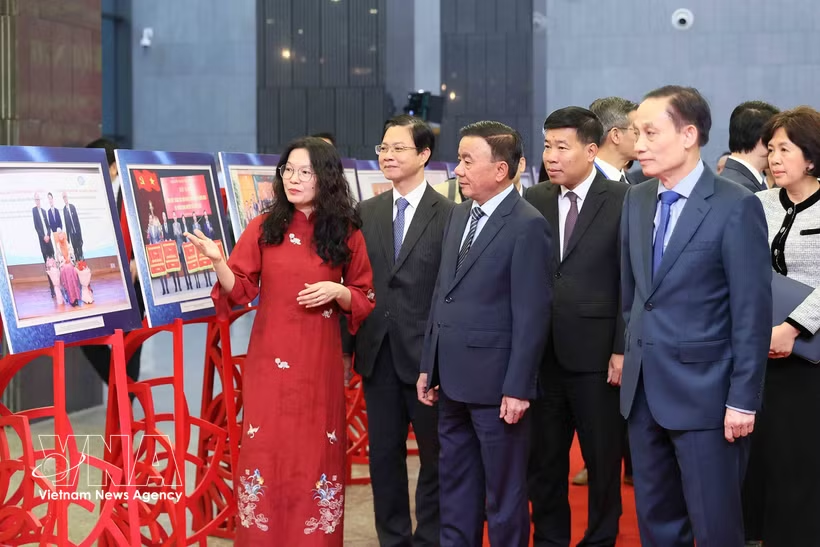
Politburo member and standing member of the Party Central Committee’s Secretariat Tran Cam Tu and delegates visit an exhibition showcasing outstanding images on people-to-people diplomacy activities in 2025. (Photo: VNA)

Hanoi (VNA) – The Communist Party of Vietnam (CPV) now places foreign affairs among the country’s key, regular tasks, alongside national defence and security. This marks a shift in thinking, with foreign policy expected to move one step ahead, helping safeguard the country early and from afar, while opening up greater space, resources and opportunities for development. In practice, this requirement is gradually being translated into concrete action.

It is no coincidence that Resolution No. 06-NQ/TW identifies foreign affairs as a key, regular task. In a world changing rapidly and marked by uncertainty, any disagreement or shift in relations among major powers can have a direct impact on Vietnam’s development environment.

General Secretary of the CPV Central Committee and President To Lam has also stressed that domestic and foreign affairs always go hand in hand and complement each other; foreign affairs are the extension of domestic affairs. If the country is to develop, it cannot simply focus on getting its own house in order. It must also know how to open its doors in the right direction, choose the right partners for cooperation, turn relationships into tangible benefits, and transform trust into concrete markets, technologies and knowledge.

Vietnam’s relationship with Malaysia illustrates this clearly. In the first half of 2026, bilateral trade reached 10.8 billion USD, up 40% from the same period in last year. The two countries have maintained a Comprehensive Strategic Partnership since November 2024. Yet the goal now is not merely to preserve good relations, but to deepen them further, creating greater openness and facilitating economic, trade and investment cooperation in a balanced direction, while promoting the digital economy, green economy, science and technology, and innovation. The target of raising bilateral trade to 20 billion USD underlines the same requirement.

The direction is equally concrete in relations with the US. Vietnam regards the US as one of its foremost partners of strategic importance, while calling for the early conclusion of negotiations on a reciprocal trade agreement and urging restraint in the use of excessive trade-defence measures that could affect the overall bilateral relationship. The two sides also need to promote mutually beneficial cooperation in science and technology. Achieving breakthroughs in science and technology, innovation and national digital transformation is a priority for Vietnam as it pursues its strategic growth objectives.

The same requirement applies to foreign capital and businesses. Vietnam is not merely seeking to attract investment; it is increasingly focused on selecting projects that bring good technology and are aligned with the country’s domestic development needs. The decision by Germany’s LAPP to regard Vietnam as a key market, amid rising demand from AI data centres, automation, renewable energy and smart infrastructure, is one example. This is precisely the direction set out in Resolution No. 06-NQ/TW, which is moving from “attraction” to “selectivity”, with priority given to high technology and projects that establish deep linkages with the domestic economy.

The resources available for development do not lie solely in investment projects or overseas markets. The more than 6.5 million Vietnamese living abroad are also a source of national strength. Remittances rose from 2.3 billion USD in 2004 to 17.7 billion USD in 2025. Total remittances sent to Vietnam from 1993 to the present, although the figures are not yet complete, have exceeded 250 billion USD, equivalent to disbursed FDI over the same period. These figures show that overseas Vietnamese are not simply people to be mobilised and cared for; they are genuinely a resource for the country.

Resolution No. 23-NQ/TW takes this thinking a step further, moving from mobilising, bringing together and caring for overseas Vietnamese to accompanying them and creating enabling mechanisms. Experts, scientists, entrepreneurs, intellectuals and young people abroad can contribute not only by returning to Vietnam, but also from afar, through networks connecting knowledge, technology, investment and markets. When each Vietnamese representative office becomes a hub connecting Vietnamese resources in its host country or locality, foreign affairs will be brought much closer to the task of national development.

For these resources to translate into real-world benefits, foreign affairs must also reach localities, businesses and the people. Thailand and Vietnam have just marked the 50th anniversary of their diplomatic relations. In Can Tho, cooperation has been given concrete form through business connections, investment, trade, tourism and education. In 2025, Thai investment in the Mekong Delta city stood at approximately 119.25 million USD. In the first six months, Can Tho exported around 13.9 million USD worth of goods to Thailand and imported 3.8 million USD. The figures show that foreign policy only truly matters when it is connected to products, markets and development needs.

Looking beyond the local level to the wider region, the Association of Southeast Asian Nations (ASEAN) is an important space for Vietnam to expand cooperation. Vietnam has been a member of the organisation for 31 years and is working with other member states towards a united and resilient community that maintains its central role. In a region of around 800 million people, strengthening the bloc is also a means for Vietnam to expand its strategic space and create greater room for development.

Yet as cooperation expands, foreign affairs must go hand in hand with national defence and security to create a position of strength. Vietnam-Malaysia cooperation in defence, security and law enforcement at sea; cooperation with Cambodia in combating transnational crime; and exchange of views on the East Sea on the basis of international law all demonstrate how a “security-development belt” can be built on trust, coordination mechanisms and the ability to resolve differences through peaceful means.

The 258.939-km Vietnam-Cambodia border is another manifestation of this requirement in everyday life. A peaceful border is maintained not only by forces tasked with protecting national sovereignty, but also through good-neighbourly relations, people-to-people exchanges, economic cooperation and consensus at the grassroots level. If done well, safeguarding sovereignty and expanding cooperation can reinforce one another.

It is increasingly clear that foreign affairs are becoming ever more closely intertwined with national development. As General Secretary and President Lam has stressed, Vietnam remains steadfast in pursuing a foreign policy of independence, self-reliance, self-strengthening, peace, friendship, cooperation and development, multilateralisation and diversification of external relations.

Maintaining a firm national standing, opening up avenues for cooperation and building the national strength needed to ensure that the country’s voice carries weight and influence: this is how the foreign-policy orientation set out at the 14th National Party Congress is translated into practice – safeguarding the country early and from afar, while opening the way towards rapid, sustainable and self-reliant development./.

VNA
See more

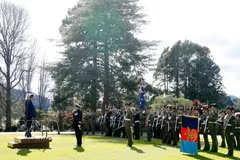
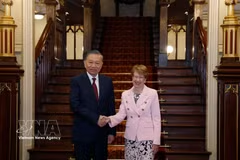
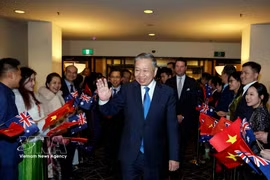
Australian Governor-General Sam Mostyn hosts a welcome ceremony for General Secretary of the Communist Party of Vietnam Central Committee and President To Lam in Canberra on August 11 morning (Photo: VNA)

Australian Governor-General hosts welcome ceremony for top Vietnamese leader

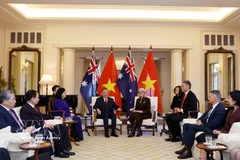
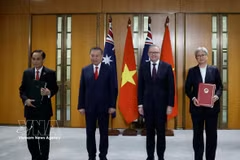
Following the welcome ceremony, General Secretary and President Lam held a meeting with Governor-General Mostyn, and talks with Prime Minister Anthony Albanese. He witnessed the exchange of cooperation documents and met the press. He also had meetings with the President of the Australian Senate and the Speaker of the House of Representatives.

Politburo member and Secretary of the Ho Chi Minh City Party Committee Tran Luu Quang leads a delegation from the city's leadership in paying tribute to President of the National Assembly of Laos Xaysomphone Phonvihane at the Lao Consulate General on August 10, 2026. (Photo: VNA)

Ho Chi Minh City leaders pay tribute to late Lao National Assembly President

The municipal Party Committee, administration, and people has lost a close comrade who paid special attention to preserving the great friendship, special solidarity, comprehensive cooperation, and strategic cohesion between Vietnam and Laos, including the friendship and cooperation between Ho Chi Minh City and Lao localities.

General Secretary of the Central Committee of the Communist Party of Vietnam (CPV) and President To Lam (R) receives Nicholas Moore, Australia’s Special Envoy for Southeast Asia, in Sydney on August 10. (Photo: VNA)

Top leader receives Australian Special Envoy for Southeast Asia

General Secretary of the Central Committee of the Communist Party of Vietnam (CPV) and President To Lam said Vietnam considers Australia one of its leading important partners in the Indo-Pacific region, noting that bilateral relations are facing many new opportunities and the Australia-Vietnam Comprehensive Strategic Partnership should continue to be advanced in an increasingly substantive and effective manner.

Ambassador Nguyen Minh Tam leads the delegation from the Vietnamese Embassy, and other Vietnamese representative agencies, as well as the Vietnamese community in Laos, to pay their respects to President of the Lao National Assembly Xaysomphone Phomvihane (Photo: VNA)

Vietnamese Embassy, community pay tribute to Lao National Assembly President

Writing in the condolence book at the memorial service, Ambassador Nguyen Minh Tam, on behalf of the Vietnamese Embassy, representative agencies, and community in Laos, expressed profound sorrow and conveyed his deepest condolences to the Lao Party, State, National Assembly and people, and the bereaved family.

Vietnamese Ambassador to the Czech Republic Duong Hoai Nam speaks on Resolution No. 23. Photo: VNA

Resolution 23: Four networks connecting OV intellectuals, experts to be established

Overseas Vietnamese are regarded not only as an integral part of the Vietnamese nation but also as an important strategic resource contributing to national strength. They serve as a bridge between Vietnam and the world and participate directly in the cause of national construction, development and defence, according to newly-issued Politburo Resolution No. 23.

General Secretary of the Central Committee of the Communist Party of Vietnam (CPV) and President To Lam (left) and Governor of New South Wales Margaret Beazley at their meeting on August 10. (Photo: VNA)

Top Vietnamese leader meets with Governor of New South Wales

Suggesting that Australia could explore growing Vietnamese coffee varieties, General Secretary and President Lam said the two sides should step up cooperation across a wide range of areas, particularly high-tech agriculture, biotechnology, agricultural processing, trade and investment.

General Secretary of the Communist Party of Vietnam Central Committee and President To Lam (right) receives prominent Vietnamese intellectuals and scientists who are members of the Vietnam-Australia Scholars & Experts Association (VASEA) in Sydney on August 10. (Photo: VNA)

Top leader receives Vietnamese intellectuals, scientists in Australia

General Secretary of the Communist Party of Vietnam Central Committee and President To Lam urged Vietnamese intellectuals and scientists in Australia to further strengthen great national unity, promote Vietnamese cultural values, mentor younger generations and Vietnamese students studying in Australia, and help foster closer community ties.

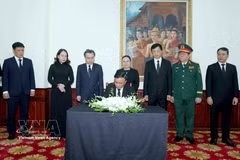
Politburo member and Standing member of the Communist Party of Vietnam (CPV) Central Committee’s Secretariat Tran Cam Tu signs the condolence book in commemoration of Politburo member of the Lao People's Revolutionary Party (LPRP) and President of the Lao NA Xaysomphone Phomvihane. (Photo: VNA)

Vietnamese Party, State leaders pay tribute to Lao National Assembly President

Writing in the book of condolences, the Vietnamese leaders expressed profound sorrow over the passing of comrade Xaysomphone Phomvihane, describing him as an outstanding and dedicated leader of the Lao Party, State, NA and people, as well as a close and loyal friend of the Vietnamese Party, State, NA, Government and people.

British researcher Kyril Whittaker (Photo published by VNA)

Vietnam’s four strategic shifts strengthen int'l partners’ confidence: British researcher

The four strategic shifts that General Secretary of the Communist Party of Vietnam and State President To Lam laid out at the recent third plenum of the 14th Party Central Committee suggest that Vietnam is seriously abiding by its commitments to the environment, economic growth and investment opportunities, the researcher said, adding they are creating new impetus for trade through large infrastructure programmes and showcasing Vietnamese talent and wealth to other countries.

Canadian friends highlight Vietnam’s values of independence, self-reliance

Canadian friends highlight Vietnam’s values of independence, self-reliance

CPC (M-L) member Margaret Villamizar noted that Vietnam’s long history of defending its independence and sovereignty has demonstrated the Vietnamese people’s organisational capacity, creativity and resilience. These qualities continue to be reflected in the country’s development and international relations today.

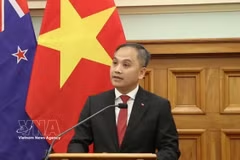
Vietnamese Ambassador to New Zealand Phan Minh Giang (Photo: VNA)

Top leader’s visit to inject fresh momentum into Vietnam-New Zealand Comprehensive Strategic Partnership: diplomat

The upcoming state visit to New Zealand by General Secretary of the Communist Party of Vietnam (CPV) Central Committee and State President To Lam is expected to provide further momentum for the Vietnam-New Zealand Comprehensive Strategic Partnership to reach a new height, commensurate with the potential and stature of the two countries, bringing more practical benefits to their people and businesses, as well as contributing to the development goals of each country and to peace, stability and sustainable development in the region and the world.