Vietnam, Australia cultivate media cooperation in digital age

To match media cooperation with the weight of the Vietnam–Australia Comprehensive Strategic Partnership, he proposed five key collaboration areas, said Head of the Communist Party of Vietnam (CPV) Central Committee’s Commission for Publicity Trinh Van Quyet.

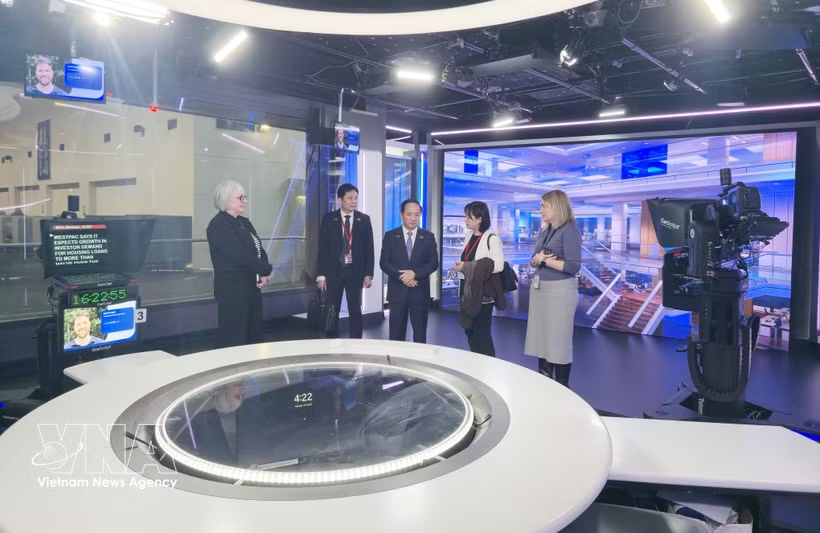
Head of the CPV Central Committee’s Commission for Publicity Trinh Van Quyet (centre) tours ABC facility (Photo: VNA)

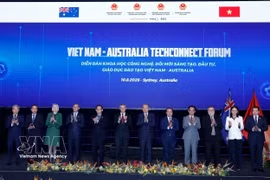
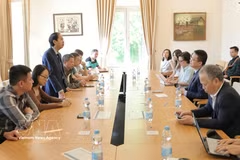
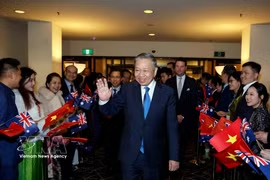
Sydney (VNA) – Head of the Communist Party of Vietnam (CPV) Central Committee’s Commission for Publicity Trinh Van Quyet led a delegation comprising officials from the Ministry of Foreign Affairs, Voice of Vietnam (VOV), and Vietnam News Agency (VNA), to visit the Australian Broadcasting Corporation (ABC) in Sydney on August 10 (local time).

The visit ran in parallel with General Secretary of the CPV Central Committee and President To Lam’s state visit to Australia.

Both sides dug deep into modern journalism trends, the application of artificial intelligence (AI), and ways to fire up media cooperation.

ABC Chair Kim Williams welcomed the Vietnamese delegation, tracing ABC’s journey from a traditional radio broadcaster into a leading multimedia news organisation. He said the network has steadily expanded its reach and built relationships with international media, including outlets in Vietnam.

Williams noted that the global media industry is being rocked by the rapid rise of digital technology, reshaping not just newsroom operations but the entire production, distribution, and management of information.

Sharing ABC’s playbook, he said AI now plays an increasingly foundational role, and the broadcaster is actively testing the technology to optimise journalistic workflows. In practice, AI has proven highly effective at converting content between formats, such as automatically turning radio broadcasts into text for digital platforms. It also assists journalists in headline writing by analysing content and suggesting top options, while helping boil large datasets down into concise news reports.

With roughly 60 offices across Australia, ABC uses AI to rapidly spin local radio from remote and regional areas into digital news stories for its website and social media platforms. This eases the load on journalists, freeing them up to chase new stories without sacrificing accuracy or objectivity, he said.

Digital technology also enables ABC to reach 99.7% of Australia’s territory through data compression and multi-platform distribution. Still, Williams warned that AI remains an emerging field demanding extreme care around journalistic ethics, reliability, and editorial responsibility.

During the working session, Quyet, who is also a Politburo member and Secrectary of the CPV Central Committee, stressed that Vietnam always attaches importance to people’s right to access information and is committed to building a professional, humane, and modern press. Vietnamese media do not just deliver timely news but also play a crucial role in projecting Vietnamese culture, image, land, and people to the world.

Describing AI adoption as an inevitable trend in modern journalism, Quyet asserted that the technology only reaches its full potential when combined with professional competence, ethics, and journalistic accountability. The human factor, he insisted, remains decisive in verifying, evaluating, and taking responsibility for content before publication.

To match media cooperation with the weight of the Vietnam–Australia Comprehensive Strategic Partnership, he proposed five key collaboration areas.

First, the two sides should keep ramping up exchanges of radio and television broadcasts and quality media products that spotlight the history, culture, countries, and people of Vietnam and Australia.

Second, they should expand co-production of specialised programnes, podcasts, and multimedia products of shared interests such as sustainable development, digital transformation, innovation, education, and tourism.

Third, ABC was encouraged to push professional training at Vietnamese media agencies, with a focus on integrated newsroom management, podcast production, digital technologies, and AI application.

Fourth, the two sides should push exchanges among media leaders, managers and experts.

Fifth, ABC and Vietnamese media outlets should leverage their roles as members of the Asia-Pacific Broadcasting Union (ABU) to enhance coordination.

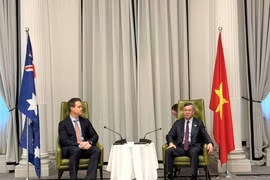
Williams backed Vietnam’s proposals, affirming that the memoranda of understanding ABC has signed with Vietnam Television and VOV provide a solid foundation for professional training. The ABU framework, he added, opens even more doors for practical multilateral cooperation in the region.

Sharing details of planned cooperation, Head of the ABC International Services Claire Gorman said ABC will launch an in-depth business programme focused on Southeast Asia and ASEAN countries, including Vietnam, later this year.

This month, ABC will also broadcast a six-part culture and arts series entitled “Culture by Design”, filmed in Hanoi, which is expected to air on VTV’s “Vietnam Today” channel.

On training, the “Digital Dialogues” programme, recently hosted by the Australian Embassy in Vietnam, helped Vietnamese journalists upgrade their skills in applying AI and digital transformation to real-world news production.

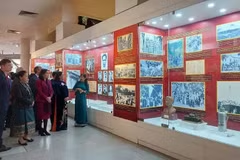
Later, the Vietnamese delegation toured ABC’s production facilities and got a close look at integrated newsroom model and modern media technologies./.
VNA

See more

Deputy General Director of the Vietnam News Agency Doan Thi Tuyet Nhung (fifth, right) and representatives of regional news agencies and media organisations attend the launch of the Asia-Pacific Media Partnership Organising Committee at the Asia-Pacific Media Forum. (Photo: VNA)

VNA attends Asia-Pacific Media Forum in Shenzhen

Participants in the forum highlighted the need to increase coverage of the region's rapid opening-up and integration, provide comprehensive information on the progress and achievements of cooperation among economies across various fields, and help create a favourable environment for regional development.

Ngo Phuong Ly (right), the spouse of General Secretary of the Communist Party of Vietnam Central Committee and President To Lam, and Kyu Kyu Hla, the spouse of Myanmar President Min Aung Hlaing, visit Van Phuc silk village on September 5. (Photo: VNA)

First ladies of Vietnam, Myanmar visit Van Phuc silk village

Ngo Phuong Ly, the spouse of General Secretary of the Communist Party of Vietnam Central Committee and President To Lam, said the two countries share similarities in silk weaving and can enrich their cultural heritage through exchanges and experience sharing.

Prime Minister Le Minh Hung join students and teachers of the Muong Khuong Inter-level Primary and Secondary Boarding School, Lao Cai province, in the opening ceremony of the 2026–2027 academic year on September 5. (Photo: VNA)

PM urges substantive education reform in 2026–2027 school year

PM Le Minh Hung called on the education sector to continue making strong changes in management mindset and teaching methods, putting learners at the centre, and viewing schools as the foundation, teachers as the driving force, families as a source of support and society as a resource accompanying education development.

General Secretary of the Communist Party of Vietnam Central Committee and President To Lam (Photo: VNA)

Top leader extends message to education sector on new school year

Party General Secretary and President To Lam expressed confidence that with the nation’s traditional fondness for learning, the dedication of teachers and the aspirations of the younger generation, the 2026–2027 academic year will open a new chapter of progress for the country’s education sector.

Students attend the opening ceremony for the 2026–2027 academic year at the primary school campus of the Gia Quat Primary and Secondary School in Hanoi on September 5, 2026. (Photo: VNA)

Students across Vietnam begin 2026–2027 academic year

This milestone school year marks a pivotal transition from laying the groundwork for reform to delivering substantive changes as the country pushes ahead with implementing Politburo Resolution No. 71-NQ/TW on breakthroughs in education and training development.

Team K91 members depart to carry out their mission. (Photo: VNA)

Search efforts continue for Vietnamese fallen soldiers in Cambodia

During the 2026-2027 dry season, Teams K70, K71, K72 and K73 will continue their search and repatriation mission, striving to fulfil the target based on 185 pieces of information concerning 761 graves. Each team is expected to collect at least 100 sets of remains during each deployment.

Mai Nguyen Tuyet Hoa, First Secretary in charge of education affairs at the Vietnamese Embassy in Russia speaks at the closing ceremony (Phôt: VNA)

AI application boosts Russian language training in Vietnam

The programme introduced updated methods for teaching Russian as a foreign language while focusing on the application of digital technology and AI in lesson design to enhance the professional capacity and adaptability of Russian-language teachers amid changes in modern education.

A resident accesses the iHanoi app. (Photo: VNA)

Hanoi launches real-time flood and rainfall map on iHanoi

The map uses a standard colour scale to provide a visual assessment, enabling residents to gauge the level of danger within seconds. The application is expected to strengthen the capital’s disaster response capacity while helping residents plan safer routes during the rainy and stormy season.

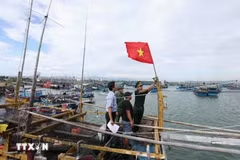
Representatives of Naval Region 4 Command present 32 gift packages to the fishermen. (Photo published by VNA)

32 fishermen rescued at sea safely return home

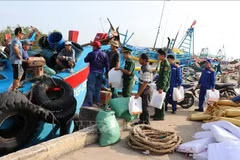
Thirty-two fishermen rescued after their fishing vessel, coded QNa 90859 TS, encountered an accident at sea, were safely brought back to their hometown in Nui Thanh commune, the central city of Da Nang.

Dr. Do Xuan Hoang, Chairman of the Union of Vietnamese Organisations in Russia. (Photo: VNA)

Resolution marks new policy approach toward overseas Vietnamese

Chairman of the Union of Vietnamese Organisations in Russia Dr. Do Xuan Hoang said the Politburo’s Resolution 23-NQ/TW on overseas Vietnamese (OV) affairs is timely and more comprehensive, better aligned with the rapid evolution of the Vietnamese community abroad after more than two decades under the Politburo’s Resolution 36-NQ/TW issued on March 26, 2004.

Vietnamese companies showcase tourism in Beijing (Photo: VNA)

Hanoi pitches tourism in Beijing to deepen travel ties

Deputy Director of the Beijing Municipal Bureau of Culture and Tourism Guo Zhuqing said Beijing and Hanoi are key gateways for bilateral cultural and tourism exchange, with conditions in place to boost visitor numbers, build trust and expand business cooperation, thus supporting people-to-people ties.

Students contemplate paintings at the exhibition (Photo: VNA)

Vietnamese in Laos, Singapore honour President Ho Chi Minh on National Day

The display features 50 paintings by the late overseas Vietnamese artist Dao Trong Ly created between 2018 and 2024. Co-hosted by the Vietnamese Embassy in Laos, the Vietnam Cultural Centre in Laos and the Vietnam Fine Arts Museum, it serves as both a cultural highlight for Vietnam’s 81st National Day (September 2) and a bridge for Vietnam-Laos special solidarity.