British experts continue uncovering mysteries of Vietnam's "Kingdom of Caves"

Park authorities believe continued cooperation with international cave experts will not only uncover more geological treasures but also enhance the site's appeal as a world-class destination for adventure tourism, scientific research and nature conservation.

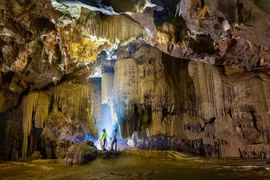
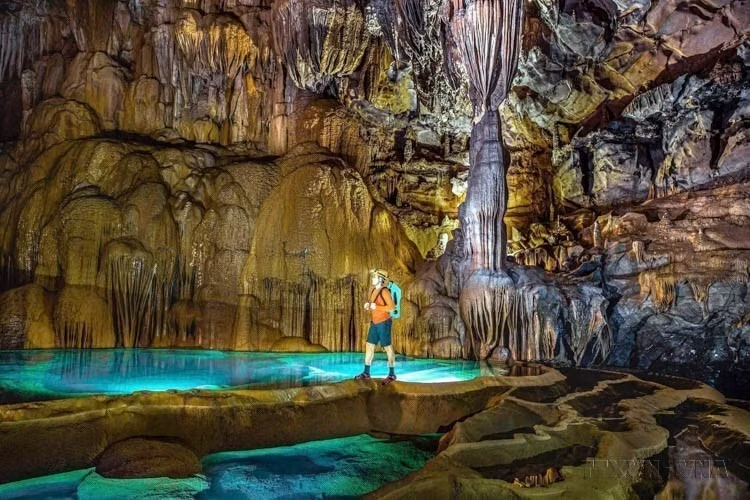
The Nightmare sinkhole is 250 meters deep, with a mysterious underground river inside, part of the Hung Thoong cave system in Phong Nha – Ke Bang National Park. (Photo published by VNA)

Quang Tri (VNA) – More than three decades after first arriving in Vietnam, British cave explorers continue to reveal new geological wonders hidden beneath the ancient forests of Phong Nha-Ke Bang National Park, reinforcing its reputation as one of the world's most remarkable karst landscapes and opening fresh opportunities for scientific research and sustainable tourism.​

Their latest expedition in early 2026 led to the exploration of Cha Ngheo Cave, a largely untouched vertical cave system that experts believe may form part of an even larger network. The team plans to return in March 2027 to continue the survey.​

Decades of exploration

​Dr Howard Limbert recalled that his first expedition to Vietnam took place in 1990, when British experts and scientists from the former Hanoi General University began surveying caves in what is now Phong Nha-Ke Bang National Park.​

During that pioneering expedition, the team explored Phong Nha Cave and Dark Cave, surveying thousands of metres of cave passages.​

Even after leaving Phong Nha, Limbert and his colleagues immediately began planning their return. "The caves here have kept my wife and me coming back ever since," he said.​

Professor Dr Ta Hoa Phuong of the Vietnam Institute of Palaeontology said the 1990 expedition marked the beginning of long-term cooperation between Vietnamese scientists and British cave experts, laying the scientific foundation for later geological research in the area.​

Their work proved invaluable in preparing the nomination dossier that led UNESCO to recognise Phong Nha-Ke Bang as a Natural World Heritage Site in 2003 under geological and geomorphological criteria, making it Vietnam's Natural World Heritage after Ha Long Bay.​

Limbert also recalled meeting General Vo Nguyen Giap in 1992, saying the legendary military leader encouraged the British team to continue exploring Vietnam's cave systems, giving them added motivation to pursue their research.​

vna-potal-phong-nha-ke-bang-tro-thanh-di-san-thien-nhien-lien-bien-gioi-dau-tien-cua-viet-nam-8147280.jpg
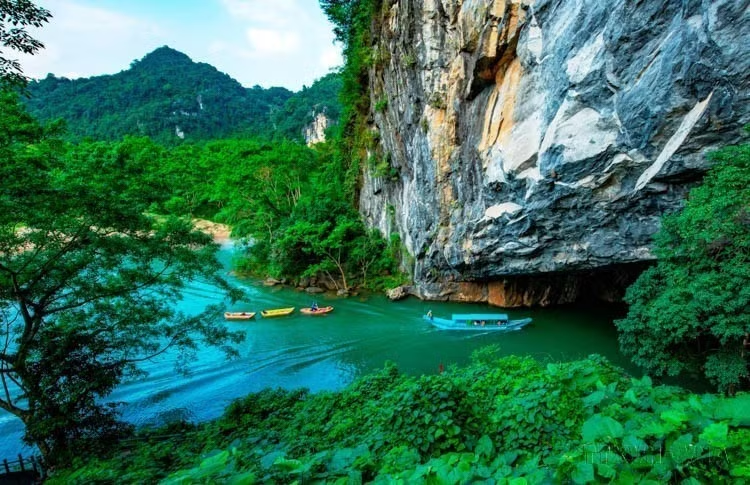
Scenery outside the entrance of Phong Nha Cave in Phong Nha – Ke Bang National Park. (Photo: published by VNA)

One of the expedition's greatest achievements came in 2009 with the discovery of Son Doong Cave after more than a decade of searching. Local forest ranger Ho Khanh guided the British team to an entrance he had first spotted in 1990, leading to the exploration of what is now recognised as one of the world's largest known caves.​

Stretching more than 6.5 kilometres, Son Doong ends at a massive limestone wall known as the Great Wall of Vietnam and has since become an international tourism icon.​

Discoveries beneath the forest

Asked about his most memorable recent expedition, Limbert pointed to the exploration of Cha Ngheo Cave in early 2026.​

Residents had long reported seeing a cave entrance high on a mountain where a stream disappeared into a deep vertical shaft, but no one had attempted to descend because of the extreme terrain.​

In early April, a 13-member expedition team comprising ten foreign specialists and three Vietnamese experts, supported by a logistics team, set out to investigate the cave.​

After more than a day trekking through dense forest and crossing streams, the team reached the entrance and camped overnight before beginning the descent the following morning.​

The first section dropped nearly 90 metres vertically. Using thousands of metres of climbing rope, the explorers descended in stages, drilling anchor bolts into limestone outcrops before continuing deeper into the cave.​

At a depth of around 350 metres, they reached a horizontal passage and then swam nearly 600 metres through an underground river.​

Only two members of the team succeeded in reaching the cave's deepest section.​

"The cave is extremely cold, and without specialised thermal equipment we could not stay there for long," Limbert said.​

He noted that the cave extends well beyond the areas surveyed so far, suggesting it could form part of a much larger underground system.​

Strengthening global recognition

According to Pham Hong Thai, Director of Phong Nha-Ke Bang National Park, experts have identified seven major cave areas, including the Phong Nha, Vom, and Nuoc Mooc systems.​

To date, researchers have documented 472 caves with a combined surveyed length of more than 254 kilometres, making the park one of the world's richest and most distinctive karst regions and earning it the nickname "Kingdom of Caves."​

During the latest survey in early 2026, Limbert's team explored 29 caves, including 26 newly discovered caves and extensions to three previously known caves, mapping more than 13.6 kilometres of underground passages.​

Professor Phuong said the findings have provided valuable scientific evidence supporting studies of the park's geology and geomorphology while strengthening its universal value.​

Park authorities believe continued cooperation with international cave experts will not only uncover more geological treasures but also enhance the site's appeal as a world-class destination for adventure tourism, scientific research and nature conservation./.
VNA

See more

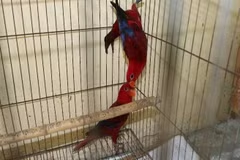
Two Red Lories (Eos rubra) found among the 104 wild animals being kept without documentation proving their lawful origin in Phuoc Thanh commune, Tay Ninh province. (Photo published by VNA)

Criminal proceedings launched against case of illegal keeping, trading of 104 wild animals

They recorded a total of 104 wild animals, comprising 92 African spurred tortoises (Geochelone sulcata) of various sizes, six Red Lories (Eos rubra) and six Green-cheeked Parakeets (Pyrrhura molinae). Authorities said the animals are subject to management under Vietnam's forestry legal regulations and are listed in Appendix II of the Convention on International Trade in Endangered Species of Wild Fauna and Flora (CITES).

BUYO Bioplastics' biodegradable plastic products are made from brewer's grains and sugarcane bagasse. (Photo: nhandan.vn)

Vietnam urged to shift from plastic waste treatment to full life-cycle management

For years, efforts to tackle plastic pollution in Vietnam have focused mainly on waste collection, recycling and disposal. However, as sustainable development and green trade standards become increasingly important, specialists argued that a broader approach is needed, covering everything from product design and material selection to production, consumption and recycling.

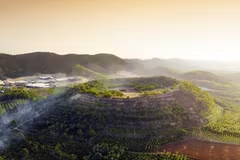
Bang Mo volcano in Lam Dong province (Photo published by VNA)

Lam Dong optimises value of UNESCO Dak Nong Global Geopark

Alongside conservation, Lam Dong aims to tap the geopark's tourism potential through geological, ecological and community-based tourism. Infrastructure and tourism development projects must ensure that heritage values, landscapes and the natural environment are preserved.

Dr. Dang Trung Phuoc (left) is introducing the history and origin of the Pinhey sand dunes (Photo: VNA)

Vietnamese Canadian scientist revives forgotten ecosystems

From restoring an ancient sand dune ecosystem in Canada to promoting the conservation of Vietnam's coastal dunes, native forests and ecological corridors, Vietnamese-born scientist Dang Trung Phuoc has remained committed to using science to revive ecosystems long misunderstood or neglected. His quiet but sustained efforts reflect both a scientist's responsibility to the communities he serves and the enduring commitment of a Vietnamese expatriate to his homeland.

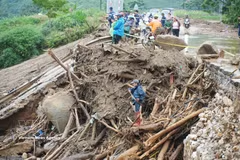
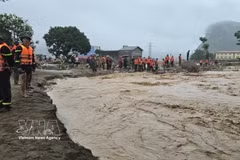
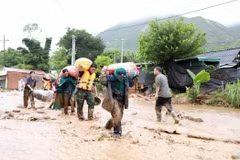
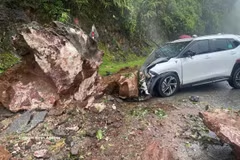
Police and military forces work together to rescue people and assist local residents in affected areas. (Photo: VNA)

PM orders proactive response to heavy rainfall in northern mountainous region

To minimise casualties and damage to public and private property, the PM instructed ministries, sectors and local authorities to strictly implement directions issued by Party General Secretary and State President To Lam, as well as the Government's directives on strengthening disaster prevention and response in 2026.

A view of the Ea So Nature Reserve in Dak Lak province (Photo: VNA)

Rare wild animals released into natural habitat in Dak Lak

Among them are two species classified under Group IB of Vietnam's protected wildlife list, namely the Bengal slow loris (Nycticebus bengalensis) and the Sunda pangolin (Manis javanica). Both are endangered forest species protected under Vietnamese law and are prohibited from commercial exploitation or use.

A large-timber plantation model in Gia Lai province (Photo: VNA)

96-million-USD project promotes agroforestry to cut emissions

The Reduction of Emissions in the Central Highlands and South Central Coast of Vietnam (RECAF) project will run from 2026 to 2031 across the provinces of Dak Lak, Gia Lai, Lam Dong, and Khanh Hoa covering about 145,000ha, according to the International Fund for Agricultural Development (IFAD).

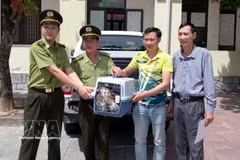
Crested goshawks are handed over by the People's Committee of Dong Le commune, Quang Tri province. (Photo: VNA)

Quang Tri rescues six rare wild animals

The animals are now receiving quarantine, treatment and specialised care. Once recovering their physical condition and wild behaviour, they will be reassessed for release back into the wild.

The Ministry of Industry and Trade has reported initial signs that the fuel is helping reduce emissions and protect the environment. (Photo: VNA)

E10 biofuel shows initial environmental benefits: Ministry

An official said the initial results indicate the nationwide rollout has begun to achieve its intended objectives, but more comprehensive monitoring over a longer period, with a wider observation network and more frequent measurement, is needed for a precise and objective assessment.