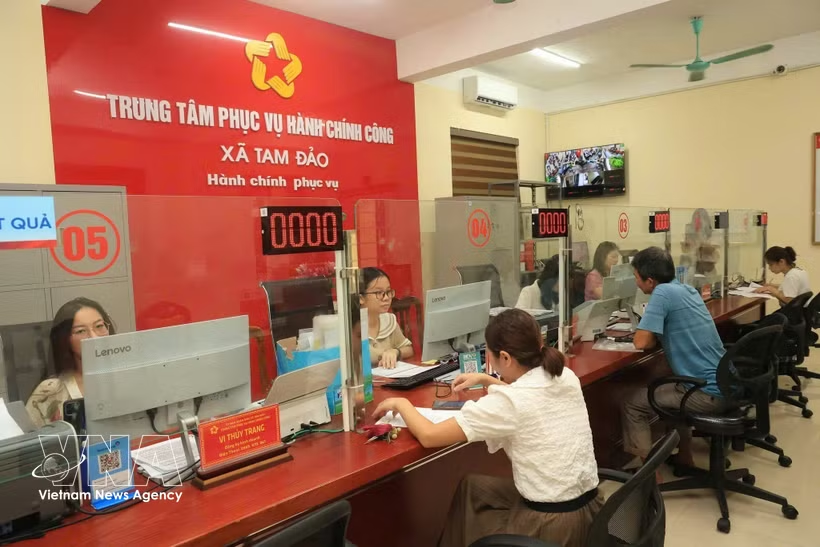
Phu Tho (VNA) – The private sector is increasingly emerging as a key growth engine of the economy. To unleash its potential and ensure sustainable development, the northern province of Phu Tho is stepping up institutional and administrative reforms to cut costs, shorten procedures, and build a more transparent, business-friendly investment climate.
These efforts are helping unlock social resources, improve the investment environment, and create fresh momentum for the private sector's growth in line with the Political Bureau's Resolution No. 68-NQ/TW.
The impact of administrative reform is evident in the progress of major projects that had been stalled or delayed for years.
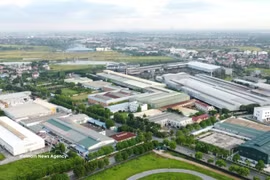
In Luong Son commune, site clearance for the Queen Valley Resort and Entertainment Complex, invested in by Legacy Riverside Co., Ltd., has reached 130.9 hectares out of 141.7 hectares, or nearly 92%. More than 93% of the site for the Dong Truong Son high-end eco-resort urban area has also been cleared.
Some obstacles remain, including land-origin verification, administrative boundary adjustments, and compensation. Local authorities, however, are working with relevant agencies to tackle each issue and keep projects on track.
Chairman of the Luong Son Commune People's Committee Chu Van Thang said that in the first half of 2026, the commune carried out site clearance for 57 projects, involving more than 815 hectares of land. More than 55% of the area has been cleared.
The locality issued 780 land recovery notices and 80 land recovery decisions for eligible cases, while drawing up detailed schedules for each project and prioritising areas where clearance could be completed quickly to create clean land for investors.
Authorities have also stepped up land-origin verification, public disclosure of dossiers, and resolution of legal issues, while maintaining dialogue and mobilising residents to support compensation plans. The delays have been managed in full compliance with the applicable regulations.
Such coordinated measures have helped shorten processing time, improve inter-agency coordination, and strengthen businesses' confidence in project implementation.
Across Phu Tho, provincial authorities have made support for major projects a priority, directing agencies to work together on investment, land, site clearance, resettlement, and land-price procedures.
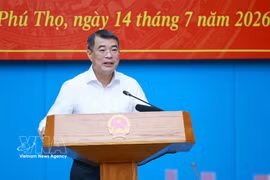
Chairman of the provincial People's Committee Tran Duy Dong has called for clear deadlines and accountability for each agency and unit, the establishment of task forces to tackle bottlenecks in major projects, and "green lane" mechanisms for key projects. Performance results will also be linked to assessments of organisations and individuals.
Another highlight is the 45-day campaign to clear overdue administrative dossiers. Almost all backlogged files have now been resolved, improving services for residents and businesses.
The digitisation of administrative procedures, meanwhile, has streamlined land-related processes by connecting cadastral databases, tax authorities, and the electronic one-stop-shop system, reducing paperwork and increasing transparency.
In the first six months of 2026, Phu Tho processed more than 612,000 administrative dossiers, with nearly 96% handled online. More than 2,100 administrative procedures have been standardised, while QR codes offer easier access to information.
Administrative reform is being accompanied by efforts to improve the institutional framework and create a stable, transparent environment for businesses.Phu Tho has actively contributed to draft laws, decrees, and circulars on investment, land, enterprises, science and technology, and digital transformation. The province has also reviewed outdated and overlapping regulations, proposing reforms that reduce pre-inspections while strengthening post-inspections.
The province has rolled out major initiatives, including a 2026-2030 scheme to improve the investment environment and provincial competitiveness, a list of projects calling for investment, and investment and tourism promotion programmes.
The "Business Coffee" model has become a regular dialogue channel between provincial leaders and the business community. Problems arising in investment, production, and business operations are brought directly to the table, with authorities directing solutions at the grassroots level.
Since April 1, 2026, Phu Tho has piloted the "24-hour Green Lane" and "50% Green Lane" mechanisms for administrative procedures involving key projects.Under the "24-hour Green Lane", 279 of 284 dossiers have been processed on or ahead of schedule, achieving 98.23%. The remaining five are being processed. All 12 dossiers under the "50% Green Lane" mechanism have been completed on or ahead of schedule.
The mechanisms have significantly shortened processing time, lowered compliance costs, and helped projects move more quickly into implementation.
Digital transformation is also reshaping public administration. Phu Tho has synchronised 100% of its land data with the National Database and connected cadastral data with tax authorities and the administrative procedure system.
The province is studying a smart land administration system using artificial intelligence and big data to improve governance and turn data into a resource for the digital economy.
The reforms are already reflected in the province's investment climate. In 2025, Phu Tho ranked among the country's top five localities for provincial economic governance quality and was placed in the "Good" group in the Provincial Competitiveness Index (PCI). It ranked second nationwide in the Access to Resources sub-index and posted strong results in transparency, proactive governance, legal institutions, informal costs, fair competition, and business support.
The results underline tangible improvements in local governance, boosting business confidence and investment appeal.
The implementation of central and provincial policies in Resolution No. 68-NQ/TW is a key focus. Priorities include improving institutions, removing overlapping regulations, cutting administrative procedures and compliance costs, and making the "24-hour Green Lane" and "50% Green Lane" mechanisms more effective.
The province will focus on boosting its PCI, PAR Index, PAPI, and SIPAS rankings, while strengthening administrative discipline and curbing actions that cause harassment or place unnecessary burdens on residents and businesses./.