Vietnam seen as gateway for Canadian farm produce to ASEAN

As Canada steps up trade diversification and seeks to reduce its dependence on the North American market, Vietnam could serve both as a market for Canadian goods and a base for Canadian businesses to build production capacity and expand operations in the region.

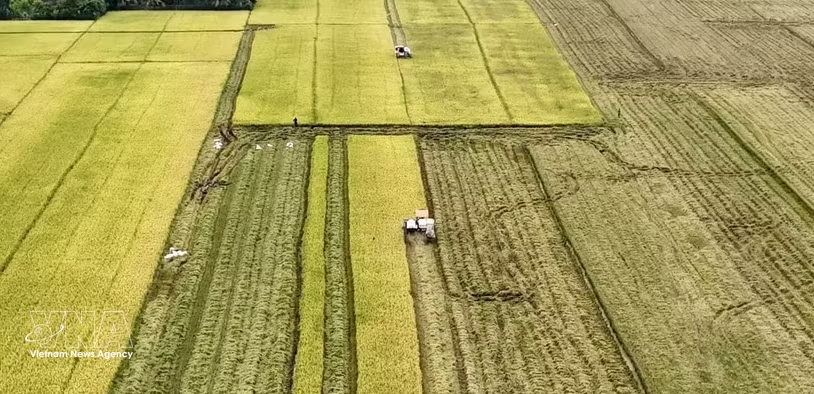
Harvesting rice in the Mekong Delta (Photo: VNA)

Ottawa (VNA) - Canadian government agencies, experts, and businesses are seeking opportunities to expand trade, investment, and agricultural technology cooperation with Vietnam amid growing demand for market diversification and sustainable agricultural supply chains, viewing the country as an important market and a gateway to Southeast Asia.

The view was shared at a seminar on Canada-Vietnam agricultural trade and investment partnership organised by the Canada-Vietnam Trade Council, which brought together representatives from government agencies, research institutions and businesses from both countries.

​Greg Folinazzo, representing Agriculture and Agri-Food Canada (AAFC), said Vietnam is a priority market and a strategic gateway for Canada’s agricultural sector in Southeast Asia.

Canadian exports of agricultural, food and aquatic products to Vietnam grew by an average of 22.7% annually during 2021-2025, reaching about 702 million CAD (503.5 million USD) last year. Major products included wheat, soybeans, frozen beef, frozen crab, and canola meal. Meanwhile, Canada imported about 964 million CAD worth of agricultural and food products from Vietnam in 2025, mainly shrimp, fish fillets and value-added processed products. The complementary trade structure creates room for greater two-way trade and supply-chain connectivity.

Calvin Xiao, Relationship Manager at Export Development Canada, said Vietnam is a key market not only because of its population and growing domestic demand, but also its potential to connect Canadian businesses with other Southeast Asian markets.

As Canada steps up trade diversification and seeks to reduce its dependence on the North American market, Vietnam could serve both as a market for Canadian goods and a base for Canadian businesses to build production capacity and expand operations in the region, he said.

Natujwa Maliondo, Senior Trade Development Officer at the Ministry of Agriculture and Irrigation of Alberta province, said Canadian businesses should look beyond Vietnam’s market size and view the country as part of a broader strategy to access the whole ASEAN market.

The Comprehensive and Progressive Agreement for Trans-Pacific Partnership (CPTPP) provides businesses from both countries with tariff preferences and improved market access. However, further administrative simplification and a better policy environment are needed to attract more Canadian investment in Vietnam’s agriculture, food and processing sectors, and encourage Vietnamese investment in Canada.

Delegates noted that Canada may find it difficult to compete with suppliers closer to Vietnam on price and transport costs, but its agricultural products have advantages in reliability, food safety, traceability, nutritional quality and environmental standards.

Beyond goods trade, bilateral agricultural cooperation is expanding into research, innovation and technology transfer, with potential areas including precision agriculture, hydroponics, fertiliser technology, deep processing, post-harvest preservation, emissions reduction and carbon-credit measurement.

Prof. Huy Dang of Trent University said climate change is reshaping food production in both countries. Canada faces harsh winters and the need to strengthen food self-sufficiency, when the Mekong Delta is affected by saltwater intrusion, land subsidence and rising sea levels.

Hydroponics could be a promising area of cooperation as the technology can save up to 90% of water, supporting production in areas where surface water is saline or groundwater extraction needs to be restricted, he said.

Businesses also highlighted the importance of finding suitable local partners, understanding business culture and building long-term relationships. They said Canadian firms could focus on specialised segments and leverage their strengths in quality, technology and branding rather than compete directly with established suppliers.

With CPTPP as a foundation and Canada-ASEAN economic ties expected to grow, agricultural cooperation is expected to become a practical avenue for Vietnam-Canada relations, creating opportunities for mutually beneficial trade, investment and innovation./.
VNA

See more

Illustrative image (Photo: VNA)

Turkish cooperatives open sourcing channel for Vietnamese businesses

The Vietnam Trade Office recommended that Vietnamese businesses in agriculture and food actively study cooperative networks in different localities in Türkiye and consider them an additional channel for accessing raw materials, processing partners, and distribution networks.

Delegates at the signing ceremony (Photo: VNA)

VPI, Beicip-Franlab Asia deepen oil, gas cooperation

Under the MoU, VPI and Beicip-Franlab Asia will undertake advanced studies in geology, geophysics, and reservoir engineering to support exploration, field development, and oil and gas resource assessment.

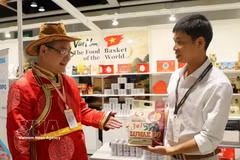
A visitor explores Vietnamese coffee at the expo. (Photo: VNA)

Vietnam pushes coffee, farm produce at Hong Kong food expo

After nearly 200 years, especially since the Doi Moi (renewal) began in 1986, Vietnamese coffee is now exported to more than 100 countries and territories and supports about 2.6 million jobs. Vietnam remains the world’s second largest coffee exporter, holding roughly 19-21% of the global market, and is the top producer of Robusta coffee.

Delegates at the event (Photo: VNA)

Da Nang hosts 2026 International Logistics Forum

Co-hosted by the Ministry of Industry and Trade and the Da Nang People’s Committee, the forum put modern logistics, strategic infrastructure, digital transformation, green growth and international connectivity at the centre of discussions.

Prime Minister Le Minh Hung speaks at the working session. (Photo: VNA)

Monetary policy must ensure macro stability, support growth: PM

The SBV was required to keep policy interest rates steady and add liquidity so lenders can access cheaper funding. It must manage the exchange rate in line with market developments, coordinate monetary tools, and intervene to stabilise the foreign exchange market, while maintaining close oversight of gold. Lenders must continue cutting costs, stabilising lending rates, and delivering substantive reductions.

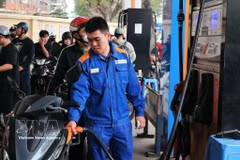
People buy petrol at a station in Hanoi (Photo: VNA)

Petrol prices cut from 15:00 on August 13

The price of E5 RON92 petrol is capped at 21,235 VND (0.81 USD) per litre, down 493 VND, while E10 RON95-III is priced at no more than 22,119 VND per litre, down 205 VND.

Domestic and foreign businesses engage in trade networking at the event series held at Ho Chi Minh's Saigon Exhibition and Convention Centre (SECC) on August 13, 2026. (Photo: VNA)

Int'l sports exhibitions, export trade fair open in Ho Chi Minh City

A series of events opened at the Saigon Exhibition and Convention Centre (SECC) in Ho Chi Minh City on August 13, including the Vietnam Sport Show 2026, Vietnam Cycle Expo 2026 and the 14th Zhejiang Export (Vietnam) Fair 2026. They feature 520 booths operated by 400 businesses from 15 countries and territories.

Production at Bumjim Electronics Vina Co., Ltd invested by the Republic of Korea in Quang Ninh province (Photo: VNA)

Resolution No. 19-NQ/TW sets new growth drivers for Vietnam

Science and technology, innovation, digital transformation and AI must be translated into higher productivity rather than pursued as ends in themselves. At the same time, people should be placed at the centre of development, not merely viewed as a resource but as the ultimate objective of development policies.

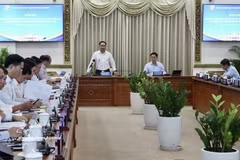
The conference on the implementation of socio-economic tasks for August and key measures for the rest of the year held in Ho Chi Minh Ciy, on August 12, 2026. (Photo: VNA)

Ho Chi Minh City mobilises resources to achieve double-digit growth target

The southern economic hub has identified accelerating public investment disbursement, strongly mobilising private-sector resources, promoting exports and consumption, and removing bottlenecks as key priorities to generate additional growth drivers in the remaining months of the year. These priorities were highlighted by its leadership at a conference on the implementation of socio-economic tasks for August and key measures for the rest of the year, held on August 12.

The opening ceremony of the East-West Economic Corridor International Trade, Tourism and Investment Fair 2026 (EWEC-Da Nang 2026) on August 12 (Photo: VNA)

EWEC-Da Nang 2026 trade, tourism, investment fair opens

The EWEC-Da Nang fair is not merely a product exhibition and promotion event, but also a platform for economic connectivity, enabling businesses to seek partners, expand markets, explore investment opportunities, cooperate in production and business, and engage more deeply in regional supply chains.

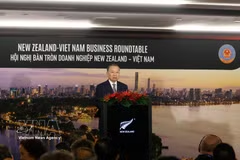
General Secretary of the Communist Party of Vietnam Central Committee and President To Lam speaks at the New Zealand–Vietnam Business Roundtable in Auckland on August 13. (Photo: VNA)

Top leader calls for joint Vietnam–New Zealand efforts to create new growth drivers

Party General Secretary and President To Lam called for joint efforts to create new growth drivers based on science, technology, innovation and green transformation, encouraging New Zealand businesses to view Vietnam not only as a market but also as a partner for research, product development, manufacturing and innovation in Southeast Asia.

The Vietnam International Sourcing Expo 2026 is scheduled to take place at the Saigon Exhibition and Convention Centre in Ho Chi Minh City from September 3 to 5. (llustrative photo: VIS)

Expo to open door for Vietnamese suppliers to enter US market

US retail giant Target is seeking Vietnamese suppliers of household goods, home textiles, children’s products, personal care and beauty products, with a focus on companies capable of manufacturing and developing products that meet requirements on quality, design and supply chain management.

A working team from Coast Guard Region 2 Command inspects fishing licences and vessel monitoring system and guides fishermen on compliance with IUU fishing regulations. (Photo: VNA)

Da Nang city tightens controls to prevent IUU fishing violations

The city’s authorities are tightening inspections and controls to prevent fishing vessels from violating IUU regulations, particularly in foreign waters, as part of efforts to help Vietnam have the European Commission’s “yellow card” warning lifted.

Vietcombank has launched a 50 trillion VND (1.9 billion USD) credit package to provide preferential financing to businesses, particularly small and medium-sized enterprises (SMEs), priority sectors and new growth drivers of the economy (Photo published by Bnews/VNA)

More preferential credit available to businesses

Under SBV requirements, commercial banks are to provide Vietnamese-dong loans to SMEs and growth-driving sectors at rates at least 1 percentage point per year lower than their average rates for loans of the same maturity. They are also required to consider waiving or reducing service fees for eligible customers in line with regulations and their financial capacity.

Delegates at the Vietnam-UK High-Level Conference 2026. (Photo: moit.gov.vn)

Vietnam, UK seek new growth drivers in technology, logistics

British Ambassador to Vietnam Iain Frew highlighted the importance of strengthening bilateral cooperation as Vietnam - UK relations have been upgraded to a Comprehensive Strategic Partnership. He said technology, finance, innovation and digital transformation are opening up new opportunities for cooperation, enabling businesses from both countries to connect, share experience and explore investment and business opportunities.