Resolution 68 opens new pathways for Vietnamese brands in regional, global markets

According to Dr. Bui Thanh Minh, Deputy Director of the Office of the Private Economic Development Research Board under the Prime Minister’s Advisory Council for Administrative Procedure Reform, Resolution 68 has helped foster a stronger entrepreneurial spirit through a series of concrete policy measures.

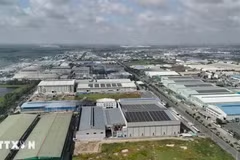
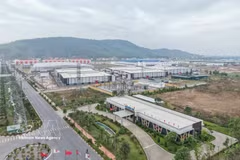
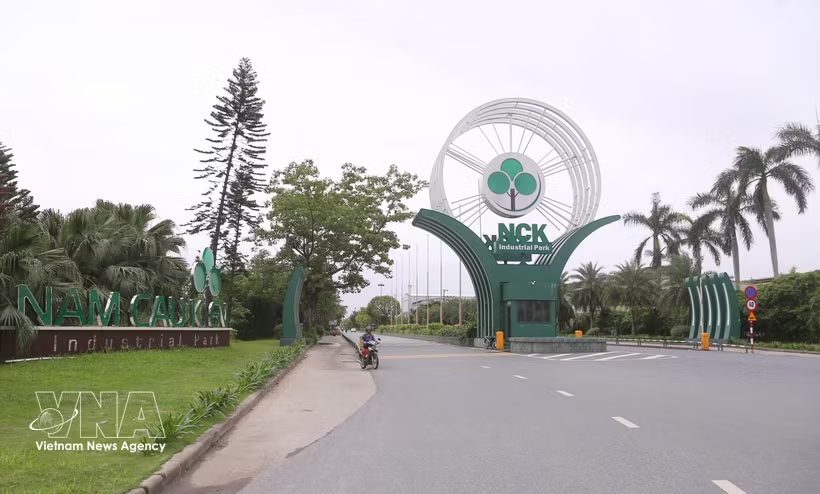
Nam Cau Kien Industrial Park - A representative private sector model in Hai Phong that has been selected by the United Nations Industrial Development Organisation (UNIDO) as one of 37 industrial parks from seven countries participating in the Global Eco-Industrial Park Programme. (Photo: VNA)

Hanoi (VNA) - More than a year after the implementation of the Politburo’s Resolution 68-NQ/TW on private sector development, Vietnam has introduced a range of new mechanisms and policies aimed at removing institutional bottlenecks, expanding investment space and unlocking resources for businesses.

The reforms are not only creating fresh momentum for the private sector but are also opening greater opportunities for Vietnamese brands to integrate more deeply into regional and global value chains.

According to Dr. Bui Thanh Minh, Deputy Director of the Office of the Private Economic Development Research Board under the Prime Minister’s Advisory Council for Administrative Procedure Reform, Resolution 68 has helped foster a stronger entrepreneurial spirit through a series of concrete policy measures.

Among the notable initiatives are Decree No. 20/2026/ND-CP guiding the implementation of special mechanisms for private sector development, the Prime Minister’s Decision approving the programme to develop 1,000 pioneering enterprises during 2026–2030, and another decision approving a programme aimed at training 10,000 chief executive officers by 2030.

Official data from the National Statistics Office under the Ministry of Finance showed that in the first four months of 2026, Vietnam recorded 77,800 newly established enterprises with total registered capital of nearly 785.4 trillion VND (29.8 billion USD), representing 50.7% in the number of new firms and 60.1% in capital year-on-year.

Several major corporations have also proactively proposed and participated in strategic national projects, including high-speed railways, the international financial centre and maritime hubs, reflecting growing confidence within the business community, built on shifts in thinking and policies.

Despite these positive signals, businesses continue to face multiple challenges, including limited access to capital and land, labour shortages, technological transformation pressures, policy uncertainty and high administrative compliance costs. During the first four months of the year, more than 15,000 enterprises completed dissolution procedures, nearly double the figure recorded during the same period last year.

Minh stressed that private sector confidence could only be strengthened through substantive reforms that allow enterprises to feel tangible improvements, including faster administrative procedures, lower compliance costs, reduced legal risks and fairer access to resources and markets.
vnanet-private-sector.jpg
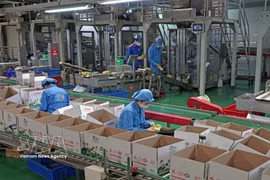
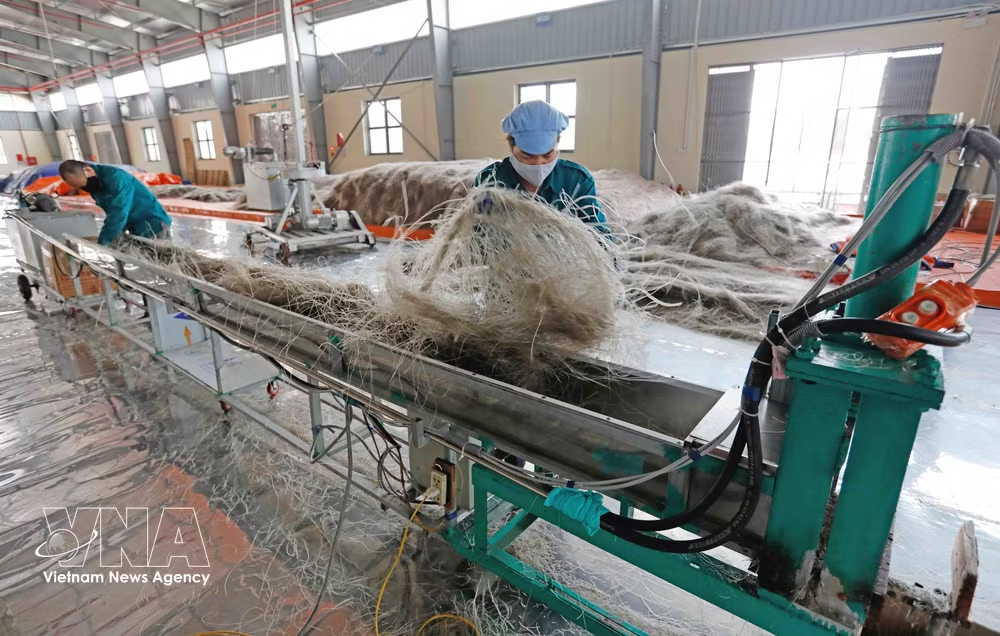
Viet Cuong Vermicelli Cooperative specialises in producing various types of vermicelli for both domestic consumption and export. (Photo: VNA)

To further realise the objectives of Resolution 68, he proposed three major priorities. First, Vietnam should continue building a transparent, stable and predictable business environment to encourage long-term investment, particularly in strategic infrastructure, high technology, digital economy, green growth, logistics, energy and innovation.

Second, administrative reform and implementation efficiency should be put at the centre. Recent government efforts to simplify procedures and business conditions, including the removal of 184 administrative procedures and 890 business conditions, are expected to reduce compliance costs and processing times by more than 50%.

Third, Vietnam should focus on developing a group of pioneering enterprises with the capacity to compete globally. These firms, he noted, should not only possess large-scale operations but also demonstrate strengths in governance, technology, innovation, finance, ESG standards and international competitiveness. Such enterprises could help build stronger domestic supply chains while enabling Vietnamese brands to penetrate deeper into regional and global markets.

The impact of Resolution 68 has also become increasingly visible at the enterprise level. The Dong Tam High-Tech Agriculture Joint Stock Company (Agri Dong Tam), for example, said the resolution has provided an important strategic impetus for private enterprises to accelerate transformation.

According to its General Director Nguyen Van Luu, the company has pursued a “dual transformation” strategy over the past year, combining digital transformation with greener and more sustainable production models. Luu said the biggest change brought by Resolution 68 was not only reflected in a 50% increase in revenue, but also in a shift in business thinking, from “selling what the company has” to “providing what the market needs”, while ensuring environmental responsibility and digital transparency.

He suggested the Government support cooperatives and enterprises in standardising digital traceability systems and carbon emission data in line with international standards. He also called for a legal framework for carbon credits and mechanisms to value specialised agricultural assets, enabling businesses to gain better access to green financing for sustainable investment./.


VNA

See more

The meeting between General Secretary of the Communist Party of Vietnam Central Committee and State President To Lam and Chairman and Chief Executive Officer of Hayleys PLC Mohan Pandithage in Colombo on May 8 (Photo: VNA)

Vietnamese leader hopes for stronger ties with Sri Lanka's Hayleys PLC

General Secretary and President To Lam said that given the complementarity of the two economies and their substantial room for growth, Vietnam wishes to enhance cooperation with major Sri Lankan enterprises, especially those with regional market networks and connectivity capabilities such as Hayleys.

The export of 1.1 million doses of vaccine lumpy skin disease (LSD) to the Republic of Korea marks an important milestone for Vietnam’s veterinary vaccine industry. (Photo: nongnghiepmoitruong.vn)

Vietnamese-made LSD vaccine enters demanding RoK market

The successful research and commercialisation of the LSD vaccine, which has been widely used in the domestic market and is gradually expanding internationally, helps affirm the position of Vietnamese veterinary vaccines globally.

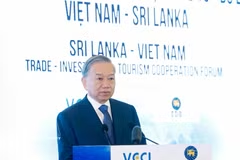
General Secretary of the Communist Party of Vietnam (CPV) Central Committee and State President To Lam addresses the Vietnam – Sri Lanka Trade-Investment-Tourism Cooperation Forum in Colombo on May 8. (Photo: VNA)

Top leader urges stronger Vietnam-Sri Lanka economic connectivity

Vietnam – Sri Lanka cooperation should be viewed within the broader context of the Indian Ocean, South Asia and emerging global supply chains, and the key issue now is not potential, but swift, decisive and effective action, said Vietnam's top leader To Lam.

The meeting between Vietnamese Minister of Industry and Trade Le Manh Hung and representatives from Essar Group (Photo: VNA)

Vietnam, India step up cooperation in energy, biofuels

Vietnam encourages capable investors to participate in oil and gas, energy and energy infrastructure projects in line with the national energy development strategy, while ensuring investment efficiency and compliance with Vietnamese law.

In the first four months of 2026, total FDI inflows into Vietnam reaches 18.24 billion USD, up 32% year-on-year. (Illustrative photo: VNA)

Vietnam draws stronger foreign investment inflows despite global headwinds

In the first four months of 2026, total FDI inflows into Vietnam reached 18.24 billion USD, up 32% year-on-year. Disbursed capital was estimated at more than 7.4 billion USD, an increase of 9.8% and the highest four-month disbursement level recorded in the past five years, reflecting effective implementation of many registered projects.

A Boeing 787 aircraft of Vietnam’s national flag carrier, Vietnam Airlines, lands on its first flight at Long Thanh International Airport. (Photo: VNA)

Deputy PM stresses strategic, synchronous planning for airport system

The national airport system planning was approved by the Prime Minister under Decision No. 648/QD-TTg dated June 7, 2023. Under the planning, 30 airports (14 international and 16 domestic) are to be developed during the 2021–2030 period, with a vision to 2050 expanding the network to 33 airports (14 international and 19 domestic).

Modern machinery improves labour productivity. (Photo: VNA)

Upskilling becomes key lever for Vietnamese workforce in digital era

As the economy is pivoting to a growth model fueled by knowledge, technology and innovation, the working class, or the backbone of production, demands better professional qualifications, vocational skills, industrial discipline and work habits. Timely adaptation is the only shield against being undercut by accelerating automation, artificial intelligence and increasingly fiercer global competition.

A circular organic farming model in Khanh Hoa is delivering initial economic efficiency. (Photo: VNA)

New growth potential unlocked for Vietnamese economy

Prime Minister Le Minh Hung once stressed that cutting administrative procedures and business conditions remains one of the fastest and most effective ways to stimulate growth and strengthen confidence among citizens and enterprises. He underscored that the reform process must remain continuous and responsive to practical requirements.

Politburo member Nguyen Duy Ngoc, who is also Secretary of the CPV Central Committee, Chairman of its Organisation Commission and standing deputy head of the Central Steering Committee for Science-Technology Development, Innovation and Digital Transformation, at a working sessions with leaders of the Indian Institute of Technology Madras (IIT Madras). (Photo: dangcongsan.vn)

Vietnam strengthens cooperation with India’s leading technology partners

Both sides exchanged views on digital identification management, electronic authentication, biometrics, personal data protection and experience in implementing large-scale national digital services. The two sides also agreed to strengthen exchanges of experts and cooperation in technical and policy experience-sharing in the coming period.