National Assembly adopts medium-term public investment plan for 2026-2030

The resolution states that the overarching goal is to enhance the efficiency of public investment so that it creates stronger spillover effects, plays a leading role in development, and mobilises maximum non-State resources for development investment.

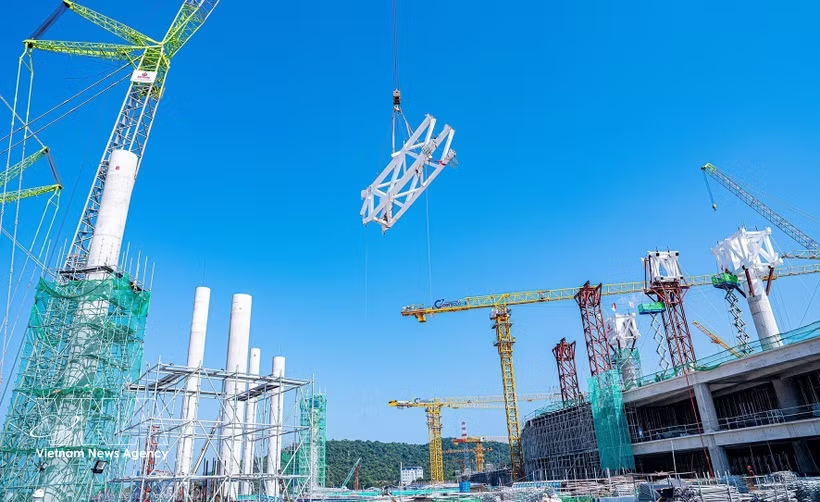
Construction is underway to expand Phu Quoc International Airport in Phu Quoc special zone of An Giang province. (Photo: VNA)

Hanoi (VNA) – National Assembly (NA) Chairman Tran Thanh Man has signed Resolution No. 27/2026/QH16 on medium-term public investment plan for 2026-2030, setting out a framework aimed at strengthening infrastructure, sustaining growth and improving social welfare.

The resolution states that the overarching goal is to enhance the efficiency of public investment so that it creates stronger spillover effects, plays a leading role in development, and mobilises maximum non-State resources for development investment.

Public investment will remain one of the country’s key growth drivers, helping complete a modern and synchronised system of strategic infrastructure while serving socio-economic development, social security, national defence and security.

At the same time, the plan underlines innovation in public investment management, with the allocation, administration and use of public funds to be based on assessments of socio-economic effectiveness, expanded infrastructure capacity, and improvements in living standards and social welfare enjoyed by the people.

Under the plan, public investment is expected to account for around 20-22% of total social investment during 2026-2030, while the ratio of total social investment to GDP is targeted at 40%. Development investment expenditure from the State budget is projected to make up about 40% of total State budget spending.
vnanet-potal-an-giang-tap-trung-day-nhanh-giai-ngan-von-dau-tu-cong-8072578.jpg
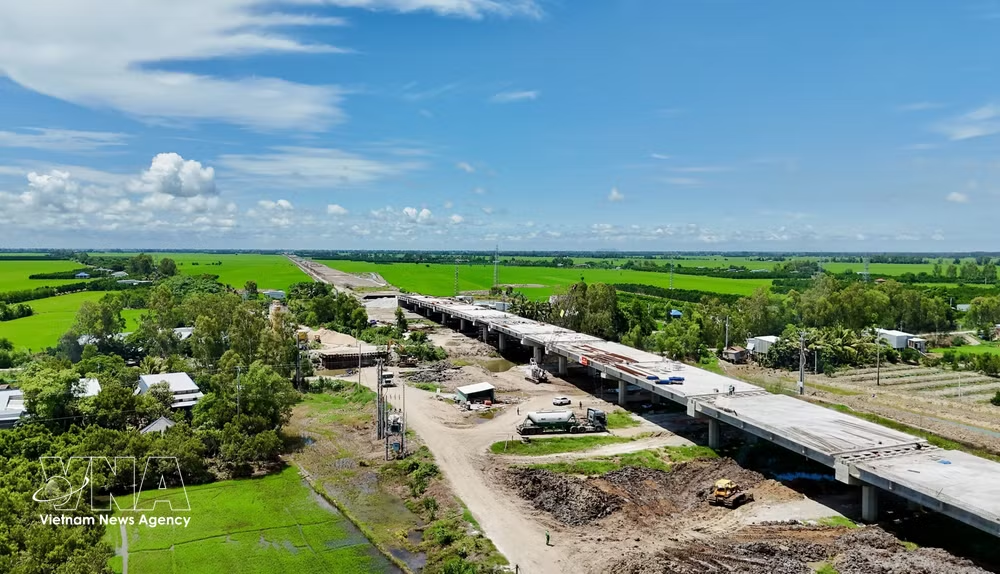
Illustrative photo (Photo: VNA)

The NA also set a target of disbursing more than 95% of assigned public investment capital. State budget-funded public investment will be concentrated on key priorities, with the number of projects to be reduced by at least 30% compared with the 2021-2025 period.

Total medium-term public investment capital from the State budget for 2026-2030 will amount to 8.22 quadrillion VND (nearly 312 billion USD). Of the total, 3.8 quadrillion VND will come from the central budget and 4.42 quadrillion VND from local budgets.

As much as 10% of the central budget allocation will be reserved as contingency funding to address issues arising during the planning period in accordance with the law on public investment and the State budget.

The legislature assigned the Government to guide output-based capital allocation, accelerate procedures for nationally important projects, and promptly issue implementation guidelines for national target programmes. Ministries, central agencies and localities were also instructed to carry out the plan in a coordinated and decisive manner, while strictly handling violations.

For locally balanced budget capital, annual investment plans must be based on actual revenue capacity and must not increase local budget deficits./.

VNA

See more

Delegates press the button to officially launch the Doan Hung Industrial Park – AMATA City Phu Tho project at the conference. (Photo: VNA)

Vietnam, Thailand strengthen investment ties, smart city cooperation

Thailand is currently Vietnam's largest trading partner within ASEAN, while Vietnam ranks as Thailand's sixth-largest trading partner globally. Bilateral trade reached 22.07 billion USD in 2025, with both sides aiming to increase the figure to 25 billion USD in the coming years. Thailand also has 805 valid investment projects in Vietnam with a combined registered capital of 15.4 billion USD.

Deputy Prime Minister Nguyen Van Thang speaks at the meeting with ministries and sectors in Hanoi on June 17 to review public investment disbursement and address bottlenecks affecting ODA projects. (Photo: VNA)

Deputy PM requests faster disbursement of ODA-funded projects

As of June 15, the disbursement rate for public investment funded by external sources had reached only 9.99% of the assigned plan. Although the figure was higher than in the same period last year, it remained well below the national average. Notably, one out of eight ministries and central agencies and 13 localities had yet to disburse any allocated capital.

Sorting green-skinned pomelos for export at the processing facility of Vina T&T Group in Vinh Long province. (Photo: VNA)

Vietnamese fruits strengthen foothold in China

The expansion of fruit trade has been supported by the implementation of the Regional Comprehensive Economic Partnership (RCEP) and ongoing efforts to upgrade the China – ASEAN Free Trade Area.

Production line for camera modules and electronic components at the factory of the Korean-invested MCNEX VINA Co., Ltd, located in Phuc Son Industrial Park, Ninh Binh province. (Photo: VNA)

High-tech FDI attraction set as strategic priority: official

The resolution sets out a number of specific targets for foreign investment attraction during the 2026–2030 period. Annual registered FDI is targeted at between 40 billion USD and 50 billion USD, while realised capital is expected to reach approximately 30–40 billion USD per year.

Production of electronic components at DBG Technology Vietnam Co., Ltd. in Yen Binh Industrial Park, Thai Nguyen province. (Photo: VNA)

Vietnam’s trade surplus with EU expands amid economic headwinds

Trade between Vietnam and the EU maintained momentum during the January–May period, supported by the EU – Vietnam Free Trade Agreement (EVFTA) and sustained demand for key Vietnamese exports, even as the EU grappled with inflationary pressures and sluggish consumer spending.

Containers are unloaded at Nghi Son International Port in Nghi Son ward, Thanh Hoa province. (Photo: VNA)

Vietnam eyes to shape national maritime industrial ecosystem

These advantages provide a strong foundation for the development of the marine economy and logistics services. As a result, the marine economy has been identified as a national strategic priority, with the coordinated development of maritime transport, seaports and shipbuilding serving as a key pillar in shaping a sustainable national maritime industrial ecosystem.

The road to the VSIP Can Tho Industrial Park connecting with National Highway 80 is under construction. (Photo; VNA)

Vietnam draws harder line on FDI quality under new resolution

The Ministry of Finance’s Foreign Investment Agency reported that total registered FDI neared 25 billion USD in the first five months of this year, a jump of almost 35% from a year earlier, with new project registrations driving the bulk of the expansion.