ADB official highlights Vietnam’s resilience, outlines reform priorities for long-term growth

ADB remains committed to supporting Vietnam’s development aspirations and reform agenda in the years ahead, said Zhang Nianshan, Director General of ADB’s Southeast Asia Department.

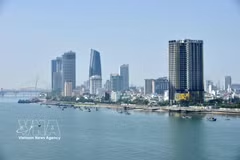
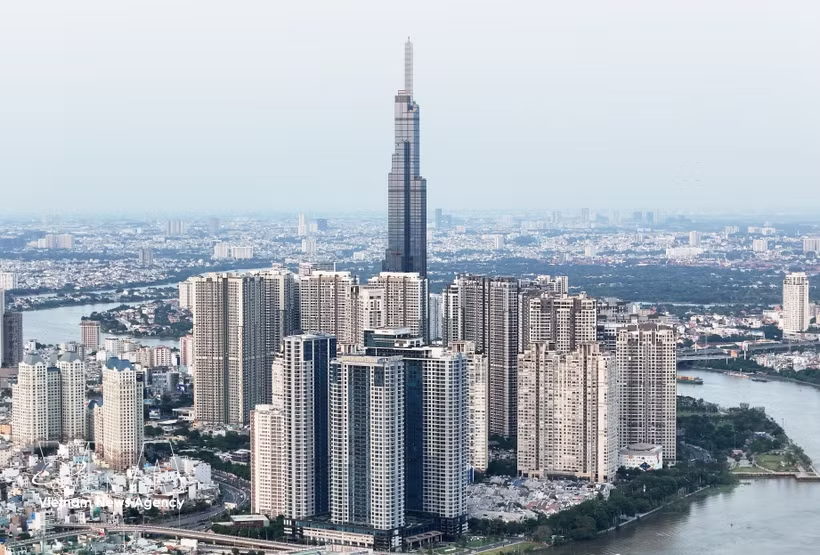
A luxury apartment complex near the centre of Ho Chi Minh City along the Saigon River. (Photo: VNA)

Hanoi (VNA) – An official from the Asian Development Bank (ADB) has expressed confidence in Vietnam’s medium-term economic outlook, describing the country as one of Southeast Asia’s most resilient economies despite mounting global uncertainties.

Speaking to a Vietnam News Agency reporter on the sidelines of the 59th Annual Meeting of the ADB Board of Governors in Samarkand, Zhang Nianshan, Director General of ADB’s Southeast Asia Department, said Vietnam possesses strong structural advantages that will help sustain growth in 2026-2027.

According to Zhang, Southeast Asia as a whole remains vulnerable to external shocks, including prolonged high interest rates, geopolitical conflicts and disruptions to global supply chains. Tensions in the Middle East, in particular, continue to affect shipping activities and energy infrastructure, resulting in tighter supply and elevated energy prices.

Under ADB’s baseline scenario, with crude oil prices averaging 96 USD per barrel this year before easing to 80 USD next year, Southeast Asia’s medium-term growth could slow to 4.2%, while inflation may rise to 4.5% in 2026.

However, the region is still expected to remain resilient in the short term thanks to strong domestic demand, he noted, adding that growth prospects will depend heavily on countries’ ability to manage external shocks while maintaining fiscal and macroeconomic stability.

Against that backdrop, Vietnam stands out for its stable macroeconomic management and strong policy responses, Zhang said.

He highlighted Vietnam’s ample fiscal space and relatively low public debt, which have enabled the Government to cushion the impact of oil market disruptions and stabilise prices effectively. ADB was particularly impressed by the Government’s timely and decisive support measures aimed at reducing negative spillover effects from the global environment.

Public investment, domestic consumption, tourism recovery and digital transformation are expected to continue supporting Vietnam’s growth momentum in 2026, he said.

Meanwhile, export-oriented manufacturing and foreign direct investment (FDI) remain key growth drivers despite external headwinds and the high comparison base of 2025.

Vietnam recorded growth of more than 8% in 2025 and has set an ambitious target of achieving double-digit growth in the 2026-2030 period as part of its goal to become a high-income country by 2045.

To realise those ambitions, Zhang said Vietnam needs to accelerate reforms in three key areas.

First, the country should improve labour productivity and economic resilience by streamlining administrative procedures, improving the business climate, strengthening governance efficiency and enhancing science and technology capacity.

Second, Vietnam needs to further develop its financial sector and capital markets, particularly by expanding the corporate bond market to mobilise long-term funding and reduce dependence on bank credit.

Third, energy security and climate adaptation should be placed at the centre of the growth agenda. Diversifying energy sources and accelerating clean energy deployment will be critical to strengthening Vietnam’s long-term competitiveness, he stressed.

Zhang affirmed that ADB remains committed to supporting Vietnam’s development aspirations and reform agenda in the years ahead./.

VNA

See more

Politburo member Nguyen Duy Ngoc, who is also Secretary of the CPV Central Committee, Chairman of its Organisation Commission and standing deputy head of the Central Steering Committee for Science-Technology Development, Innovation and Digital Transformation, at a working sessions with leaders of the Indian Institute of Technology Madras (IIT Madras). (Photo: dangcongsan.vn)

Vietnam strengthens cooperation with India’s leading technology partners

Both sides exchanged views on digital identification management, electronic authentication, biometrics, personal data protection and experience in implementing large-scale national digital services. The two sides also agreed to strengthen exchanges of experts and cooperation in technical and policy experience-sharing in the coming period.

International buyers explore products at the Vietnam International Sourcing 2025. (Photo: VNA)

Vietnam to host international sourcing event series in September

The Vietnam International Sourcing 2026 (VIS 2026) is one of Vietnam’s key trade promotion activities this year, serving as a platform to boost trade and investment cooperation while supporting the shift towards supply chain sustainability amid global economic uncertainties.

The first VinaFIS Fisheries Techexpo 2026 opens at the Saigon Exhibition and Convention Centre in Ho Chi Minh City on April 28. (Illustrative photo: VNA)

Ho Chi Minh City expands innovation startup space

Currently ranked 110th among the world’s most dynamic startup ecosystems and among Southeast Asia’s top five, the southern economic hub of Ho Chi Minh City is seeking to build on its existing strengths to move into the world’s Top 100 startup cities in the coming years.

Illustrative image (Photo; VNA)

Top Vietnamese leader’s visit to Sri Lanka to tap trade potential

According to the Vietnamese Ministry of Industry and Trade (MoIT), Sri Lanka is Vietnam’s fourth-largest trade partner in South Asia after India, Bangladesh, and Pakistan. In recent years, Vietnam has been running a steady surplus, with exports exceeding imports.

A booth at VIETNAM MEDIPHARM 2026. (Photo courtesy of organisers)

Int'l medical, pharmaceutical expo opens in Hanoi

The exhibition, which runs until May 9 at the Hanoi International Centre for Exhibition, showcases advanced products and technologies across a range of fields, including pharmaceuticals, drug manufacturing machinery and equipment, medical devices, hospital and clinic services and dental equipment.

Vietnamese coffee products are promoted at Kaffee Campus 2026. (Photo: VNA)

Vietnam seeks stronger foothold in Germany’s premium coffee market

Industry representatives noted that Germany’s market is gradually shifting from Arabica towards high-quality Robusta as climate change affects supply. Although Vietnam remained Germany’s second-largest coffee supplier after Brazil with export turnover of 1.22 billion USD in 2025, its coffee is still largely associated with industrial processing.