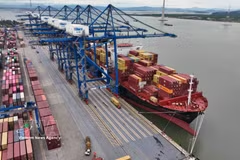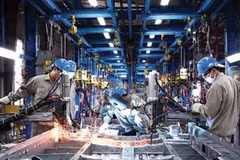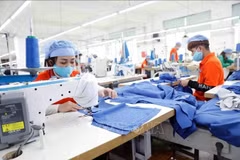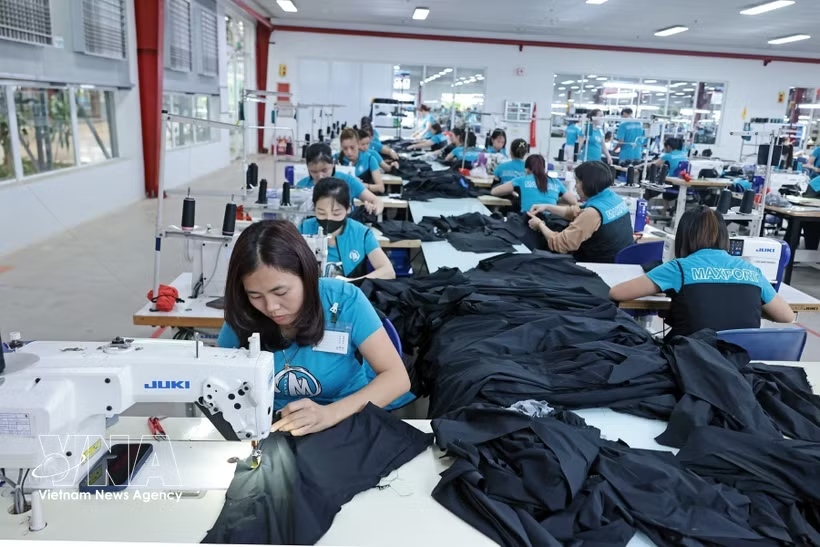
Hanoi (VNA) – Upskilling has become a critical lever for Vietnamese working class to cement its role, sharpen competitiveness and advance sustainable development as it navigates a mix of opportunities and challenges in the digital era.
Modern technology mastery imperative
As the economy is pivoting to a growth model fueled by knowledge, technology and innovation, the working class, or the backbone of production, demands better professional qualifications, vocational skills, industrial discipline and work habits. Timely adaptation is the only shield against being undercut by accelerating automation, artificial intelligence and increasingly fiercer global competition.
By late 2025, Vietnam counted 17.5 million industrial and construction workers and 21.2 million in services, or 39% of the population and 73.6% of the labour force. The share of trained workers rose to about 70% from 64.5% in 2020. Workers holding degrees or certificates jumped to nearly 29.2% from 24.1%. Notably, a tech-savvy younger generation is starting to emerge, signaling fresh dynamism in the new era.
The Vietnam General Confederation of Labour (VGCL) warned that working class development still falls short of the country’s growth ambitions. Workforce quality is patchy, the technical labour structure is lopsided, while shortages of skilled workers, tech-fluent technicians and modern-technology specialists persist across sectors. The large young workforce is unstable, has a short career shelf-life, and increasingly risks slipping into the informal economy.
To build a modern working class, the VGCL is urging the Party Central Committee to issue a comprehensive working class development strategy matched with the national socio-economic blueprint. It wants concrete steps to forge a modern workforce tightly integrated with sci-tech and innovation.
There is also a need to lift educational attainment, professional skills, industrial discipline and work ethic so workers can adapt to new production environments and integrate globally. Expanding welfare and social safety nets should be prioritised. Companies must be encouraged to embrace greater social responsibility, share benefits more fairly, create sustainable jobs and offer stable conditions.
Foreign-invested enterprises already favour recruiting and training highly skilled technical staff, who directly dictate modern production line efficiency.
Vocational training push
Vocational education enrollment hit 2.2 million in 2025, or 107% of the annual target, according to the Directorate of Vocational Education and Training. Short-term and elementary-level courses still make up the bulk.
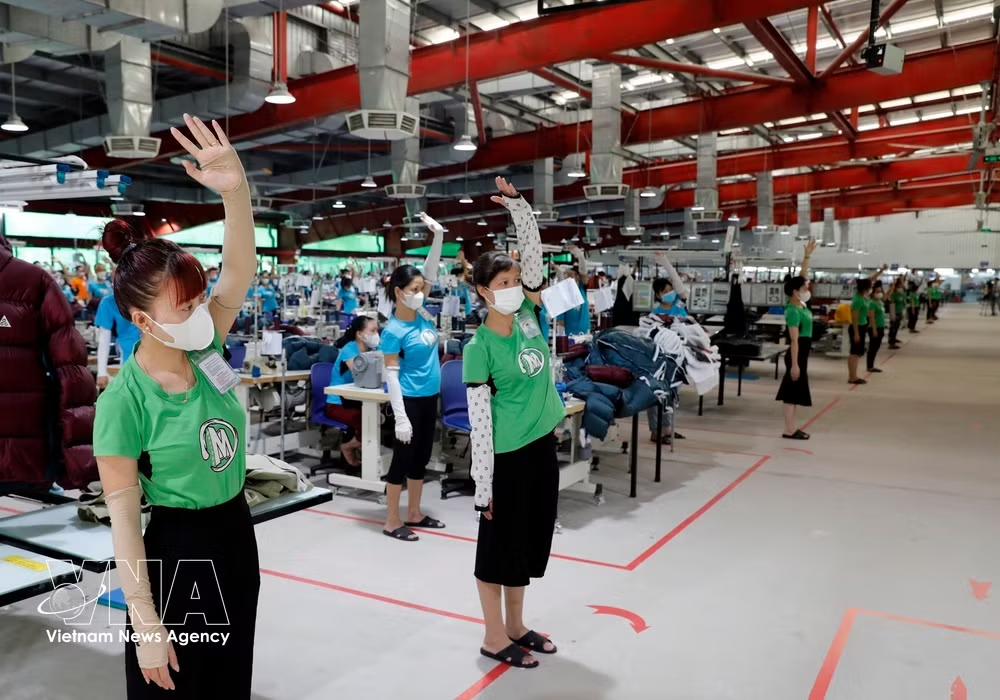
During 2024-2025, more than 85% of vocational schools partnered with over 7,200 companies to co-develop curricula, set output standards and assess students, while hosting over 310,000 interns. More than 80% of graduates landed jobs, with 70–75% working in their trained fields.
Yet, enrollment in long-term, full-time courses remains low. That may suffice for low-skilled roles, but advanced sectors, industrial electricity, mechatronics, metal cutting, mold making, welding, still demand intensive, long-duration training.
Trinh Thi Phuong from the Academy of Politics Region II said building a quality workforce now requires sweeping education reform with practical orientation. Teaching content and methods must be overhauled to foster creativity, problem solving and lifelong learning. Courses must go beyond theory to stress hands-on skills, teamwork and agility in the face of rapid labour market changes.
At the same time, school-enterprise links must be forged to embed real production and trade practices into training.
Priority should go to vocational courses tightly aligned with actual production and trade, especially for foundational and spearhead industries needing highly skilled labour. Flexible short-term courses must expand to quickly deliver digital skills and readiness for smart workplaces and emerging technologies.
Foreign language proficiency is also rising on the agenda for policymakers and business executives. Workers who can communicate effectively with foreign experts and business owners will have far wider job opportunities, she added.
The Vietnamese working class now spans nearly every key economic sector, generating about 65% of GDP and more than 70% of state budget revenue./.