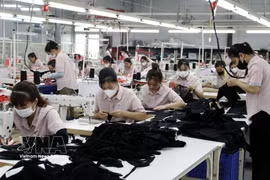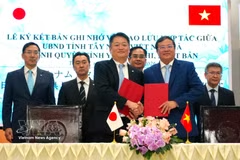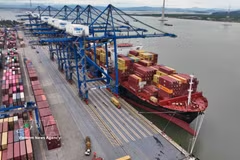
Hanoi (VNA) - Foreign direct investment (FDI) inflows into Vietnam continued to post positive signs in the first months of 2026, underscoring the resilience and attractiveness of the country’s investment environment amid global economic uncertainties.
According to the Ministry of Finance (MoF), Vietnam is currently home to around 46,200 valid FDI projects with total registered capital of nearly 545 billion USD. Accumulated realised capital has surpassed 357 billion USD, equivalent to 65.6% of the total registered investment.
In the first four months of 2026, total FDI inflows into Vietnam reached 18.24 billion USD, up 32% year-on-year. Disbursed capital was estimated at more than 7.4 billion USD, an increase of 9.8% and the highest four-month disbursement level recorded in the past five years, reflecting effective implementation of many registered projects.
Nguyen Duc Hien, Vice Chairman of the Party Central Committee's Commission for Policies and Strategies, said Vietnam continued to maintain strong momentum in attracting foreign investment. The sharp increase in newly-registered FDI capital compared to the same period last year reflected growing confidence among international investors in Vietnam’s business and investment climate.
The MoF’s Foreign Investment Agency noted that despite slower global growth, volatile trade policies, prolonged geopolitical tensions, and increasing economic fragmentation, Vietnam still posted encouraging results in attracting investment, demonstrating the economy’s resilience and long-term appeal.
Notably, the quality of FDI inflows has shown signs of improvement. The 9.8% rise in realised capital indicated that existing projects are being implemented steadily and disbursement progress remains on track, further reinforcing investors' confidence.
During the January-April period, Vietnam licensed 1,249 new FDI projects with combined registered capital of 12.15 billion USD, up 3.7% in the number and 2.2 times in the capital volume compared to the same period last year. The figures showed that Vietnam remains a key destination in global supply chain diversification strategies.
Capital contribution and share acquisition activities also remained vibrant, signalling that foreign investors are not only seeking new projects but are also looking to deepen their presence through existing Vietnamese enterprises.
A significant trend is the growing concentration of FDI into large-scale, high-tech projects, in line with Vietnam’s selective investment attraction strategy which prioritises advanced technologies, high added value, and stronger spillover effects for domestic enterprises. This is expected to be a key factor in improving the quality of FDI inflows in the coming years.
Kim In Woo, Vice Chairman of the Korea Chamber of Business (KOCHAM) in Vietnam, said cumulative investment of the Republic of Korea in Vietnam had reached 95.23 billion USD with 10,425 projects as of February 2026. He noted that Vietnam’s open economy, solid manufacturing base, and strong growth make it an important production, export, and long-term strategic market for Korean businesses.
Meanwhile, Sun Fenglei, Chairman of the Chinese Business Association in Vietnam, said more than 10,000 Chinese enterprises are currently operating in Vietnam, including over 400 listed companies.
Many are accelerating expansion into high-tech sectors such as information electronics, new energy, and artificial intelligence, gradually moving away from traditional labour-intensive industries.
Torben Minko, Vice Chairman of the European Chamber of Commerce (EuroCham) in Vietnam, said EuroCham currently represents around 1,500 businesses operating in Vietnam. According to him, the high level of confidence among European enterprises demonstrates that Vietnam remains an attractive investment destination.
Despite positive assessments of Vietnam’s investment climate, business associations noted that the country still needs to further improve manufacturing capacity, technological capabilities, and industrial linkages to attract and retain high-quality projects. Policy consistency, transparency, predictability, and faster administrative procedures are also becoming increasingly important to strengthening competitiveness.
Torben Minko added that green transition and ESG standards are rapidly becoming mandatory requirements for businesses. Vietnam therefore needs to integrate these factors more deeply into production and business activities to meet rising expectations from international investors.
Hien also pointed out several bottlenecks in the FDI sector, including weak linkages between foreign-invested and domestic firms, low localisation rates, limited technology absorption capacity, underdeveloped research and development activities, and shortcomings in institutions, infrastructure, and human resources. Without effective solutions, the spillover effects of FDI on the broader economy could remain limited, he warned.
Dr. Phan Huu Thang, former Director of the Foreign Investment Agency, said localities should implement comprehensive measures to develop a highly skilled workforce capable of meeting the requirements of high-tech and high value-added industries in order to improve the quality of FDI attraction.
He also stressed the need to promote joint ventures and partnerships between domestic and foreign-invested enterprises, enabling Vietnamese firms to participate more deeply in global value chains, strengthen management capacity, and gradually build their own technological capabilities./.