📝OP-ED: From historic autumn of 1945 to 2045 aspiration

Eighty-one years since the August Revolution of 1945, Vietnam is at the threshold of another transformation, from a developing country to a developed, high-income nation. What links those two autumns is a refusal to bow to adversity, along with the embrace of self-reliance, national solidarity and confidence in the path chosen by the Party and President Ho Chi Minh.

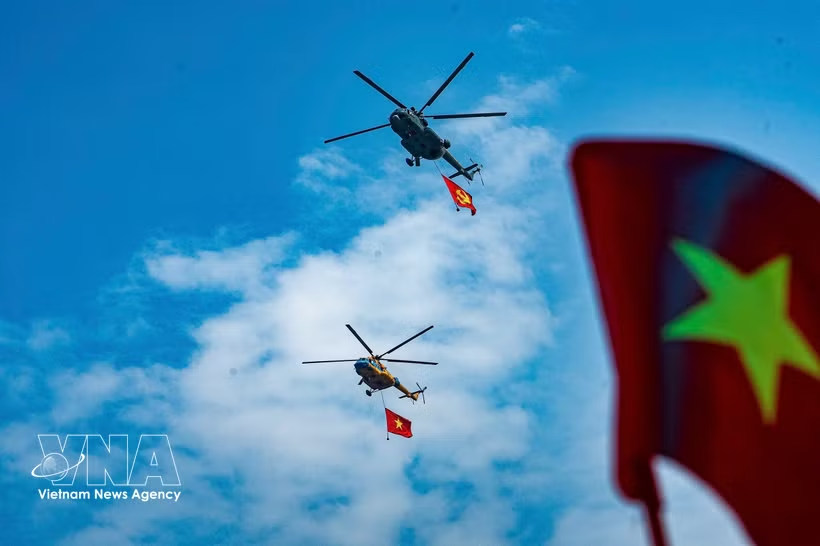
Helicopters conduct aerial rehearsals over Hanoi ahead of the 80th National Day anniversary celebration in 2025 (Photo: VNA)

Hanoi (VNA) – Eighty-one years after the August Revolution of 1945, its legacy remains a central force in Vietnam’s national trajectory. The country has moved from colonial rule to independence, defended its sovereignty and built its current position. As it pursues major development goals for 2030 and 2045, that legacy continues to drive the national push forward.

Before the August Revolution, Vietnam was under colonial and fascist rule. The 1945 famine killed more than 2 million people. Against that backdrop, the Communist Party and President Ho Chi Minh led a nationwide general uprising that seized power and established the Democratic Republic of Vietnam. A subjugated people became masters of the state, what President Ho Chi Minh called “an extremely great change in the history of our country”.

Seizing power was only the first test. The fledgling revolutionary administration had to confront hunger, ignorance and foreign aggression at once. From the “rice jar for famine relief” and “Gold Week” to mass literacy campaigns and nationwide resistance, the country joined hands to defend independence. Nine years of war against French colonialism and nearly 21 years against US imperialism followed. Almost three decades of fighting ended in victory, securing independence and reunification.
vnanet-t.jpg
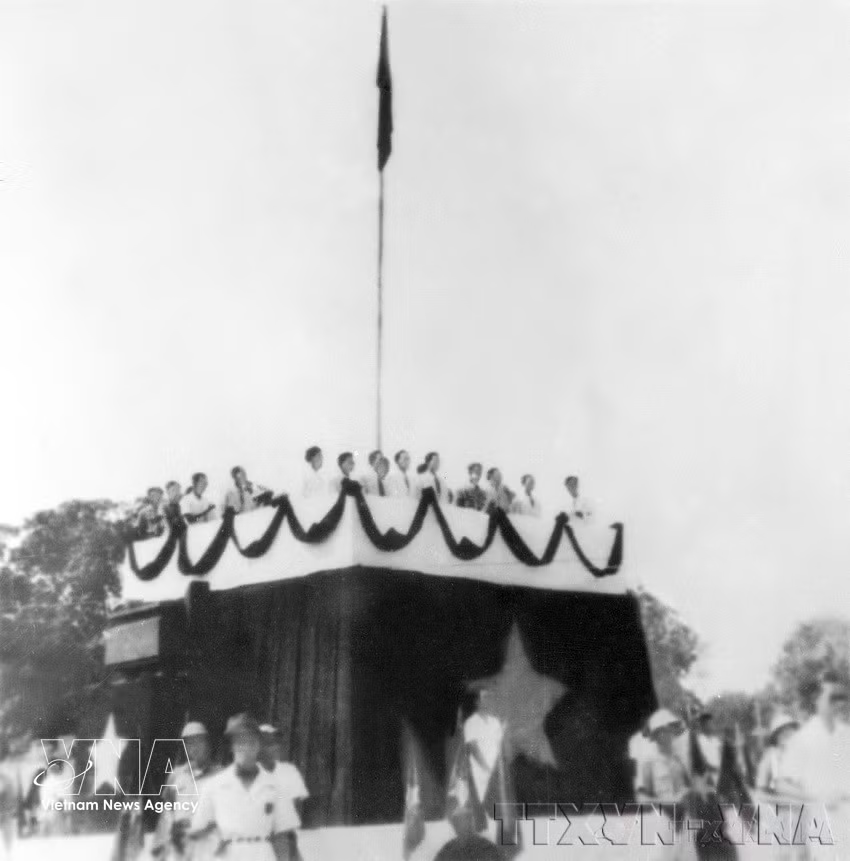
President Ho Chi Minh declares the birth of the Democratic Republic of Vietnam at Ba Dinh Spare in Hanoi on September 2, 1945. (Photo: VNA)

After the wars, Vietnam faced a different struggle: reconstruction, poverty reduction and the search for a development path under extreme constraints. In 1986, the Party launched Doi Moi (Renewal), opening a route out of crisis, encirclement and embargo toward integration into the world.

Forty years of Doi Moi have transformed the economic landscape. Vietnam has moved from a poor, underdeveloped economy to one of the world’s 34 largest. Its economic scale has expanded almost 100-fold since 1986; per capita income has risen from less than 100 USD to nearly 5,000 USD.

Former Minister of Foreign Affairs Nguyen Dy Nien said the eight-decade journey, especially 40 years of Doi Moi, has been defined by shifts in the Party’s approach to leadership and governance, and by the timely removal of development bottlenecks. The 1986 sixth National Party Congress, he said, was a historic marker.

For Vietnam to meet near- and long-term goals, Nien argued that the priorities remain renewing thinking, reassessing the country against global shifts, attracting and using talent effectively, and preserving national identity during integration.

The establishment of the Democratic Republic of Vietnam, predecessor of today’s Socialist Republic of Vietnam, has broader significance. Konstantin Ilyich Mogilevsky, Russian Deputy Minister of Science and Higher Education and Co-Chairman of the Russian Historical Society, has said Vietnam’s liberation movement was the first in Asian history to overthrow colonial rule through its own efforts and open a new future. That precedent, he said, is particularly relevant.

“The whole world is undergoing profound transformation”, Mogilevsky said. “More countries and peoples are choosing free and independent development based on traditional values. This positive shift reflects the objective maturation of the principle of equality among all stakeholders in international relations”.

Vietnam’s current gains came from generations that endured hardship, made sacrifice, embraced reform and recovered from challenges. Yet substantial risks remain: the middle-income trap, weak labour productivity, an aging population, climate change, inequality, non-traditional security threats, and institutional and business-environment bottlenecks. Corruption, wastefulness, misconduct and bureaucracy among some officials and Party members must still be tackled resolutely.

Eighty-one years after the 1945 Autumn, Vietnam is entering a new growth phase. It is streamlining the state apparatus, moving to a two-tier local administration model, and merging cities and provinces to improve governance and bring authorities closer to citizens. Alongside administrative reform, the country is pushing science, technology and innovation while building up the private sector next to the state sector. Those are key resources for faster, more sustainable growth.
vnanet-u-4026.jpg
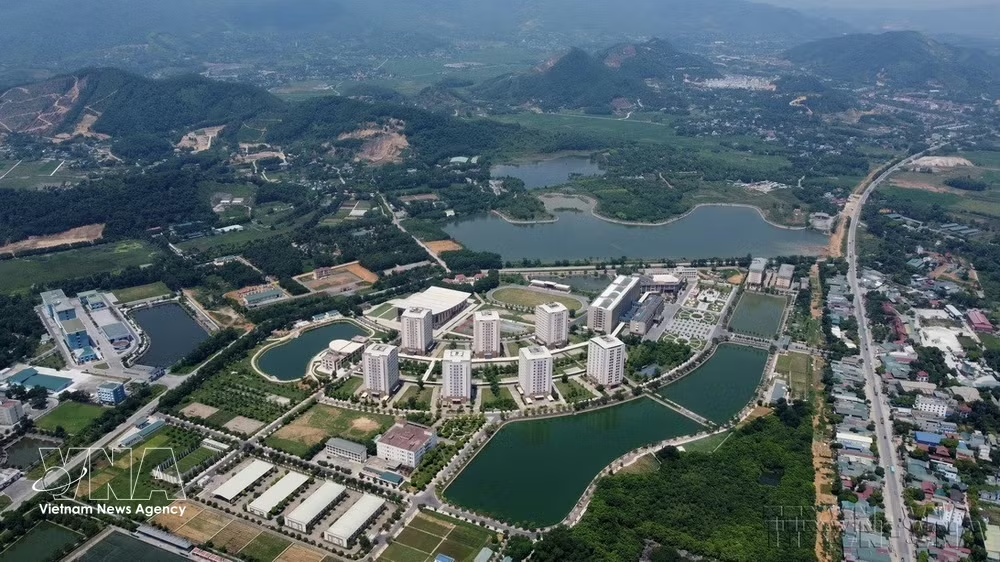
Eighty-one years after the 1945 Autumn, Vietnam is entering a new growth phase. (Illustrative photo: VNA)

The next checkpoints are close: 2030 is four years away, and 2045, the centenary of an independent Vietnam, is 19 years off. The 14th National Party Congress set the development direction and ambitions. The second and third plenums of the 14th Party Central Committee laid groundwork for organisational reform and new operating models, clearing bottlenecks, unlocking resources and creating new development capacity. The 16th National Assembly has been deciding major issues. The goal is a Vietnam that stands alongside the world’s major powers by 2045.

International forecasts support the optimism. The International Monetary Fund (IMF) projects that Vietnam will become the world’s 32nd largest economy by 2029. That outlook reinforces the need to optimise opportunities, stay on course and act decisively to turn the ambition into reality.

The August 1945 General Uprising opened up a new chapter. Eighty-one years later, Vietnam is at the threshold of another transformation, from a developing country to a developed, high-income nation. What links those two autumns is a refusal to bow to adversity, along with the embrace of self-reliance, national solidarity and confidence in the path chosen by the Party and President Ho Chi Minh. Those values are being reinforced through every reform policy and development push. As Party General Secretary and President To Lam said: “To overcome all challenges, we must maintain solidarity, unity in will and action, and place the interests of the nation and people above all else”./.​

VNA

See more

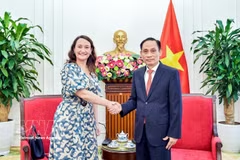
Minister of Foreign Affairs Le Hoai Trung (right) receives Uruguayan Deputy Foreign Minister Valeria Csukasi Cabrera on August 17 (Photo: VNA)

Vietnam treasures traditional friendship with Uruguay: FM

Vietnam highly values Uruguay’s role, position, and contributions to the regional and international communities, as well as the achievements the country has made under the administration of President Yamandú Orsi, said Minister of Foreign Affairs Le Hoai Trung.

President of the National Assembly Tran Thanh Man (right) and Alberto Anaya Gutierrez, General Secretary of the Mexican Labour Party (PT), at their meeting in Hanoi on August 17 (Photo: VNA)

Vietnam, Mexico to enhance exchange of legislative experience

Vietnam and Mexico will strengthen coordination and enhance delegation exchanges between the Vietnamese National Assembly and the Mexican Senate and Chamber of Deputies, while sharing experience in lawmaking and parliamentary activities among committees and promoting the role of the two parliamentary friendship groups.

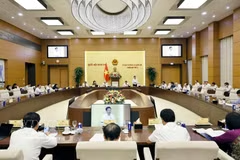
A view of the fifth session of the National Assembly Standing Committee (Photo: VNA)

NA Standing Committee reviews three revised draft laws

The National Assembly (NA) Standing Committee continued its fifth session on August 17, scrutinising three draft laws concerning administrative procedures, telecommunications, radio frequencies and architecture.

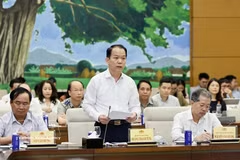
Minister of Justice Hoang Thanh Tung speaks at the discussion (Photo: VNA)

NA Standing Committee reviews draft Law on Urban Development

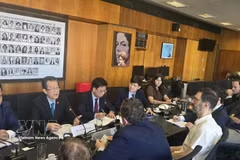
Speaking at the session, NA President Tran Thanh Man noted that the draft Law on Urban Development was initially designed for Ho Chi Minh City before its scope was expanded to other cities and additional provisions were incorporated. Given the tight timeframe and substantial workload, the NA will make its utmost effort to consider and adopt the contents as scheduled.

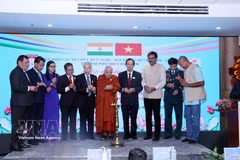
A traditional Indian candle-lighting ceremony opens the gathering. (Photo: VNA)

People-to-people diplomacy deepens Vietnam-India ties

Building on this foundation, the city has strengthened ties with Indian localities. In May, Ho Chi Minh City and Mumbai signed a memorandum of understanding on friendship and cooperation, opening up greater opportunities for collaboration in finance, technology, logistics, urban development, innovation, culture, cinema, tourism and people-to-people exchanges.

General Secretary of the Communist Party of Vietnam Central Committee and President To Lam addreses the opening ceremony of the first class of a knowledge update and training programme for members of the 14th Party Central Committee in Hanoi on August 17 (Photo: VNA)

Top leader attends opening of knowledge update programme for 14th Party Central Committee members

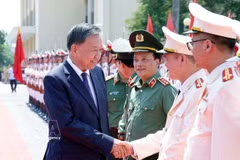
General Secretary and President Lam stressed that the programme is being held in the first year of implementing the Resolution of the 14th National Party Congress, which set out the goals and tasks for the entire tenure. The Party Central Committee has adopted measures to remove bottlenecks and unlock resources. The decisive task now is to ensure effective implementation by turning policies into feasible programmes, coordinated action and concrete results, thereby translating the Party's will into national development and a better life for the people.

The delegation meets with progressive friends in the US (Photo: VNA)

Vietnam, US strengthen cooperation to ease suffering of AO/dioxin victims

A delegation from the Vietnam Association for Victims of Agent Orange/dioxin's chapter in Ho Chi Minh City (VAVA HCMC) visited the US directly inform American friends about the long-term consequences of AO/dioxin in Vietnam and seek the support of progressive groups, veterans, legal experts and youth organisations in efforts to care for the victims.

Vietnamese leaders send congratulations to Congo on 66th National Day

Vietnamese leaders send congratulations to Congo on 66th National Day

General Secretary of the Communist Party of Vietnam Central Committee and President To Lam on August 15 sent a congratulatory message to President of the Congolese Party of Labour and President Denis Sassou Nguesso on the occasion of the 66th National Day of the Republic of Congo (August 15, 1960–2026).

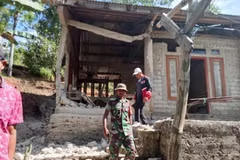
A house is damaged after the earthquake in Flores, Indonesia, on August 15. (Photo: Xinhua/VNA)

Vietnamese leaders send condolences over deadly earthquake in Indonesia

General Secretary of the Communist Party of Vietnam Central Committee and President To Lam and Prime Minister Le Minh Hung on August 15 sent messages of condolences to Indonesian President Prabowo Subianto following a powerful earthquake in Indonesia that caused heavy casualties and affected thousands of families.

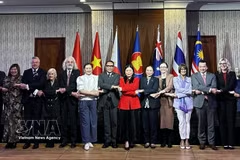
Participants at the event (Photo: VNA)

ASEAN, Western Australia strengthen connection

Representatives of ASEAN member states highlighted the historic significance of ASEAN Day in reaffirming the bloc's foundational values and promoting solidarity, dialogue, cooperation and consensus in support of regional peace, stability and prosperity.