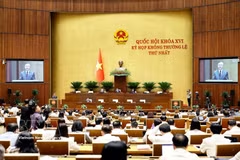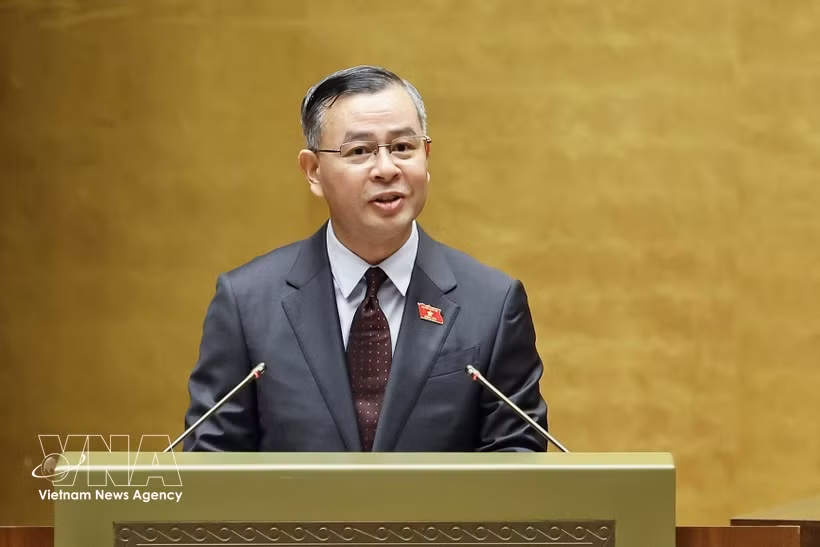
Hanoi (VNA) - As part of its first extraordinary session, the 16th National Assembly on August 19 examined a proposal and report on orientations for drafting the Law on State Budget (consolidated), aimed at establishing a unified public finance management mechanism and improving the efficiency of State budget resources.
Minister of Finance Ngo Van Tuan said the Law on State Budget 2025 and the Law on Public Investment 2024 (amended and supplemented in 2025), have undergone fundamental revisions to institutionalise resolutions and conclusions of the Party, strengthen the central budget’s leading role and local budget autonomy, and promote decentralisation while removing bottlenecks in public investment.
However, the coexistence of the two laws has created overlaps in authority, documentation, procedures, and deadlines between State budget estimates and public investment plans, resulting in duplicate procedures for managing public investment funds. There are also no sufficiently strong mechanisms linking the five-year financial plan with the medium-term public investment plan.
Therefore, consolidating the two laws is necessary to establish a consistent public finance management mechanism; minimise procedures, time and compliance costs; and improve the mobilisation, management and use of State budget resources to support growth, he said.
The draft consolidated law, comprising 10 chapters and 102 articles, largely inherits effective provisions of the two existing laws while streamlining them to reduce administrative procedures. In line with Politburo Resolution No. 66-NQ/TW, it only stipulates framework provisions and fundamental principles within the National Assembly’s authority, while assigning the Government to issue detailed regulations on procedures and matters that are subject to frequent changes in implementation.
A key orientation is to integrate the five-year financial plan and State budget estimates with public investment plans. Specifically, the medium-term public investment plan will be incorporated into the five-year financial plan, while annual public investment plans will be integrated into annual State budget estimates. State budget spending principles, criteria and norms will also be unified for both recurrent and investment spending.
The draft also synchronises the powers and responsibilities of the NA and its Standing Committee, the Government, the Prime Minister, ministries, People’s Councils and People’s Committees at all levels, and relevant agencies in public investment management. Particular emphasis is placed on evaluating investment efficiency throughout the entire process, from planning and appraisal to capital allocation, implementation, management and post-completion operation.
It further revises State budget management mechanisms, including the allocation and use of increased budget revenue during budget execution, and the use of contingency funds, financial reserves and additional revenues to respond to emergencies.
Commenting on the draft’s orientations, the NA’s Committee for Economic and Financial Affairs stressed that consolidation must form part of a broader reform of State budget and public investment management, ensuring that the new law genuinely eliminates overlaps and establishes unified procedures for budgeting, allocation, implementation and final settlement.
The committee also called for stronger decentralisation, with clear allocation of authority and responsibility based on the principle of “localities decide, localities implement and localities take responsibility,” alongside resources commensurate with assigned tasks.
Regarding public investment efficiency, Deputy Chairman of the committee Nguyen Huu Toan said the proposed mechanism for controlling and evaluating investment efficiency is an important new element. However, he noted that the draft only sets out general requirements for assessing socio-economic efficiency without specifying evaluation criteria and principles.
The committee therefore proposed clearer criteria for assessing investment efficiency, responsibilities of investment decision-makers and project developers, post-completion evaluations and public disclosure of results, as well as accountability for projects failing to meet their objectives or delivering low efficiency./.