Amendments to Land Law aim to achieve three key goals

The Government has identified three major objectives: promptly institutionalising Party policies on land, private-sector development and national digital transformation; addressing urgent practical obstacles to unlock resources and support the goal of double-digit economic growth; and building a modern, streamlined and effective land management system through stronger decentralisation and administrative reform.

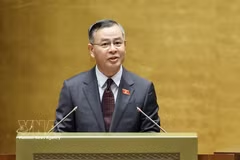
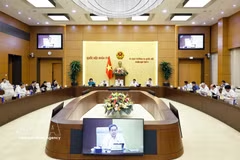
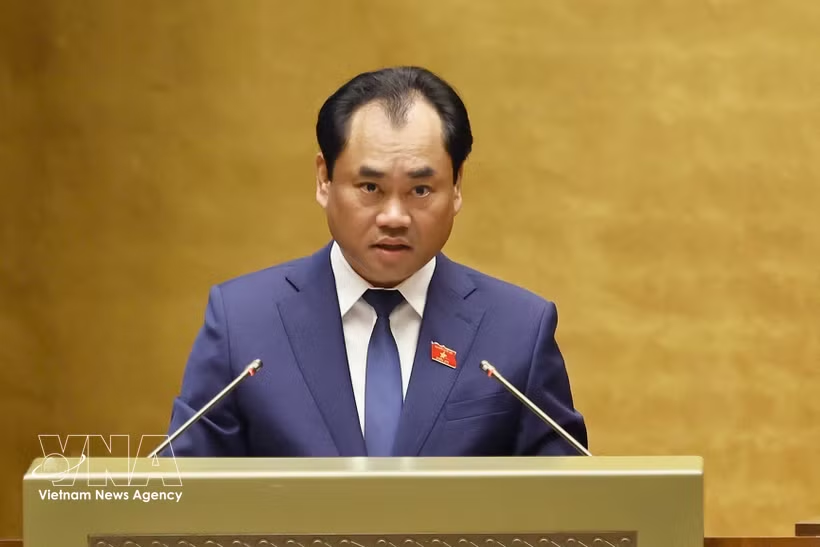
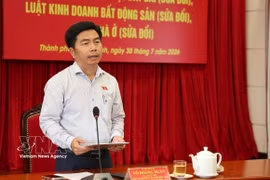
Minister of Agriculture and Environment Trinh Viet Hung presents the Government’s proposals on the amendments to the 2024 Land Law. (Photo: VNA)

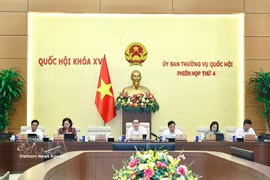
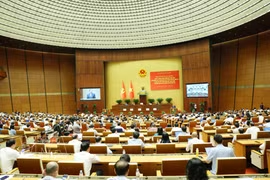
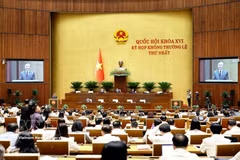
Hanoi (VNA) – The 16th National Assembly continued the second phase of its first extraordinary session on August 19, hearing reports on the policy orientations for amending the 2024 Land Law.

Authorised by the Prime Minister, Minister of Agriculture and Environment Trinh Viet Hung presented the Government’s proposals on the amendments.

After nearly two years of implementation, the 2024 Land Law and its guiding documents have brought significant improvements to State management on land. However, practical implementation has exposed shortcomings, particularly inconsistencies with the two-tier local administration model and newly amended laws. The Government therefore considers the amendment urgent to institutionalise new Party guidelines, remove institutional bottlenecks and unlock land resources for socio-economic development.

The Government has identified three major objectives: promptly institutionalising Party policies on land, private-sector development and national digital transformation; addressing urgent practical obstacles to unlock resources and support the goal of double-digit economic growth; and building a modern, streamlined and effective land management system through stronger decentralisation and administrative reform.

It has also approved seven major policy groups, covering land-use planning; land allocation, leasing, auctions and project bidding; land recovery, compensation and resettlement; land-related finance and pricing; land users’ rights and obligations and land consolidation; administrative reform, digital transformation and decentralisation; and stronger inspection, supervision and measures against land abandonment, pollution and degradation.

The draft law also incorporates three key areas: institutionalising the Party’s guidelines under Resolution No. 21-NQ/TW; codifying pilot and special mechanisms adopted by the National Assembly and Government; and revising land management powers and responsibilities to suit the two-tier local administration model, with greater authority delegated to grassroots administrations.

The NA’s Committee for Economic and Financial Affairs strongly agreed on the necessity and urgency of the amendments, targeting its entry into force on March 1, 2027. The committee called for continued improvements to both the draft law and policy framework before they are submitted to the National Assembly’s second session.

It also urged a substantive shift toward modern land governance, with stricter management of rice-growing land, forests and defence and security land, while allowing more flexible management of other land categories in line with socio-economic development needs.

Regarding land recovery, the committee stressed the need for clear criteria for projects deemed genuinely necessary for national or public interests, and ensuring that people’s lawful rights are protected, particularly in cases involving urban development and resettlement.

On land-related finance, it called for reasonable land pricing mechanisms to support production and business, attract investment and allow land price frameworks to be adjusted flexibly in line with changing conditions./.

VNA
See more

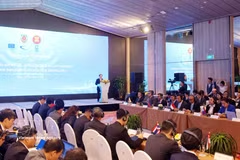
A view of the Hue–Japan Connectivity Conference 2026 held in the central city of Hue on September 6, 2026. (Photo: VNA)

Hue strengthens connectivity with Japanese partners

With the aim of creating an increasingly favourable and transparent environment for investment and cooperation, Hue is committed to continuing to accompany, support and create conditions for Japanese investors, businesses and organisations in exploring and implementing activities in the city.

General Secretary of the Communist Party of Vietnam Central Committee and President To Lam, and his spouse Ngo Phuong Ly leave Hanoi on September 7 for a state visit to Russia, an official visit to France and attendance at the International Space Summit in Paris, from September 7 to 12. (Photo: VNA)

Top leader departs for visits to Russia, France, attendance at Int’l Space Summit

The trip is of great importance both bilaterally and multilaterally, as it aims to strongly implement the foreign policy outlined by the 14th National Party Congress, strengthen political trust and create an external environment conducive to Vietnam’s development in the new era. The trip is also expected to help mobilise international resources for national development.

Stéphanie Do (centre) at a discussion with French readers and the Vietnamese community in France about her book, titled The Journey to Parliament of the First Vietnamese-French Female Lawmaker. (Photo published by VNA)

Vietnam–France relations: From cooperation to co-creation

Vietnam and France are facing a “historic opportunity” as Vietnam undergoes rapid transformation, while France is also seeking to strengthen partnerships with dynamic economies in Asia. The two countries therefore share a common interest in moving forward together and seizing the current opportunity to bring bilateral relations into a new phase of development.

A view of the meeting between Politburo member and Minister of Foreign Affairs Le Hoai Trung and Governor of Nara prefecture Yamashita Makoto in Hue city on September 6, 2026. (Photo: VNA)

Foreign Minister receives Japanese officials in Hue

Minister of Foreign Affairs Le Hoai Trung affirmed that locality-to-locality cooperation is an effective channel for implementing commitments and agreements reached by the two countries’ high-ranking leaders, while strengthening connectivity and people-to-people exchanges between Vietnam and Japan.

National Assembly President Tran Thanh Man speaks at a meeting with Korean friends in Seoul on September 6. (Photo: VNA)

National Assembly President meets Korean friends in Seoul

National Assembly (NA) President Tran Thanh Man stressed that Korean non-governmental organisations, associations, scientists and businesses have contributed significantly to major achievements recorded in Vietnam-RoK relations over the past years.

An overview of the meeting between Prime Minister Le Minh Hung and a delegation of Japanese localities in Hue city on September 6. (Photo: VNA)

Local cooperation a distinctive feature of Vietnam-Japan relations: PM

Prime Minister Le Minh Hung emphasised that local collaboration is an important and distinctive feature of Vietnam-Japan relations, and that the Vietnamese Government considers it a practical and effective channel that contributes to the overall development of bilateral ties.

National Assembly President Tran Thanh Man and his spouse meet with Vietnamese Embassy officials and staff, and representatives of the Vietnamese community in the Republic of Korea in Seoul on September 6. (Photo: VNA)

NA President meets Vietnamese community in RoK

The NA President called on Vietnamese people in the RoK to continue strengthening solidarity, abiding by local laws, and contributing to the host country and bilateral ties, while preserving the Vietnamese language, national cultural identity and traditions.

Myanmar President Min Aung Hlaing and his spouse, Kyu Kyu Hla, lay a wreath at the Monument to Heroic Martyrs on Bac Son Street in Hanoi. (Photo: VNA)

Myanmar President concludes official visit to Vietnam

The visit contributes to strengthening political trust and creating momentum for increasingly substantive and effective cooperation between the two countries, for the benefit of their peoples and development, while contributing to peace, stability and development in the region.

National Assembly President Tran Thanh Man and his spouse Nguyen Thi Thanh Nga arrive in Seoul on the afternoon of September 6 (local time), beginning an official visit to the Republic of Korea. (Photo: VNA)

National Assembly President begins official visit to RoK

The visit aims to promote parliamentary diplomacy between the two countries, contributing to breakthroughs in economic, trade and investment cooperation, particularly by making effective use of the new pillar of science and technology collaboration.

Vietnamese National Assembly President Tran Thanh Man and then-RoK National Assembly Speaker Woo Won Shik sign memorandum of understanding on cooperation between the two legislatures in 2025. (Photo: VNA)

Parliamentary diplomacy helps strengthen Vietnam–RoK comprehensive strategic partnership

The official visit to the Republic of Korea (RoK) by National Assembly President Tran Thanh Man affirms the consistent importance that the Party, State and NA of Vietnam attach to the bilateral Comprehensive Strategic Partnership. It is not only aimed at strengthening political trust, but also at discussing specific measures to translate high-level agreements into concrete outcomes.