Amendments needed for transparent, coordinated land, housing and real estate policies: PM

Regarding the Housing Law, the PM said the Constitution provides that the State creates conditions for citizens to exercise their right to have a place to live. Therefore, policy thinking should shift from “having to own a home” to “having a place to live.”
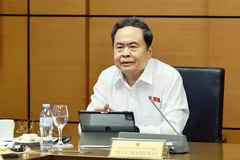
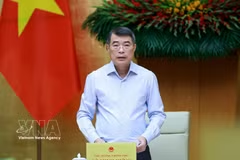
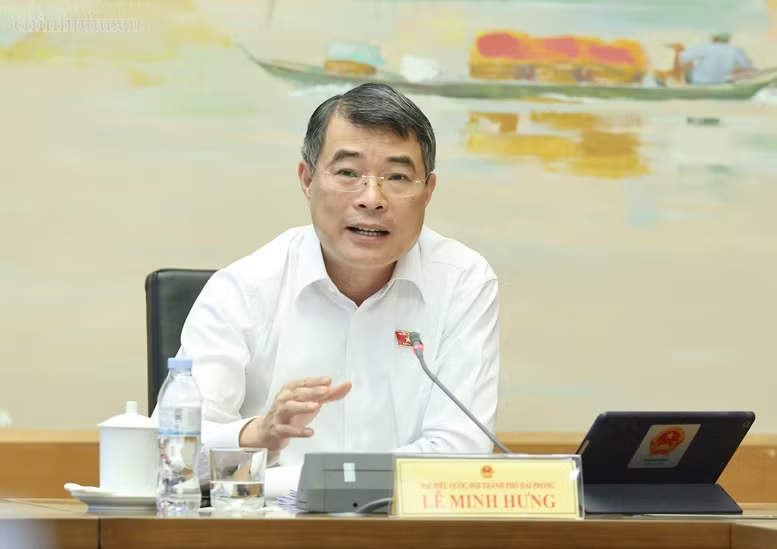
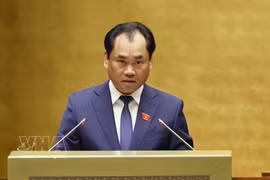
Prime Minister Le Minh Hung speaks at a group discussion on policy orientations for revising the Land Law, Housing Law and Law on Real Estate Business in Hanoi on August 19. (Photo: chinhphu.vn)

Hanoi (VNA) – Prime Minister Le Minh Hung has called for amendments to Vietnam's laws on land, housing and real estate business to create a more coordinated and transparent policy framework, reduce input costs and lay a foundation for a new stage of development.

Speaking at a group discussion on policy orientations for revising the Land Law, Housing Law and Law on Real Estate Business in Hanoi on August 19, part of the 16th National Assembly's first extraordinary session, the PM said the revisions should not only address current problems but also introduce breakthrough policies to support development.

Revisions necessary for input cost control

Regarding the Land Law, PM Hung highlighted the need to reform land-use planning and planning procedures. In line with Resolution No 21-NQ/TW, issued on July 28, 2026 at the 14th Party Central Committee’s third session, on viewpoints and orientations for amending the Land Law and related laws (Resolution No. 21), he said each locality should move toward having a single integrated planning framework at the provincial level, instead of multiple overlapping plans.

He stressed that strict criteria and conditions must be set to prevent arbitrary changes to land-use plans or land-use purposes.

Land allocation, leasing and changes in land-use purposes must also be conducted in a public, transparent and competitive manner, he said. The law should clearly distinguish cases involving land-use rights auctions, bidding for projects using land and direct land allocation to investors, while providing clear rules on land-use payments.

Land prices are another major issue, PM Hung said, as they are an input cost for virtually all projects and economic activities. High land prices eventually push up the prices of final products while investors may also face higher borrowing costs and additional expenses when administrative procedures take too long.

The State should determine land prices based on scientific methods and reliable data while making the process transparent and connecting land databases with sectoral databases, he said.

These comprehensive measures are needed to control input costs and, subsequently, housing, land and final product prices, the Government leader underlined, adding that costs must be clearly calculated and measures introduced through laws as well as regulations guiding enforcement to minimise them.

Regarding land acquisition, compensation and resettlement, the PM demanded a shift from simply compensating people for assets taken by the State to rebuilding their lives. Living conditions after land acquisition should be better than before.

He also called for administrative reforms and greater decentralisation to shorten procedures, noting that lengthy land allocation procedures ultimately add to project costs and push up prices.

From home ownership to housing access

Regarding the Housing Law, PM Hung said the Constitution provides that the State creates conditions for citizens to exercise their right to have a place to live. Therefore, policy thinking should shift from “having to own a home” to “having a place to live.”

pm1.png
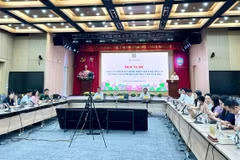
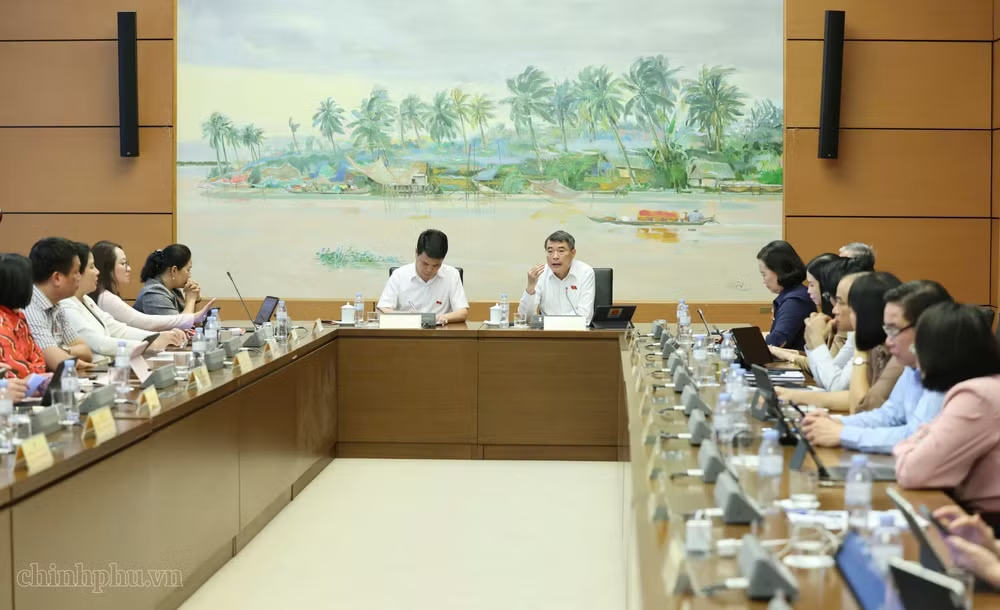
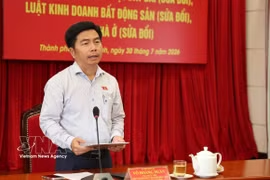
Prime Minister Le Minh Hung and deputies at the group dicussion on August 19. (Photo: chinhphu.vn)

A key priority should be the development of rental housing and social housing. The draft law distinguishes four types of housing: commercial housing, rental housing, public-service housing and policy housing.

The PM said the State alone cannot meet the housing needs of workers, students, public employees and members of the armed forces. More private-sector resources must therefore be mobilised.

The goal is to build a sufficiently large and high-quality source of rental housing with adequate infrastructure that gives tenants security, he said.

On the lifespan of apartment buildings, PM Hung noted that no building can last forever. Buildings must be inspected when they reach the end of their designed lifespan and, if they fail to meet safety standards, must be repaired or rebuilt.

However, residents' property rights must remain protected by law, he stressed. Rules must be detailed and transparent so that people understand their rights and feel secure.

Regarding the Law on Real Estate Business, the leader said the priority is to develop a transparent, healthy, stable and sustainable market. Information should be publicly available, while transactions through trading platforms and payments via banks should be encouraged and cash transactions discouraged.

He added that authorities are working to build an integrated information system linking real estate data with the national residents database and databases on planning, taxation, notarisation and banking. Measures are also being worked out to better protect vulnerable parties in real estate transactions./.
VNA

See more

Minister of Finance Ngo Van Tuan speaks at the session (Photo: VNA)

NA considers consolidated law to streamline public finance management

Consolidating the Law on State Budget 2025 and the Law on Public Investment 2024 (amended and supplemented in 2025) is necessary to establish a consistent public finance management mechanism; minimise procedures, time and compliance costs; and improve the mobilisation, management and use of State budget resources to support growth.

President Ho Chi Minh's Mausoleum attracts a large number of visitors (Photo: VNA)

📝OP-ED: A century of aspirations, a rising Vietnam

Today, Vietnam's mission is to open the doors wider to development, move the country forward and join the ranks of major powers through its own strength. This is also the most practical way to carry forward the spirit of the historic autumn of 1945.

The 16th National Assembly begins the second phase of its first extraordinary session on August 19. (Photo: VNA)

NA begins second phase of first extraordinary session, focusing on land, housing policies

The 16th National Assembly began the second phase of its first extraordinary session on August 19, hearing presentations on policy orientations for drafting the Law on State Budget (consolidated); amending the 2024 Land Law, the 2023 Housing Law, and the Law on Real Estate Business; and the integration of four national target programmes into a single one.

Member of the Communist Party of Vietnam Central Committee and Deputy Foreign Minister Nguyen Manh Cuong (R) meets with Roman Roun, Chairman of the Communist Party of Bohemia and Moravia (KSCM) in Hanoi on August 18. (Source: Baoquocte.vn)

Vietnam, Czech Republic step up effective implementation of Strategic Partnership

The two sides expressed their delight at the positive and substantive development of traditional friendship and multifaceted cooperation between Vietnam and the Czech Republic, and welcomed the elevation of bilateral ties to a Strategic Partnership in January 2025, which has created a new framework and impetus for deeper, more effective and sustainable cooperation.

Politburo member and Minister of Foreign Affairs Le Hoai Trung (R) receives visiting Chairman of the Communist Party of Bohemia and Moravia (KSCM) Roman Roun in Hanoi on August 18 (Photo: VNA)

Vietnam, Czech Republic seek to deepen multifaceted cooperation

Politburo member and Minister of Foreign Affairs Le Hoai Trung affirmed that the Party, State and people of Vietnam have always cherished the valuable support extended by the Communist Party and people of former Czechoslovakia, as well as by the KSCM and Czech people today.

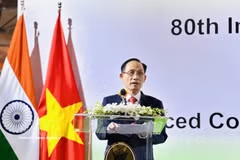
Minister of Foreign Affairs Le Hoai Trung speaks at the event. (Photo: VNA)

Vietnam-India cooperation grows more practical, future-oriented

Vietnam-India relations, founded by President Ho Chi Minh and Indian leaders and nurtured by generations of the two countries, have developed into a special and enduring friendship. Bilateral cooperation has delivered significant and practical benefits, with two-way trade doubling over the past decade, while defence and security cooperation has become increasingly substantive and effective, reflecting high levels of strategic trust.

Prime Minister Le Minh Hung speaks at the Government's August law-building session on August 18. (Photo: VNA)

Draft laws must support management reform, stronger decentralisation: PM

Participants looked into 11 draft laws and one draft resolution, including laws amending and supplementing several articles of laws on non-agricultural land use tax and corporate income tax; natural resources tax; securities; accounting and independent auditing; the Labour Code; and laws on archives, gender equality, Red Cross activities and employment.

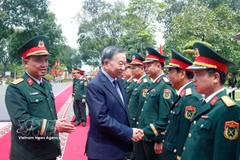
General Secretary of the Communist Party of Vietnam and President To Lam, who is also Secretary of the Central Military Commission, visits Infantry Division 308 of Army Corps 12 under the Ministry of National Defence in Hanoi on August 18 (Photo: VNA)

Top leader visits Infantry Division 308

General Secretary and President To Lam urged the division to preserve its proud tradition and turn it into determination and action, underscoring the need for it to uphold the “vanguard” spirit, especially in building a revolutionary, regular, elite and modern army; training and maintaining combat readiness; advancing science, technology, innovation and digital transformation; observing discipline and law; mastering modern weapons and equipment; and fulfilling its three functions as a combat, working and production force.

An overview of the NA Standing Committee discussion (Photo: VNA)

NA Standing Committee focuses on four major issues in Penal Code revision

According to Deputy Minister of Public Security Le Van Tuyen, the revision focuses on four major areas. These include amending provisions on crimes, revising provisions on penalties, amending regulations on exclusion, postponement, and exemption of criminal liability and the statute of limitations, and revising provisions to ensure sound legislative technique.