Hanoi (VNA) – Deputy Prime Minister Nguyen Van Thang has asked the Vietnam International Financial Centre (VIFC) to prioritise financial products capable of generating actual transactions and attracting medium- and long-term capital for the economy.
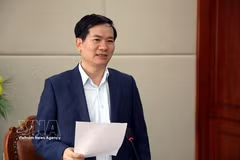
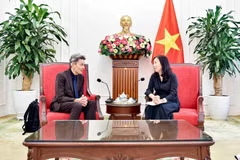
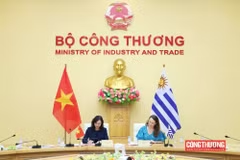
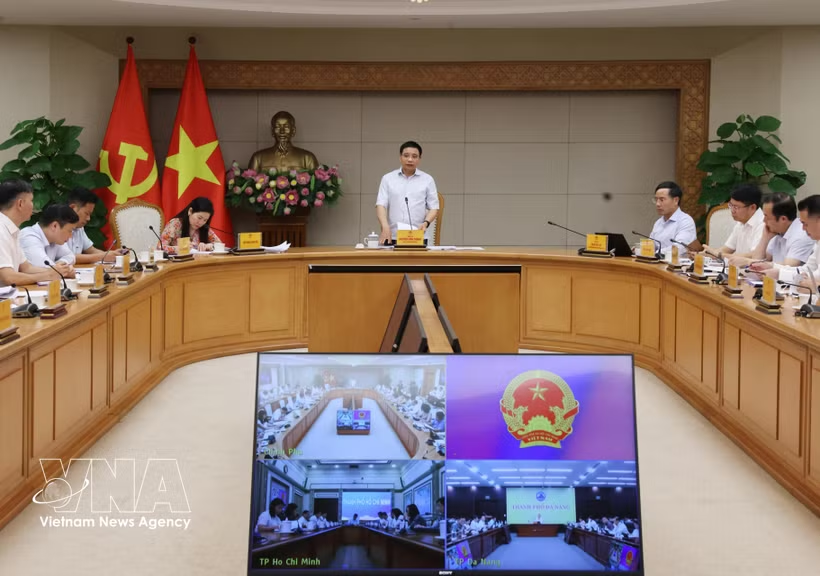
Thang, who is also Chairman of the VIFC Executive Council, made the request while chairing a council meeting in Hanoi on August 19. The event was connected online with officials in Da Nang and Ho Chi Minh City, which accommodate the VIFC.
The Deputy PM stressed that developing the VIFC is particularly important and urgent as Vietnam faces huge demand for resources to support economic growth, especially the double-digit expansion target.
With credit growth remaining high, the capital market needs to play a stronger role in supplying resources to the economy, he said.
The immediate goal is to ensure that the VIFC in Ho Chi Minh City and Da Nang operates smoothly, attracts members, develops products and soon generates specific transactions, with the top priority given to mobilising medium- and long-term capital for economic development.
Thang stressed that despite numerous difficulties during the preparation process, the institutional and organisational foundations of the VIFC have basically been completed. The centre is now entering the initial stage of operation, involving a large volume of work and many new and complex tasks requiring coordination among ministries, agencies and the two cities.
He asked the Ministry of Finance (MoF) and local authorities to strengthen coordination and promptly address delayed tasks and outstanding problems to ensure the VIFC operates efficiently and substantively.
The official also highlighted Vietnam's recent upgrade in stock-market status. FTSE Russell is scheduled to announce the Vietnamese stocks to be included in global indexes on August 21, which is expected to attract major international investment funds to Vietnam.
This will provide a good opportunity for Ho Chi Minh City and Da Nang to approach investors and promote investment opportunities at the VIFC, he remarked.
The Deputy PM asked the MoF to finalise its report on the proposed model for the VIFC executive body and submit it to the PM for consideration in August.
The ministry was also tasked with urgently researching, designing and developing new financial products. Thang emphasised that each product must have a clear legal basis, an implementing agency, an operating and supervisory mechanism, and implementation timeline, with priority given to products that can generate actual transactions.
The ministry was further asked to review obstacles in the legal framework governing international financial markets and propose amendments and supplements to Resolution No. 222 and relevant decrees.
Meanwhile, the State Bank of Vietnam (SBV) was requested to review membership requirements for domestic and foreign financial institutions, particularly investment banks, and consider possible adjustments.
Thang also called for the early establishment and launch of a specialised court and an international arbitration centre, with a target of September.
The MoF and the SBV were also tasked with completing inspection and supervision arrangements by September, using existing supervisory bodies, while ensuring clear division of responsibilities and compliance with the apparatus streamlining policy.
The two executive bodies in Ho Chi Minh City and Da Nang were instructed to review and classify members, focusing on attracting core financial institutions linked to priority products and services, while strengthening risk controls during member licensing and operations./.