Da Nang seeks to boost online exports

To help businesses go global, Da Nang is shifting from supporting individual online activities to developing an integrated ecosystem covering products, branding, platforms, payments, logistics, legal issues and market information. This is also part of the city’s e-commerce development orientation for 2026-2030, which identifies e-commerce as an important component of the digital economy.

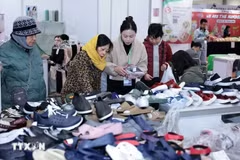
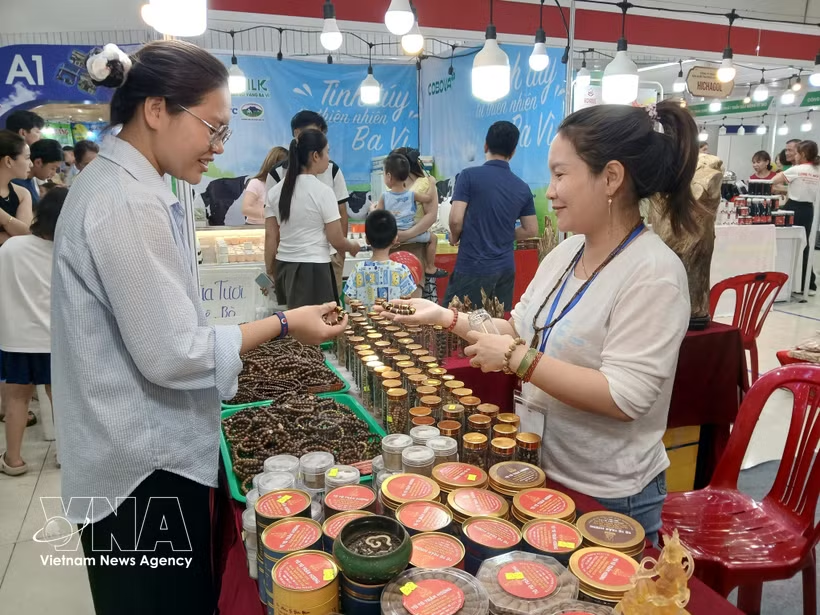
Key export sectors such as textiles – garments, footwear and furniture, along with many signature products of Da Nang, have strong potential to expand their markets through online export channels. (Photo: VNA)

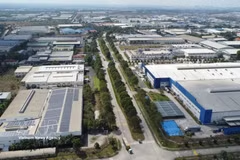
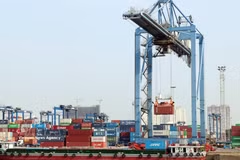
Da Nang (VNA) – Amid the rapid development of the digital economy, e-commerce is creating new ways for Vietnamese businesses to directly access international markets. With its strategic location in central Vietnam, international seaports and airport, increasingly developed logistics networks and digital infrastructure, Da Nang is well positioned to develop online exports.

The city is also rolling out policies to help businesses move beyond online sales toward building comprehensive export capabilities.

According to Amazon Global Selling, online exports offer major opportunities for Vietnamese businesses, especially micro-, small- and medium-sized enterprises (MSMEs), which account for 97% of the country’s total businesses. Vietnam’s B2C e-commerce export value reached 3.6 billion USD in 2023 and is projected to nearly double to 6.1 billion USD by 2028. Key sectors such as furniture and fashion are forecast to grow by 20-26% annually, two to five times faster than traditional exports.

Tran Xuan Thuy, Country Sales Director of Amazon Global Selling Vietnam, said many Vietnamese businesses have strong production capacity and already export to the US and Europe, but mainly manufacture products for foreign brands. Cross-border e-commerce enables them to reach international consumers directly and increase added value through branding, design and creativity.

In Da Nang, B2C e-commerce sales currently account for nearly 10% of total retail sales and consumer service revenue. More than half of surveyed businesses said they had sold or promoted products through e-commerce platforms and social media.

However, online exports and cross-border e-commerce remain below the city’s potential. Many businesses are still focusing on domestic online sales and promotion and have yet to make the transition to online exports. They face challenges in selecting markets and platforms, standardising products and packaging, building international brands, arranging payments and logistics, and complying with customs, tax and import-market regulations. Participation costs, advertising, warehousing and order fulfilment are also major barriers for SMEs.

To help businesses go global, Da Nang is shifting from supporting individual online activities to developing an integrated ecosystem covering products, branding, platforms, payments, logistics, legal issues and market information. This is also part of the city’s e-commerce development orientation for 2026-2030, which identifies e-commerce as an important component of the digital economy.

According to Huynh Xuan Son, Deputy Director of the municipal Department of Industry and Trade, Da Nang is implementing support policies under Resolution No. 29/2025/NQ-HDND dated December 11, 2025. These include establishing online showcases for export products, providing digital information on products, sectors and markets, and supporting businesses in joining international e-commerce platforms.

Ho Van Hieu from the Vietnam E-commerce Association said Da Nang and the central region possess many high-quality handicraft products and strong production capabilities. However, businesses need to improve their digital capacity while addressing legal, branding and logistics requirements. The association will help connect enterprises with platforms such as Amazon, as well as logistics and digital solution providers.

By selecting promising products and providing targeted support, the city aims to help businesses gradually strengthen their online export capabilities, expand markets and bring products from the city and the central and Central Highlands regions closer to global consumers./.

VNA

See more

Deputy Minister of Foreign Affairs Le Thi Thu Hang receives Rolf Mutzenich, a member of the Foreign Affairs Committee of the German Bundestag, in Hanoi on August 18. (Photo: baoquocte.vn)

Vietnam welcomes German firms’ expansion

Vietnam welcomes and stands ready to create favourable conditions for German businesses to expand their investment and operations in the country, particularly in infrastructure, smart seaports, renewable energy, high-speed railways, science and technology, and high-quality human resource training.

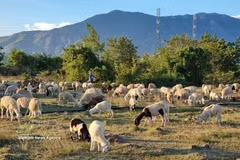
Khanh Hoa province has the largest sheep population in Vietnam, with around 100,000 individuals. (Photo: VNA)

Khanh Hoa province explores Halal ecosystem development

Khanh Hoa aims to estabish itself as a Halal-friendly destination while supporting businesses in expanding export markets, attracting strategic partners and investors, and drawing projects from countries with strong Halal logistics, tourism, manufacturing, processing and agriculture sectors.

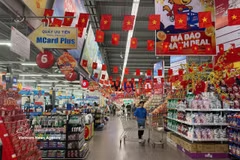
The proportion of Vietnamese goods remains high at supermarkets. (Photo: VNA)

Vietnamese brands win over domestic consumers to go global

Amid increasingly fierce global competition, the goal is no longer simply to increase domestic consumption of Vietnamese goods, but to develop strong Vietnamese brands capable of winning consumers through quality, innovation and added value, thereby creating a stepping stone for expansion into international markets.

Illustrative image (Photo: VNA)

Automated VAT refunds to be rolled out from December

As of August 11, VAT refunds rose 32% from a year earlier, reaching 64.4% of the full-year estimate. Tax authorities issued 11,627 refund decisions totaling 111.726 trillion VND (4.26 billion USD), up 9% by volume. The payouts improved cash flow for companies and supported production, trade and exports.

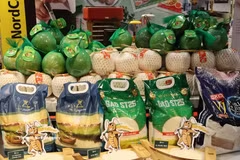
ST25 rice is the centrepiece of the Vietnam Goods Week at Selgros. (Photo: VNA)

ST25 rice officially enters Selgros wholesale supermarket chain in Germany

The placement of ST25 rice on Selgros shelves not only creates an additional opportunity for German consumers to access Vietnamese rice products, but also contributes to efforts to increase the added value of Vietnamese agricultural products by shifting the focus from volume to quality, branding and value.

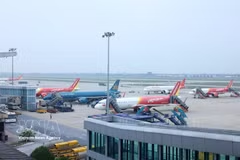
Trains on the elevated section of the Cau Giay – Nhon route in Hanoi provide convenient transportation for local residents. (Photo: VNA)

Multimodal connectivity to drive Vietnam’s transport infrastructure

Under the proposed approach, roads would serve mainly as connectors and for first- and last-mile transport; railways would handle large volumes over long distances; maritime transport would serve import and export cargo; inland waterways would carry large volumes at low cost; and air transport would focus on fast delivery and high-value goods.

Amata Industrial Park in Dong Nai city (Photo: VNA)

Green shift powers investment in southeast Vietnam

The Amata Industrial Park in Dong Nai City, established 32 years ago and covering more than 500ha, is home to over 160 domestic and foreign businesses. Selected in 2020 as one of three national pilot sites for conversion into an eco-industrial park, Amata has raised its compliance with the international eco-industrial park framework from 41% to 86% in 2024, and is working towards becoming Dong Nai's first certified eco-industrial park.

At a port in Ho Chi Minh City (Photo: VNA)

Multi-channel capital mobilisation needed to achieve double-digit growth

The Ministry of Finance estimates development investment for 2026-2030 at a minimum of 38.5 quadrillion VND (1.48 trillion USD), or about 40% of GDP. The state budget is expected to provide only about 20%, or more than 7.7 quadrillion VND, leaving over 80%, or more than 30 quadrillion VND, to be raised from the broader economy. That makes expanding capital mobilisation channels beyond bank credit essential.

An aerial view of the Nhieu Loc – Thi Nghe area in Ho Chi Minh City. The southern metropolis is home to the Vietnam International Financial Centre. (Photo: VNA)

Vietnam International Financial Centre launches membership registration system

Integrated into the official Vietnam International Financial Centre portal at vifc.gov.vn, the online system for registering and recognising members provides a unified online service channel through which investors, organisations and businesses can complete procedures related to membership, from new registration and recognition to information updates and termination of membership.