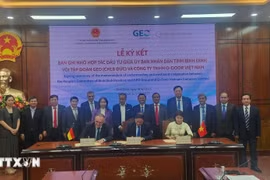
Hanoi (VNA) – Vietnam is ready to facilitate German businesses’ investment and expansion in the country, particularly in areas where Germany has strengths and that align with Vietnam’s new development priorities.
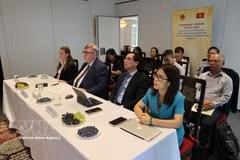
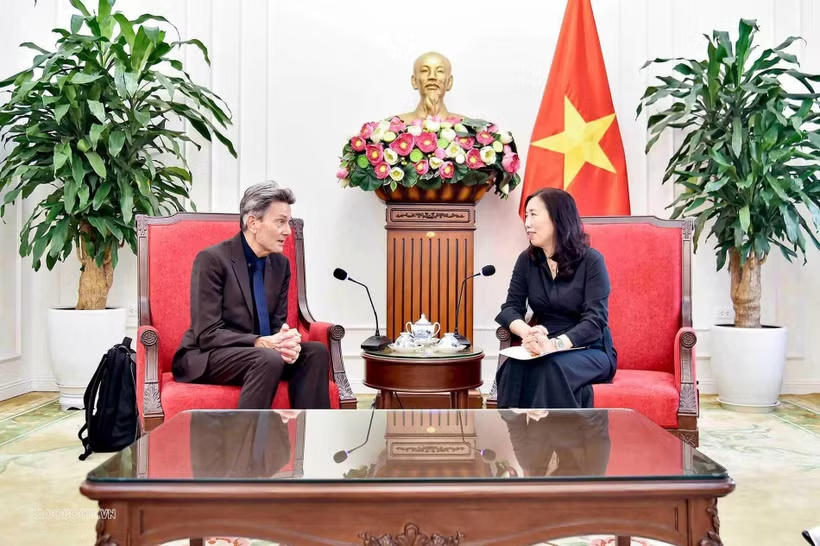
Deputy Minister of Foreign Affairs Le Thi Thu Hang made the statement while receiving Rolf Mutzenich, a member of the Foreign Affairs Committee of the German Bundestag, in Hanoi on August 18.
Welcoming Mutzenich’s visit, Hang affirmed that Vietnam regards Germany as one of its leading important partners and wishes to further deepen the bilateral Strategic Partnership.
Briefing her guest on Vietnam’s development outlook in the new era, she said Vietnam aims to achieve double-digit economic growth and its two centenary goals, with a vision of becoming a developed, high-income country by 2045. The country is also promoting a new development model that places science and technology, innovation, digital transformation and the private sector at the heart of growth.
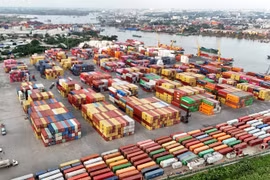
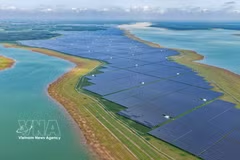
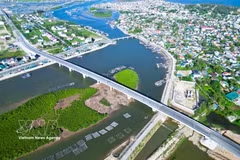
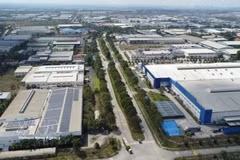
Hang affirmed that Vietnam welcomes and stands ready to create favourable conditions for German businesses to expand their investment and operations in the country, particularly in infrastructure, smart seaports, renewable energy, high-speed railways, science and technology, and high-quality human resource training.
Mutzenich expressed his impression with Vietnam’s socio-economic achievements and affirmed that the German Bundestag remains committed to advancing bilateral ties in line with the Strategic Partnership. He said Vietnam-Germany relations have substantial potential for further development, beginning with strengthening political trust, increasing exchanges of delegations and enhancing parliamentary cooperation.
Hang called for stronger cooperation through Party channels, particularly between the Communist Party of Vietnam and Germany’s Social Democratic Party (SPD). The German side expressed interest in promoting dialogue between the two parties.
She also proposed greater exchanges of legislative and supervisory experience between parliamentarians and specialised committees, and called on the German Bundestag to continue supporting the more than 200,000 Vietnamese people living, studying and working in Germany.
The two sides agreed to strengthen cooperation in education and training, increase exchanges of students and researchers, and promote high-quality human resource development. They also agreed to expand cooperation in labour, science and technology, innovation, defence and security, while stepping up delegation exchanges and parliamentary cooperation.
They concurred to step up coordination at multilateral mechanisms, efforts to advance Vietnam-EU and Germany-ASEAN relations, and effective utilisation of cooperation potential to make the Vietnam-Germany Strategic Partnership more substantive and effective.
Discussing international and regional issues of mutual concern, the two sides underscored the importance of dialogue and confidence-building, and expressed support for multilateralism with the United Nations at its centre.
They also stressed the importance of maintaining peace, stability, security, safety and freedom of navigation and overflight in the East Sea, and resolving disputes peacefully in accordance with international law, particularly the 1982 United Nations Convention on the Law of the Sea (UNCLOS)./.