Hanoi (VNA) - The US market continues to offer significant opportunities for Vietnamese products, but increasingly stringent requirements on origin, quality, supply chains and compliance are forcing businesses to change their approach, from targeting niche markets to building brands and taking greater control of their products, said experts at a seminar held in Hanoi on August 18.
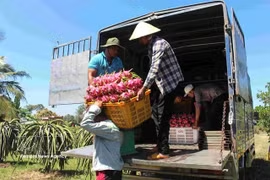
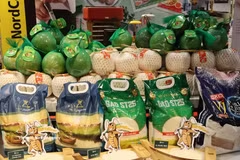
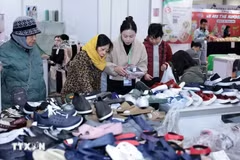
The US is one of Vietnam's largest and most important export markets. Alongside traditional products such as garments, footwear and wooden furniture, made-in-Vietnam food products are increasingly common not only in distribution channels serving Asian communities but also in other retail systems.
However, Do Ngoc Hung, head of the Vietnam Trade Office in the US, said the market is large but far from homogeneous. Consumer demand, distribution systems, regulations and market-entry costs vary significantly across states, regions and customer groups. Businesses therefore need to identify specific segments, locations and distribution channels and calculate the total cost of reaching consumers, rather than pursuing a broad-based approach.
Vietnamese products continue to be highly valued by US importers, and Vietnam remains an important source of supply. However, price competitiveness is no longer decisive. Buyers are increasingly concerned about delivery flexibility, response times, replenishment capacity, consistent quality and supply-chain management.
For food and consumer goods, demand is shifting towards convenient and deeply processed products with transparent information on origin, health and sustainability. In the industrial sector, importers are also paying closer attention to raw materials, production locations and suppliers' capacity, he said.
Vu Tu Thanh, Acting Regional Managing Director & Chief Country Representative of Vietnam for the US-ASEAN Business Council, said the huge scale of US imports and the trend towards diversifying supply sources were creating further opportunities for Vietnamese businesses.
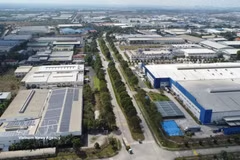
Vietnam has considerable advantages in participating more deeply in US supply chains, including improving production capacity, a favourable geographic location, a large workforce and extensive export experience.
However, Thanh noted that the US is tightening controls on origin, circumvention and transshipment. As a result, records on raw materials, production processes, factory capacity, input-output norms, invoices, customs declarations and supply-chain data are becoming increasingly important.
Vietnamese businesses must demonstrate genuine production capacity and the value added generated domestically, the expert stressed.
Beyond product and origin requirements, businesses must also proactively manage cash flow, working capital, tax and accounting to minimise risks when expanding in the US.
Tran Lich, Director of Vietnam Impact Startup Incubator and Accelerator (VISIA), said having a good product did not guarantee successful entry into the US market. Many Vietnamese businesses remain accustomed to contract manufacturing and only obtain certifications when requested by customers. This approach can cause them to miss opportunities at the outset if they lack required certifications, technical documentation or traceability systems.
Lich said that businesses should prepare professional English-language documentation covering not only catalogues but also product codes, certifications, raw material sources, production locations and capacity, minimum order quantities, delivery times, quality-control procedures and traceability capabilities.
Choosing the right niche market, target customers, geographic area and distribution channel is equally important. Businesses should proactively seek importers, distributors and specialised retail chains instead of focusing solely on major e-commerce platforms.
Effective supply-chain data management is another key requirement. Businesses should establish supplier management systems and retain invoices, customs declarations, input-output norms, batch-level production data, labour records and specialised certifications. When inspections arise, they can respond using readily available data rather than spending time assembling documents.
Experts also advised businesses to calculate the full landed cost of goods in the US rather than relying only on ex-factory prices. Taxes, transportation, insurance, warehousing, banking fees, compliance costs, returns and state-level obligations can all significantly affect profitability.
In the longer term, Vietnamese businesses need to gradually move from contract manufacturing to taking ownership of their products, starting with packaging and product design, brand building and intellectual property, and eventually developing their own products and technologies.
According to Lich, businesses do not need to develop complex technologies immediately. Taking the initiative in designing products, packaging and styles suited to the US market can already increase value, enhance competitiveness and reduce dependence on contract orders.
Experts said the US market still offers considerable room for Vietnamese products, but businesses need to shift from a sales-oriented mindset towards building market capabilities, with compliance, supply-chain management, quality and product value serving as the foundation for sustainable growth./.
VNA