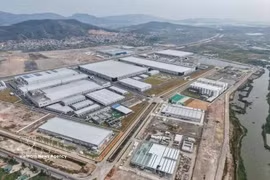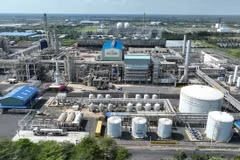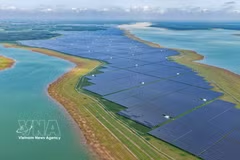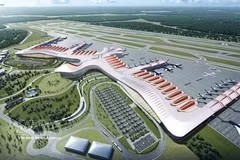
Quang Ninh (VNA) – The northern province of Quang Ninh is pushing for special, breakthrough mechanisms and policies to establish a free digital and knowledge economic zone, placing the pilot at the core of its growth strategy.
Vu Quyet Tien, Deputy Secretary of the provincial Party Committee, said the proposed zone will cover nearly 26,400 ha across 10 communes and wards, including Hoang Que, Yen Tu, Dong Mai, Tuan Chau, Viet Hung, Bai Chay, Hoanh Bo, Thong Nhat, Quang La and Cao Xanh, and will be split into three interconnected functional sub-zones.
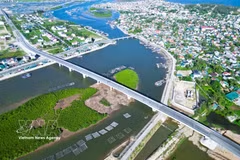
Sub-zone 1, spanning about 5,770ha in Dong Mai, Tuan Chau and Viet Hung, will house an AI R&D centre, an international university cluster for digital talent and a coastal smart urban area.
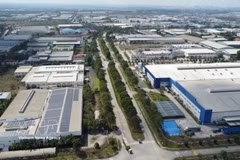
Sub-zone 2 will cover almost 19,380ha across Viet Hung, Bai Chay, Hoanh Bo, Thong Nhat, Cao Xanh and Quang La, featuring digital twin technology-based smart governance, a model digital administration centre, a northern eco-urban area, a disaster recovery data centre, industrial facilities and logistics services.
Sub-zone 3 will span about 1,230ha in Hoang Que and Yen Tu wards and focus on semiconductor manufacturing and hardware components.
Beyond existing rules for economic zones, digital technology and hi-tech industries, Quang Ninh is proposing unprecedented, competitive policy incentives to attract major corporations, investors, engineers and digital workers from Vietnam and abroad to its digital economy and innovation hub.
Following the Politburo’s Resolution 57-NQ/TW dated December 22, 2024 on science, technology, innovation and national digital transformation, Quang Ninh is rolling out breakthrough digital infrastructure projects, including the Tuan Chau concentrated digital technology park and a smart border gate between Mong Cai and China’s Dongxing, aiming to create new growth poles driven by AI, data and high technology.
Since mid-February, Quang Ninh has worked with China’s Guangxi Zhuang Autonomous Region to pilot a smart border gate at the Mong Cai-Dongxing international crossing, using advanced technologies to speed up the clearance of people, vehicles and goods and improve inspection efficiency.
For passengers at Bac Luan I bridge, biometric checks, including facial and fingerprint recognition, are being deployed with automated e-Gates to cut processing times and move toward contactless clearance. For cargo at Bac Luan II bridge, 5G-powered intelligent unmanned guided vehicles with advanced positioning systems are being tested.
To prepare resources for emerging economic models, Quang Ninh has already signed strategic cooperation agreements with FPT, MobiFone, VNPT, Viettel, GTel and the Vietnam Academy of Science and Technology. It has set aside 3% of local budget spending, or nearly 1.09 trillion VND in 2026, for science, technology, innovation and digital transformation, while pooling social resources for an innovation ecosystem.
To date, digital infrastructure has shown early results: 5G reaches 94% of the population, all state agencies are connected to a dedicated data transmission network, and all valid administrative records have been digitised.
The drive for institutional reform and new development space underscores Quang Ninh’s determination to achieve 12% average annual GRDP growth from 2026 to 2030, establishing it as a strategic growth pole and paving the way to become a centrally-run city./.