Bill seeks to narrow application scope of death penalty for six offences

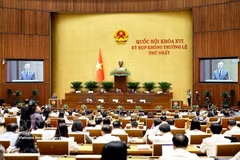
Lawmakers on August 20 discussed the Government's proposal and a verification report on the draft revised Penal Code, which narrows the application scope of the death penalty for six offences, retaining it for only four, namely treason, murder, terrorism and illegal drug production.

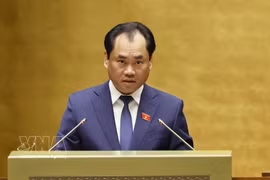
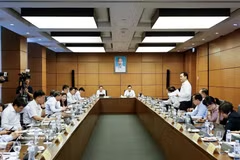
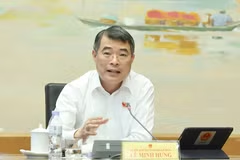
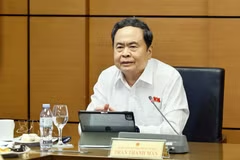
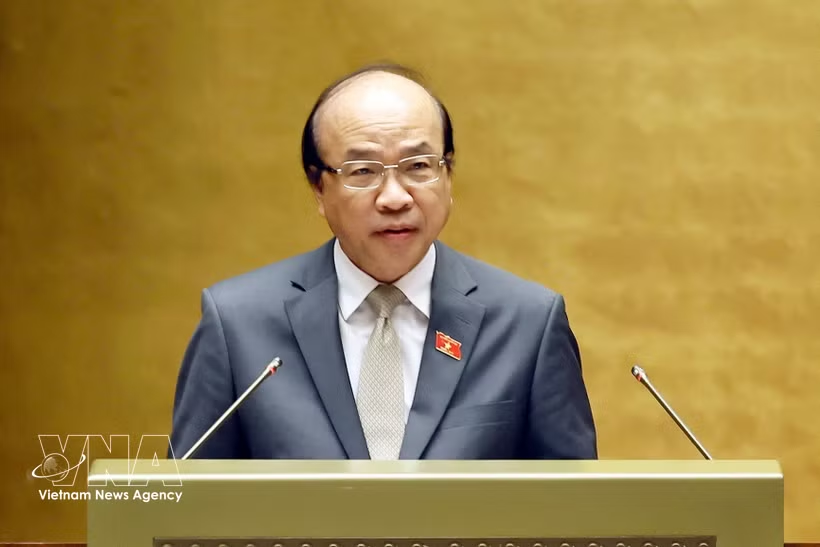
Chairman of the National Assembly's Committee for Legal and Judicial Affairs Phan Chi Hieu delivers a verification report on three draft laws - the revised Penal Code, the revised Criminal Procedure Code, and the revised Law on Organisation of Criminal Investigation Agencies on August 20. (Photo: VNA)

Hanoi (VNA) – Lawmakers on August 20 discussed the Government's proposal and a verification report on the draft revised Penal Code, which narrows the application scope of the death penalty for six offences, retaining it for only four, namely treason, murder, terrorism and illegal drug production.

Authorised by the Prime Minister, Minister of Public Security Gen. Luong Tam Quang presented a summary of the Government's proposal, saying that the amendments are based on the Party's major resolutions, conclusions and directives, and highlighting the 2013 Constitution and relevant laws on justice and criminal matters as the foundation for the adjustments.

He said that the revision and supplement are an objective and necessary requirement to ensure that the Penal Code, an important legal instrument, effectively meets the requirements of crime prevention and combat, protects human and citizens' rights, and supports national development in the new period. The draft comprises three parts, 25 chapters and 415 articles.

Regarding offences, the draft adds provisions on organised crime and introduces the offences of establishing or participating in an organised criminal group. The move aims to provide a legal basis for early prevention and handling of crime while incorporating the UN Convention against Transnational Organised Crime into domestic law.

The draft also introduces nine new offences, focusing on economic management, cybersecurity, high technology, the environment, public safety and the proliferation of weapons of mass destruction. It adds new acts to the definitions of existing offences, particularly those involving information technology, telecommunications networks, economy, trade and intellectual property. The provisions are designed to close loopholes in criminal laws, prevent crimes from going unpunished, meet international integration requirements and strengthen crime prevention and combat in the new context.

Regarding the narrowing down of the death penalty for six offences, Quang said that the move is intended to institutionalise the Party's policy, align with progressive legislative trends and strengthen Vietnam's position in international judicial cooperation, extradition and mutual legal assistance.

Presenting the verification report, Chairman of the National Assembly's Committee for Legal and Judicial Affairs Phan Chi Hieu agreed on the need for fundamental and comprehensive amendments to the laws as proposed by the Government.

It broadly supported provisions allowing the postponement of criminal prosecution and exemption from criminal liability for violations causing economic losses but committed for the purpose of socio-economic development or ensuring national defence and security, where there is no corruption and the conduct generates economic or social benefits for localities and the country.

However, it pointed to the need for relevant areas to be reviewed and specific offences to which such leniency will apply to be clearly identified.

The committee also supported adding new offences to address newly emerging socially harmful acts and further incorporate international treaties to which Vietnam is a party. However, it urged a thorough review of the constituent elements of offences, clearer boundaries between criminal offences and administrative violations, and consistency with specialised laws.

Some opinions called for consideration of criminalising or creating separate offences to address violations in areas that have a major impact on state management, national security and social order and have caused public concern, such as violations of regulations governing unmanned aircraft or other flying vehicles, and violations of regulations on examinations, testing, assessment, admissions and training in the education sector./.

VNA
See more

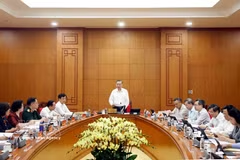
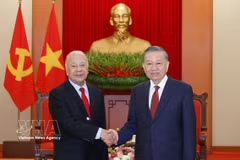
General Secretary of the Communist Party of Vietnam Central Committee and President To Lam speaks at the working session with the Party Central Committee’s Commission for Organisation to discuss a project reviewing the five-year implementation of Resolution No. 28-NQ/TW on continuing to renew the Party’s leadership and ruling methodology over the political system in the new period. (Photo: VNA)

Party leadership must closely link with targets, outcomes, accountability: Top leader

General Secretary and President To Lam said the review of the Resolution No. 28-NQ/TW implementation is an important political task in the building of the Party and the political system. It should examine how the Party exercises its leadership and ruling role and how the entire political system translates the Party’s guidelines and policies into action and concrete results.

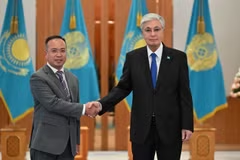
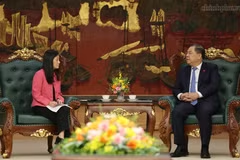
Vietnamese Ambassador to Kazakhstan Nguyen Thanh Le (L) and Kazakh President Kassym-Jomart Tokayev at their meeting on August 19. (Photo published by VNA)

Vietnam seeks to deepen strategic partnership with Kazakhstan

Ambassador Nguyen Thanh Le affirmed that he will work closely with Kazakhstan’s Ministry of Foreign Affairs, ministries, agencies and localities to effectively implement high-level agreements, strengthen political trust and promote cooperation in trade, investment, transport and logistics, tourism, culture, education and people-to-people exchanges.

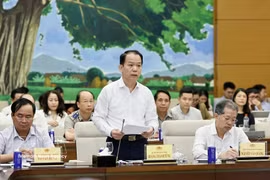
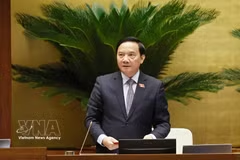
National Assembly Vice President Nguyen Khac Dinh precides over the discussion (Photo: VNA)

Amendments to bills aim to close loopholes in criminal laws

The amendments to the Penal Code focus on four major areas - revising and supplementing provisions on offences and penalties; revising provisions on grounds for exclusion, postponement and exemption from criminal liability and the statute of limitations for criminal prosecution; and ensuring consistency, feasibility and sound legislative drafting.

☀️ Morning digest on August 20

☀️ Morning digest on August 20

Party General Secretary and President To Lam's working session with the Ministry of Culture, Sports and Tourism, the Vietnam International Fisheries Exhibition 2026, and Vietnam advancing to the ASEAN Cup final after beating Malaysia 2-0 in the second leg of semifinals are among news highlights on August 19 evening.

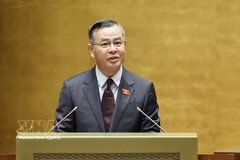
Minister of Finance Ngo Van Tuan speaks at the session (Photo: VNA)

NA considers consolidated law to streamline public finance management

Consolidating the Law on State Budget 2025 and the Law on Public Investment 2024 (amended and supplemented in 2025) is necessary to establish a consistent public finance management mechanism; minimise procedures, time and compliance costs; and improve the mobilisation, management and use of State budget resources to support growth.

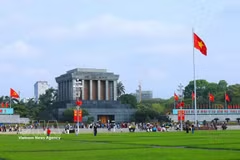
President Ho Chi Minh's Mausoleum attracts a large number of visitors (Photo: VNA)

📝OP-ED: A century of aspirations, a rising Vietnam

Today, Vietnam's mission is to open the doors wider to development, move the country forward and join the ranks of major powers through its own strength. This is also the most practical way to carry forward the spirit of the historic autumn of 1945.

The 16th National Assembly begins the second phase of its first extraordinary session on August 19. (Photo: VNA)

NA begins second phase of first extraordinary session, focusing on land, housing policies

The 16th National Assembly began the second phase of its first extraordinary session on August 19, hearing presentations on policy orientations for drafting the Law on State Budget (consolidated); amending the 2024 Land Law, the 2023 Housing Law, and the Law on Real Estate Business; and the integration of four national target programmes into a single one.