“Accompanying and listening” connects strength of Vietnamese communities worldwide: France-based expert

Resolution No. 23 not only calls for greater mobilisation of overseas Vietnamese resources but also highlights the responsibility to accompany, support and listen to the community. When OVs feel that the homeland genuinely regards them as an integral part of the nation, trust and a lasting desire to contribute will naturally grow.

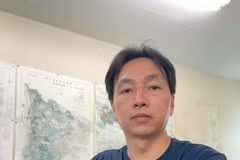
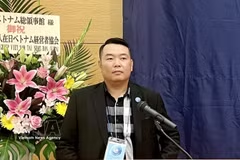
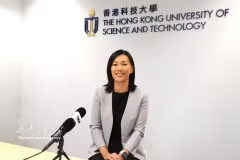
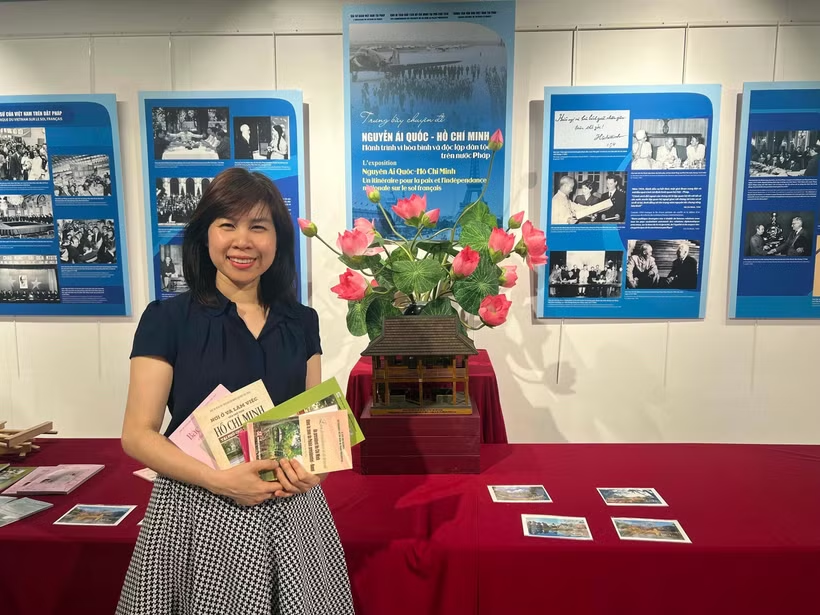
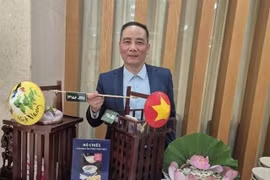
Dr. Hoang Thi Hong Ha on the sidelines of a series of cultural and scientific activities honouring President Ho Chi Minh in France on June 26-27. (Photo published by VNA)

Paris (VNA) – The spirit of “accompanying and listening” highlighted in the Politburo’s Resolution No. 23-NQ/TW on overseas Vietnamese (OV) affairs is key to strengthening trust, fostering community bonds and mobilising the diverse resources of Vietnamese people abroad for national development, according to Dr. Hoang Thi Hong Ha, Chairwoman of Parfums du Vietnam and a member of the Executive Committee of the Association of Vietnamese in France.

This approach is particularly important as OV communities are becoming increasingly diverse in terms of generations, professions, living conditions, views and levels of attachment to their homeland, Ha said.

She stressed that national unity does not mean everyone must think alike. Instead, it is important to create common ground where all those who have goodwill towards Vietnam feel respected, heard and able to contribute.

Drawing on years of studying, researching and living within the Vietnamese community in France, Ha noted that people have different ways of contributing to the homeland, whether through knowledge, business, social activities, culture and education, or through professional and social networks built in their host countries.

For younger generations born and raised abroad, their connections with Vietnam may begin with simple things such as the Vietnamese language, family memories, music, cuisine or cultural experiences. Therefore, it is important that every Vietnamese living overseas, regardless of generation, feels they have a place within the national community and can contribute according to their abilities.

The expert emphasised that Resolution No. 23 not only calls for greater mobilisation of overseas Vietnamese resources but also highlights the responsibility to accompany, support and listen to the community. When OVs feel that the homeland genuinely regards them as an integral part of the nation, trust and a lasting desire to contribute will naturally grow.

She also highlighted the role of Vietnamese associations and organisations abroad as important bridges connecting OV communities with Vietnam and their host societies. Such organisations can go beyond providing meeting spaces to facilitate cultural exchanges and international cooperation.

Culture, she said, is a particularly powerful connector. Programmes promoting Vietnam's culture, arts and heritage, including the Then practice of the Tay, Nung and Thai ethnic groups, in France can help OVs reconnect with memories and identity, while opening a door for younger generations to explore their roots.

Preserving culture, however, should not mean simply repeating traditional practices. Young people need opportunities to engage through contemporary forms such as arts, creative activities, exhibitions, educational programmes and exchanges with Vietnamese and French peers.

She also called for stronger networks connecting Vietnamese professionals, researchers, entrepreneurs, artists, youth and community organisations abroad. Such resources often remain fragmented despite their considerable potential.

According to her, networks should be built around specific fields and practical projects, linking Vietnamese experts and institutions with overseas associations and partners such as schools, museums and cultural organisations. Clearer focal points and more flexible coordination mechanisms between overseas organisations and domestic agencies will also help turn community initiatives into concrete outcomes.

The resources of overseas Vietnamese, she stressed, should be understood broadly, encompassing not only financial contributions and remittances but also knowledge, international experience, professional expertise, languages and networks.

If every Vietnamese person, wherever they live, feels that they have a place and can contribute to the country’s development, this will provide an important foundation for strengthening the collective strength of Vietnamese communities abroad in the new period, added Ha./.

VNA
See more

A view of a workshop on advancing gender equality in the public sector amid the restructuring and streamlining of the political system in Hanoi on September 15 (Photo: VNA)

Vietnam seeks to advance gender equality amid public-sector reform

Organisational restructuring presents an opportunity to review personnel standards, procedures and working methods. If gender considerations are integrated into the process, it can help remove long-standing barriers, make better use of female talent and build a fairer and more accountable working environment.

Some of the suspects arrested in the case (Photo: Quang Ninh city's Public Security Department)

Quang Ninh police bust 38.4 million USD transnational cybercrime ring

Quang Ninh city's Public Security Department warned individuals, agencies and businesses not to publicly disclose or provide personal information or bank account details on social media, and urged organisations and businesses to strictly comply with regulations on protecting customers’ personal data.

Teachers and children at Hoa Hong Kindergarten in Ha Giang 2 ward, Tuyen Quang province (Photo: VNA)

Vietnam to provide tuition support for preschoolers

Eligible children will be entitled to tuition exemptions, reductions or support, assistance with learning costs and other benefits in accordance with laws on education, children, people with disabilities, ethnic affairs and social assistance.

More than 100 delegates, including nearly 30 delegates from countries in Asia and Africa, attend the event. (Photo courtesy of the ActionAid)

Ecological agriculture for sustainable future

The workshop “Ecological agriculture for a sustainable future”, organised by ActionAid International in Vietnam, emphasised that women and young people must be the subjects and leaders of change, rather than merely participants or beneficiaries.

International delegates attend the 7th national congress of the Vietnam Union of Friendship Organisations in Hanoi on September 14. (Photo: VNA)

Phan Anh Son re-elected VUFO president

For the 2026–2031 term, the Vietnam Union of Friendship Organisations (VUFO) will follow the motto “Proactive adaptation, creative breakthroughs, practical effectiveness”.

Deputy Prime Minister Pham Thi Thanh Tra encourages the staff of the Centre for DNA Identification. (Photo: VNA)

Identifying martyrs’ remains requires whole political system’s efforts: Deputy PM

Deputy Prime Minister Pham Thi Thanh Tra inspected the practical implementation of DNA identification technology at the Centre for DNA Identification under the Institute of Biology of the Vietnam Academy of Science and Technology, and the Military Institute of Forensic Medicine under the Military Medical Department of the Ministry of National Defence on September 14.

Doan Duc Hao, Director of the Department of Youth Affairs and Gender Equality under the Ministry of Home Affairs, speaks at a working session with a 16-member delegation of young Korean civil servants in Hanoi on September 14, 2026. (Photo: VNA)

Vietnam, RoK promote cooperation, youth’s role

Le Thi Viet Lam, Deputy Director of the Department of International Cooperation under the Ministry of Science and Technology, said Vietnam wishes to continue building an ecosystem that connects the State, research institutes, universities and businesses, enabling them to share resources and create value. This is also an area in which Vietnam is interested in learning from Korean experience.

To operate Metro Line No. 1 (Ben Thanh–Suoi Tien), Ho Chi Minh City Urban Railway Company No. 1 (HURC1) currently employs 700 people to keep nearly 200 train trips running each day. (Photo: nhandan.vn)

Ho Chi Minh City addresses manpower shortage for urban railway development

Under the human resources training scheme serving the development of the urban railway network approved by the municipal People’s Committee, the city will need around 70,000 workers by 2030 to support investment in and development of its metro system, including project management personnel, operations and maintenance staff, engineers, technical workers, consultants and designers.