Vietnam, Singapore eye deeper cooperation in AI, semiconductors, high technology

Assoc. Prof. Dr. Luu Anh Tuan of the College of Computing and Data Science at Nanyang Technological University (NTU) said there is significant potential for Vietnam-Singapore cooperation in AI, digital transformation and technical governance.

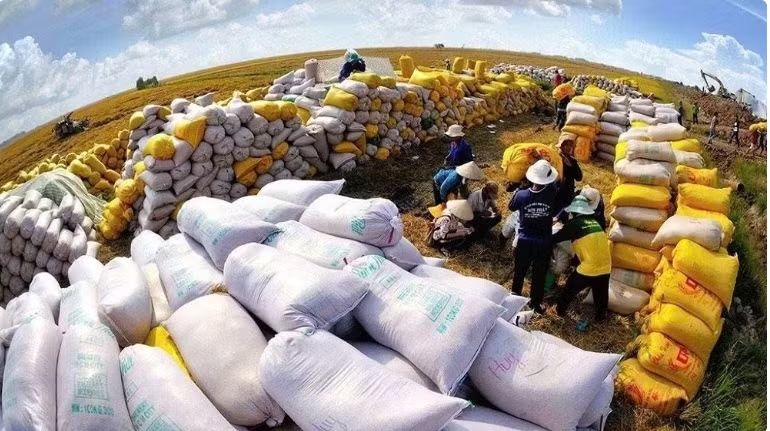
Vietnam's rice exports to Singapore have increased sharply (Photo: VFFA)

Hanoi (VNA) – Vietnam-Singapore relations are opening new cooperation opportunities, from the Vietnam-Singapore Industrial Parks (VSIP) model to digital transformation, green energy, semiconductors and smart logistics.

Favourable conditions for stronger cooperation

Singapore has extensive experience in science, technology and innovation, backed by long-term investment in research and development (R&D), an open innovation ecosystem linking research institutes, universities and businesses, and a transparent legal environment conducive to technology commercialisation. The country is also a pioneer in smart cities, digital infrastructure and green technology, with strong capabilities in building and facilitating innovation ecosystems.

Vietnam, meanwhile, has a young population and a large pool of human resources in science, technology, engineering and mathematics (STEM), providing an important foundation for innovation. Its stable geopolitical position and abundant rare earth reserves also make it an attractive destination in supply chain diversification strategies.

These strengths create favourable conditions for expanded cooperation in science, technology and innovation.

Singapore was among the first Asian countries to develop strategic technology industries, launching its semiconductor industry in the 1970s. It has since pursued a next-generation semiconductor strategy to adapt to the rapid development of artificial intelligence (AI) and advanced technologies.

Dr. Ha Son Tung, Deputy Head of the Advanced Optical Technology Department at Singapore's Agency for Science, Technology and Research (A*STAR), said Singapore has practical experience that Vietnam can draw on, particularly in technology governance, research ecosystem development and high-quality human resource training.

Given their geographical proximity, cultural similarities and increasingly close economic ties, the two countries have considerable potential to expand bilateral research cooperation, he said.

Building on the success of VSIP, Vietnam and Singapore could broaden cooperation into high-tech fields through direct research projects between their science and technology agencies. Training high-quality human resources for AI and the semiconductor industry should also be a priority, he added.

Enhancing competitiveness and adaptability

Vietnam also has significant opportunities to accelerate breakthroughs in science and technology by tapping the intellectual resources of the overseas Vietnamese community, particularly in Singapore.

As a regional technology and innovation hub, Singapore is home to many Vietnamese experts working in AI, big data, semiconductors, biotechnology and public policy. Some hold key positions at multinational technology companies, universities and research institutes.

Experts said this community could serve as a strategic bridge for promoting research cooperation, technology transfer and resource connectivity between the two countries.

Against the backdrop of intensifying global technological competition, stronger Vietnam-Singapore cooperation in AI, semiconductors and innovation could not only bring economic benefits but also enhance both countries' competitiveness and ability to adapt to technological changes.

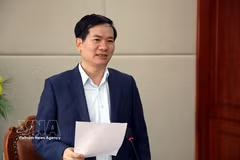
Assoc. Prof. Dr. Luu Anh Tuan of the College of Computing and Data Science at Nanyang Technological University (NTU) said there is significant potential for Vietnam-Singapore cooperation in AI, digital transformation and technical governance.

Singapore has accumulated extensive experience in developing a national digital transformation ecosystem and applying AI, while Vietnam has an advantage in its young, dynamic workforce and capacity to rapidly adopt new technologies, he noted.

If the two sides strengthen experience sharing and jointly develop practical AI products, cooperation could become an important driver of technological development in both countries and the wider region, Tuan said.

With bilateral ties growing increasingly robust and both sides committed to promoting innovation, cooperation in AI and high technology is expected to become a prominent pillar of Vietnam-Singapore relations in the coming period./.
VNA

See more

At the working session (Photo: VNA)

Can Tho, Guangxi seek collaboration in logistics, supply chains

Chinese investors now back 35 projects in Can Tho with registered capital of nearly 1.2 billion USD. In the first seven months of 2026, Can Tho’s exports to China hit 77.5 million USD, while imports stood at 64.7 million USD. Key exports included rice, seafood, farm produce, processed agricultural products and apparel while main imports comprised agricultural chemicals, veterinary medicines, fertilisers, chemicals, fabrics and other materials and inputs.

Vietnamese Minister of Finance Ngo Van Tuan grants an interview to the Vietnam News Agency (VNA). (Photo: VNA)

Vietnam, Russia move to boost financial cooperation

On bilateral economic, trade and investment ties, Tuan said two-way trade hit 3.24 billion USD in the first seven months of 2026, up 12% from a year earlier. Vietnam’s exports to Russia totaled 1.33 billion USD, while imports amounted to 1.91 billion USD.

Cai Mep - Thi Vai Port complex in Ho Chi Minh City (Photo: VNA)

Ho Chi Minh City seeks to make seaports new growth driver

To maximise its seaport advantages, Ho Chi Minh City is developing smart and green ports while promoting clean energy, lower emissions and sustainable supply chains. It aims to establish an integrated ecosystem linking seaports with industrial parks, logistics centres, free trade zones, multimodal transport networks and an international financial centre.

Farmers visit the off-season durian orchard of Cao Chi Dai in Vinh Hanh commune, An Giang province (Photo: VNA)

Vietnam promotes finance for green agriculture

Over the past five years, Vietnam has developed and gradually implemented a green finance system to support low-emission and environmentally friendly production, including agriculture. Based on the State Bank of Vietnam's Directive No. 03/CT-NHNN dated March 24, 2015, banks including BIDV, VCB, HDBank and Agribank have introduced green credit packages for waste treatment, high-tech agriculture, digital transformation, regional linkages and emission reduction across production chains.

An overview of the meeting between representatives from Polish businesses and the Agency for Domestic Market Surveillance and Development. (Photo: Agency for Domestic Market Surveillance and Development)

Polish businesses seek suppliers, partners in Vietnam

MAJAMI, a confectionery manufacturer and trader under Sweet House, is seeking distributors for Polish confectionery products in the Vietnamese market. Meanwhile, GABONA, a distributor and wholesaler of professional cosmetics, hair care and make-up products and beauty accessories, is looking for Vietnamese manufacturers of vegan and natural cosmetics.

Kendra Rinas, Chief of Mission for IOM Vietnam speaks at the event. (Photo: VNA)

Vietnam advances in building, using migrant labour data system: workshop

Data presented in the report reflects effective migration governance in recent years. The average recruitment cost paid by migrant workers dropped by 23.8%, from 164.9 million VND (6,400 USD) in 2021 to 125.7 million VND in 2025. Conversely, average first-month earnings abroad rose by 25.4%, increasing from 22.4 million VND to 28.1 million VND.

Workers produce leather shoes for export at Lefaso Tra Vinh Investment and Production Joint Stock Company in Tra Cu commune, Vinh Long province. (Photo: VNA)

Vietnamese exporters pivot to ease pressure from US tariffs

Pressure from the new US tariff policy is prompting Vietnamese exporters to reassess their strategies. Rather than pursuing volume-driven growth, many are shifting towards higher-value orders, tighter cost control, greater productivity and a more balanced allocation of markets to reduce reliance on a single destination.

A worker handles and stacks goods. Nearly 138,100 businesses were newly founded from January to August, up 7.7% over the same period last year, while more than 40,800 businesses completed dissolution procedures, a jump of 125.5%. (Photo: VNA)

Firm entry and exits point to continued restructuring pressure

Updates from the National Statistics Office last week showed that nearly 138,100 businesses were newly founded from January to August, up 7.7% over the same period last year, while more than 40,800 businesses completed dissolution procedures, a jump of 125.5%.

A Vietnamese business introduces durian cakes to Chinese visitors at the 22nd China-ASEAN Expo (CAEXPO) in 2025. (Photo: VNA)

Vietnam steps up trade, investment promotion at China-ASEAN Expo

According to the CAEXPO Secretariat, Vietnam will once again lease an entire exhibition area of about 3,000sq.m, featuring 170 booths, making it one of the ASEAN countries with the largest exhibition spaces at this year’s event. Nearly 100 Vietnamese businesses have confirmed their participation, including major brands such as Trung Nguyen Group, TH Group, Saigon Coffee and Biti’s.

An overview of the VIFC's Executive Council meeting on September 7 (Photo: VNA)

Six groups of products, services proposed at Vietnam International Financial Centre

Deputy Minister of Finance Nguyen Thi Bich Ngoc said the products and services include investment funds and asset management, asset-backed digital assets, international carbon credits, commodity trading and derivatives infrastructure linked to trade and supply-chain financing, financial technology, and bonds issued at the centre. As these groups are at different stages of readiness, they will be rolled out in phases rather than simultaneously.